Monthly Energy Digest – March 2026
March brought stark contrasts for the Ukrainian power system: from the resumption of exports and a notable reduction in the deficit to new large-scale destruction and a revision of economic generation models. The winter heating season ended, and electricity consumption gradually declined as temperatures warmed. Coupled with longer daylight hours and the active operation of solar power plants, this enabled the system to reach surplus levels during the daytime and even to start short-term electricity exports.
However, stabilization was disrupted by a new wave of large-scale attacks, the most intense of which occurred on March 7, 14, and 29. These strikes, along with the planned shutdown of two nuclear power units for repairs, which began on March 12, once again worsened the power shortage issue. The situation remained especially severe in the Odesa and Kharkiv regions, where the strictest outage schedules were in place due to network restrictions.
The second half of March brought changes to the operation of the maneuvering capacity due to updated regulatory conditions for the PSO. The removal of preferential gas prices for gas piston and gas turbine plants compelled the owners of such generation to operate mainly during evening peaks, when the market price of electricity covers fuel costs. This created additional challenges for dispatchers in the morning hours and during periods of low solar activity.
Despite these challenges, the end of the month was characterized by confident positive trends. If, on March 23–24, the country still operated under strict schedules and emergency outages, then, thanks to warming and the mobilization of all available resources, by March 28–29 most regions had completely lifted restrictions. March concluded with a significantly lower deficit of about 1 GW compared to 5–6 GW during the winter, enabling optimistic forecasts for energy supply stability to households in April.
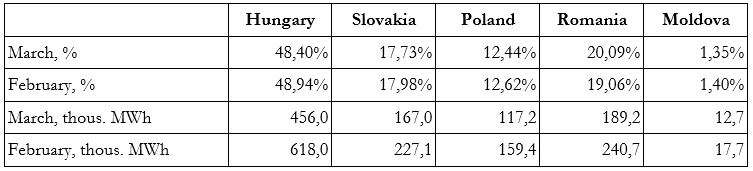
In March, Ukraine resumed electricity exports, but the volume was very small at 30.2 thousand MWh. Imports decreased compared to February but still reached a high level — 942,1 thousand MWh — marking a second record high, 25% lower than in February.
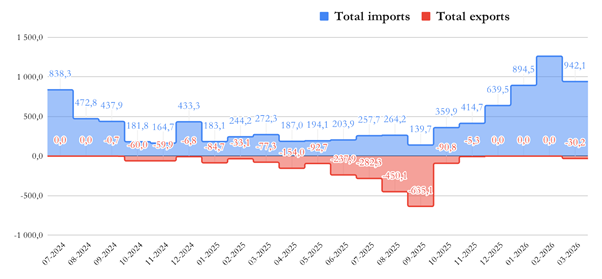
Monthly electricity export and import volumes for the recent year
(The chart is based on ENTSO-E data)
March and February import comparison (based on ENTSO-E data)
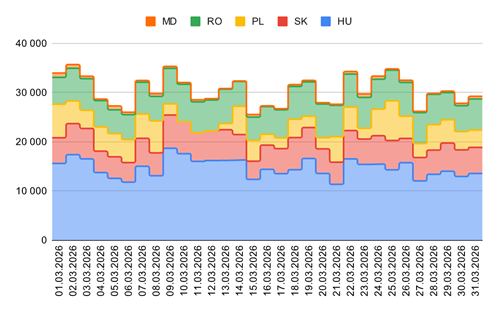
Daily volumes of electricity imports by countries of origin, MWh
(The chart is based on ENTSO-E data)
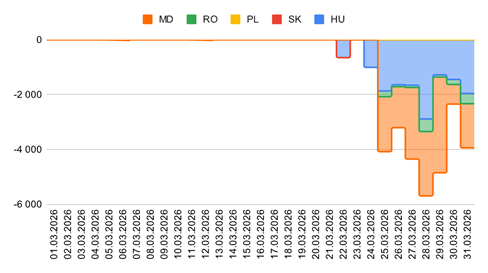
Daily volumes of electricity exports by countries of origin, MWh
(The chart is based on ENTSO-E data)
The Cabinet of Ministers has eliminated the winter requirement for the largest state-owned companies to import at least 50% of their electricity for their own use. Specifically, the government removed the January mandate for UkrZaliznytsia, Ukroboronprom, Naftogaz of Ukraine, and their subsidiaries to meet at least 50% of their electricity needs. Previously, these companies were required to import at least 50% of their electricity by March 31. Additionally, the government canceled UkrHydroEnergo’s obligation to import electricity at night to fill the upper reservoir of the Dniester pumped-storage power station.
The rules for limiting electricity supply were updated in mid-March. Moving forward, distribution system operators will no longer enforce mandatory restrictions on consumers who import or independently generate at least 60% of their total electricity use. In early March, the government increased the share of imported electricity to 90%, with the change taking effect by the end of March.
Ukraine is launching a project to build two new interstate power transmission lines with Romania to enhance energy security and boost cross-border cooperation. The relevant agreements were recorded in a signed document on the construction of interconnectors during a meeting of the presidents of both countries in March 2026.
The project involves creating two lines with different capacities. The construction of the smaller, first interconnector is scheduled to be finished by the end of 2026. The implementation of the larger trunk line is planned for two years. The network expansion will help stabilize energy supply in border regions, which will receive additional resources to meet the capacity gap.
Increasing the number of interconnectors is a strategic move to integrate the Ukrainian power system with the European ENTSO-E network. This will not only boost electricity imports and exports but also enhance the energy stability of the entire Eastern European region. Currently, Ukraine and Romania are connected by only one power transmission line, which limits operational capacity maneuvering.
The Slovak transmission system operator SEPS sent an official letter to NPC Ukrenergo regarding the unilateral termination of the Agreement on Mutual Emergency Assistance. SEPS did not provide an explanation for the decision.
In fact, the current agreement was set to expire in May. This means that SEPS will not renew the contract. The last time Ukrenergo received emergency aid from SEPS was in January 2026.
Earlier, the Slovakian government threatened to halt electricity exports to Ukraine in response to the suspended oil transit after the Druzhba pipeline was damaged by a Russian drone. Since suspending exports would be entirely illegal, the Slovak government instructed the Slovak TSO, SEPS, to cease emergency supplies to Ukraine.
Ukrenergo reiterated that an early termination of the agreement by the Slovak operator will not affect the operation of the Ukrainian power system, as emergency assistance from Slovakia was sporadic and provided in very limited volumes. The last time SEPS provided emergency assistance at Ukrenergo’s request was on January 23.
The debt on the balancing market to NPC Ukrenergo continues to grow and reached a record UAH 45.19 billion by the end of February 2026. At the beginning of 2025, the debt of balancing market participants to the transmission system operator was UAH 35 billion.
At the same time, Ukrenergo’s debt to balancing market participants is also rising. If it was UAH 18.55 billion at the start of 2025, by the end of 2025 it increased to UAH 22.93 billion, and by the end of February 2026, it reached UAH 26.62 billion.
The average weighted day-ahead market price in Ukraine in March 2026 was 7,359 UAH/MWh, which is 26% lower than in February 2026. This decline resulted from decreased demand and increased supply, with excess capacity observed during most periods. In March, electricity consumption decreased due to warmer temperatures and longer daylight hours. Meanwhile, electricity generation increased, especially at solar power plants (due to longer daylight and higher solar insolation) and hydroelectric plants (because of flooding).
The average daily import was 30 million m3 from all directions. Most of the gas – 36.6% — came from Poland, and 30% came from Hungary. As the heating season began to end in late March, the nationwide shutdown of the centralized heat supply began. This led to a decrease in gas consumption, and gas was pumped into storage facilities. Natural gas usage dropped below 50 million m³ per day due to warmer weather and the end of the heating season. Ukraine’s underground natural gas reserves total 9.8 billion m³, including 4.7 billion m³ of long-term storage gas, which is an increase of 4.2 billion m³ from last year.
Hungarian Prime Minister Viktor Orban announced his plan to gradually halt natural gas supplies to Ukraine. The decision is driven by the suspension of Russian oil transit through the Druzhba pipeline, which supplies raw materials to Hungarian and Slovak refineries. Budapest has set a condition: the export of blue fuel will only resume once Kyiv guarantees stable oil pumping.
A government resolution has already been issued, establishing a legal basis for restrictions. Specifically, the Hungarian gas transmission system operator (TSO) has been instructed not to auction capacity for gas transportation toward Ukraine for the third quarter of 2026. The Hungarian government plans to allocate the released gas volumes to its own underground storage facilities to enhance national energy security and maintain preferential tariffs for domestic consumers.
The Ukrainian gas transmission system has sufficient alternative routes through Poland, Slovakia, and Romania. The reserved gas import capacities on these borders are ample for importing a relatively large volume of gas. Currently, the guaranteed daily capacity at the Slovakia border is 42 million cubic meters, at Poland’s border 18.4 million, and at Romania’s border 7.68 million. Last year, daily gas imports rarely exceeded 50 million cubic meters.
The government ban on holding capacity reservation auctions by the TSO will likely be challenged because it conflicts with European energy law standards.
As of the end of March, no interruptions in natural gas imports from Hungary have been recorded, and contracts are designed for imports until the end of March. Natural gas from Hungary is imported by both state-owned companies (Naftogaz of Ukraine and LLC GTS Operator of Ukraine) and individual private companies.
The Cabinet of Ministers of Ukraine, at its meeting on March 30, 2026, approved amendments to the current mechanism for imposing special obligations on natural gas market participants to ensure the general public interest in the natural gas market’s functioning.
The term of the PSO for supplying natural gas to household consumers, gas distribution system operators, the supplier of last resort (GK Naftogaz of Ukraine), and electricity producers was extended from March 31, 2026, to September 30, 2026, inclusive, instead of the previous deadline.
The regulator has made significant revisions to how generation participates in the PSO mechanism. In mid-March, gas turbine and gas piston plants that produce only electricity were removed from the PSO and began purchasing gas on market terms starting March 12. Additional changes effectively eliminate preferential gas prices for most electricity producers, including TPPs and CHPs. The only exception is for new generating facilities brought into operation after December 1, 2025, in frontline regions, where the preferential price stays at 19,000 UAH per thousand cubic meters. This approach aims to encourage the development of new distributed generation in higher-risk regions.
The Cabinet of Ministers of Ukraine has appointed a new composition of the Supervisory Board of NJSC Naftogaz of Ukraine, comprising six members: four independents and two government representatives. The appointment was made based on a nomination committee’s submission. The selection was carried out through a competitive process.
Independent international members include the following persons with extensive experience in the energy sector.
State representatives on the Supervisory Board include the following persons.
The Federal Supreme Court of Switzerland has fully rejected Gazprom’s request to annul the June 16, 2025 arbitration award, which requires Gazprom to pay Naftogaz over $1.4 billion in debt for natural gas transportation services, plus interest. Additionally, the court ordered the Russian company to pay legal costs of 200,000 Swiss francs ($226,000) and to reimburse Naftogaz for 250,000 Swiss francs ($282,500) in expenses incurred during the proceedings before the Federal Supreme Court.
A new biomethane plant owned by the Teofipol Energy Company has started operations in Ukraine. The plant is the largest in the industry, with a design capacity of about 56 million cubic meters of biomethane annually. Since its launch, the total number of biomethane producers in Ukraine has increased to 6, and the total capacity is now 106 million cubic meters per year. Another seventh biomethane plant is expected to begin operation in Ukraine this year.
On March 20, 2026, Ukraine launched a cashback program for petroleum products as part of the National Cashback initiative. Ukrainians can get a portion of their money back when purchasing fuel at participating gas stations: 15% for diesel, 10% for gasoline, and 5% for autogas. This helps save between UAH 2 and UAH 11 per liter, with a maximum cashback of UAH 1,000 per person per month. The program will run until May 1, 2026. It is a temporary measure aimed at partially offsetting the rise in fuel prices for drivers.
The Ministry of Energy of Ukraine has finalized a Hydrocarbon Sharing Agreement with the American company Aspect Holdings. The agreement was signed during CERAWeek in the USA. This appears to be the signing of Amendment No. 2 to the Hydrocarbon Sharing Agreement for production within the Varvynska Block. The company is represented in Ukraine by the Ukrainian Energy L.L.C.
Ukraine and Ukrainian Energy L. L. C. signed an agreement on sharing hydrocarbons in the Varvynska Block in January 2021, which became the eighth PSA.
The Varvynska Block is situated in the Poltava and Chernihiv regions, covering 3,471 sq. km. According to the National Joint Stock Company Nadra Ukrainy, 79 oil and gas wells have been drilled within the area and have been liquidated.
This publication was created by the Ukrainian Institute of the Future with the support of the Askold and Dir Foundation, administered by ISAR Unity as part of the project “Strong Civil Society in Ukraine – a Driver of Reforms and Democracy” funded by Norway and Sweden. The content of the publication is
the responsibility of the Ukrainian Institute of the Future and does not reflect the views of the governments of Norway, Sweden, or ISAR Unity.



Together we can change the future! Your support allows us to continue our research and provide objective analysis of key social issues. Join us today to build the future of our generations together.
Support