Digests • 17 July 2026
On June 17, the Ministry of Finance published the Budget Declaration for 2027–2029. In this digest, we analyze the Declaration’s key forecast indicators and present the main conclusions on the figures provided for 2026 and subsequent years.
On June 18, the NBU kept the key policy rate unchanged at 15%.
The Ukrainian Institute for the Future updated its forecasts for macroeconomic indicators, the budget and the balance of payments through the end of 2026. More details — in this digest.
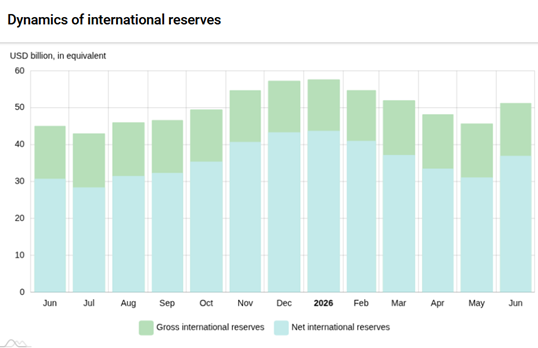
International reserves increased from USD 45.7 billion to USD 51.3 billion in June 2026.
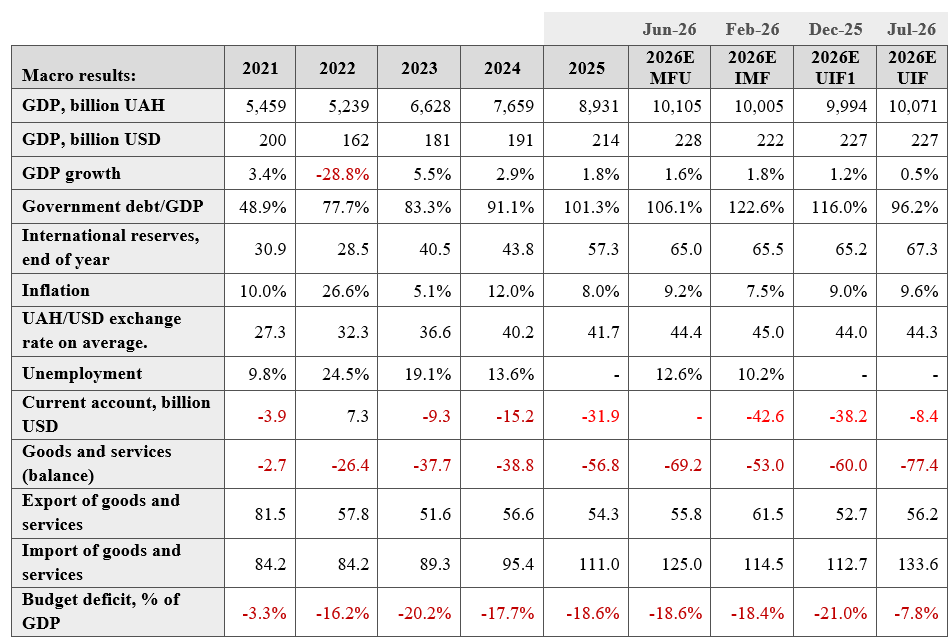
Changes and assumptions regarding the UIF forecast
In December 2025, UIF released its 2026 forecast, which included 2 scenarios. The baseline scenario assumed that the war would continue at least throughout 2026. The second scenario envisaged the war being frozen in the second half of 2026. At present, given the absence of a negotiation track for many months and the escalation of destruction on both sides, we are now developing a single forecast scenario — the continuation of the war until the end of 2026.
One of the main assumptions of the forecast under the “war throughout 2026” scenario, made in December 2025, was sufficient financing, which we estimated at a higher level than the Government of Ukraine — USD 58 billion, of which USD 10 billion would be grants and USD 48 billion would be loans. Primarily, loans from the EU. However, since the EU decided to provide Ukraine with a loan in the form of reparations from Russia, the Government of Ukraine decided to classify the funds from the EU as EU grants. Parliament has already approved amendments to the budget through Draft Law No. 15224, expanding the revenue side to UAH 2,291 billion (primarily from EU grants), and has decided to increase expenditures by UAH 1.7 trillion, primarily for defense. These budget amendments have been incorporated into our recalculation of the consolidated budget. At present, we expect USD 62 billion in grant financing (USD 11 billion under ERA and USD 51 billion under USL). There are also USD 3.8 billion in IMF loans. In addition, EUR 12.5 billion in financing under the Ukraine Facility was planned for 2026. In June 2026, the Ministry of Finance received EUR 2.8 billion in financing under the Ukraine Facility for fulfilling 11 of 20 conditions. We believe that Ukraine will not receive the full EUR 12.5 billion under the Ukraine Facility, and our forecast/assumption for 2026 is EUR 7 billion (USD 8 billion) in loan support. We also believe that a portion of the EU grants is at risk due to the Ministry of Finance’s position, and our forecast assumes receipt of USD 59 billion in grants and USD 13.7 billion in loans in 2026. This amounts to more than USD 70 billion in financial assistance.
In addition, the shift in EU financing from loans to grants significantly affects our forecast of public debt at the end of 2026. We recalculated public debt at the end of 2026 taking into account the minimized volume of loan financing for Ukraine in 2026, as well as the change in the euro exchange rate against the US dollar, which, according to our assumption, will reduce public debt by USD 2 billion.
In December 2025, when preparing our trade balance forecast, we were the most pessimistic regarding the trade deficit for 2026 — USD 60 billion, which exceeded the forecasts of the NBU and the Government of Ukraine. However, the actual balance of payments performance in the first half of 2026, as the trade deficit continues to reach record levels, makes it necessary to revise our trade deficit forecast downward. On the other hand, the large share of grants also alters forecasts for the current and financial accounts of the balance of payments.
We see that at the end of June, the first tranche of EU military assistance to Ukraine under the Ukraine Support Loan (USL) was received. However, the NBU did not include these funds in its reserves. We do not know how the NBU will treat these funds going forward, but we decided to account for them in our forecast as grants and record them in full under secondary income in the balance of payments. We also calculated international reserves at the end of the year, taking these funds into account as grants. However, since Ukraine is expected to receive EUR 28.3 billion in such military assistance under its agreement with the EU (or USD 32–33 billion), this distortion and the exclusion of these funds from the NBU’s reserves may result in international reserves being USD 32–33 billion lower than projected in our forecast.
Each section of this digest contains points regarding updates to UIF forecasts for macroeconomic indicators in 2026, the execution of the consolidated budget through the end of 2026 and the balance of payments.
State Statistics Service of Ukraine (Ukrstat) estimated GDP for Q1 2026. In Q1 2026, real GDP:
−0.7% compared with the previous quarter (seasonally adjusted);
−0.6% compared with Q1 2025. This is worse than the previous estimate of -0.5% made in April.
Nominal GDP amounted to UAH 2,047.2 billion.
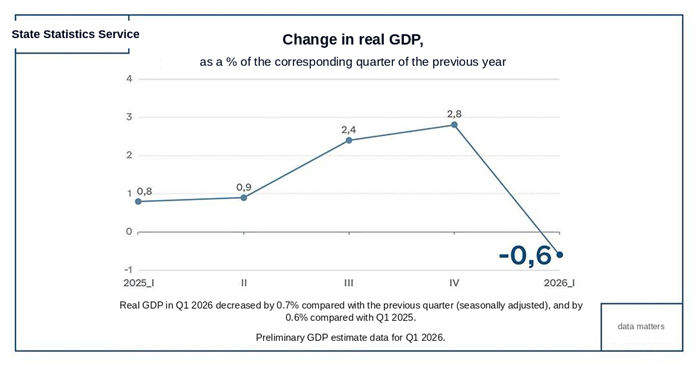
Source: Ukrstat.
The Cabinet of Ministers revised its GDP growth estimate for 2026, lowering Ukraine’s economic growth forecast from 2.4% to 1.6%.
Consumer prices in June 2026 decreased by 0.1% from May and increased by 7.2% from June 2025.
Core inflation in June 2026 was 0.5% compared with May and 8.1% compared with June 2025.
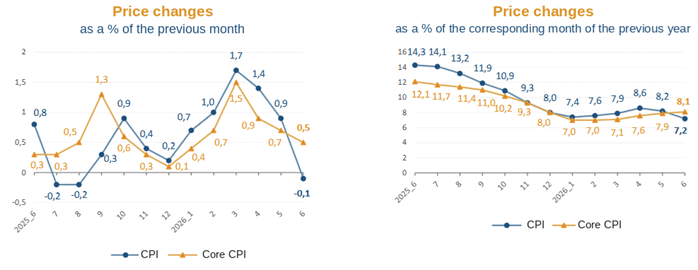
Change in prices over the past 12 months. Source: Ukrstat.
In the consumer market in June (compared with May), prices for food and non-alcoholic beverages decreased by 0.8%. Eggs recorded the largest price decline (27.8%). Prices for vegetables, processed grain products, lard, fruit, sugar, rice and poultry decreased by 3.7–0.6%. At the same time, prices for sunflower oil, fish and fish products, pasta, and bread increased by 1.0–1.7%.
Prices for alcoholic beverages and tobacco products increased by 1.4%, driven by a 1.8% increase in tobacco product prices.
Clothing and footwear decreased in price by 2.3%, including footwear — by 3.0% and clothing — by 1.9%.
The 0.9% increase in prices (tariffs) for housing, water, electricity, gas and other fuels was primarily driven by increases in water supply tariffs of 15.3% and sewerage tariffs — of 14.6%.
Transport prices increased by 0.2%, mainly due to increases in rail and road passenger transport fares of 3.4% and 1.2%, respectively. At the same time, fuel and lubricants decreased in price by 1.6%.
On June 18, the Board of the National Bank of Ukraine decided to keep the key policy rate at 15%. This decision ensures that current monetary conditions remain sufficiently tight, while also taking into account strong demand for hryvnia-denominated savings instruments and the easing of risks associated with the war in the Middle East and insufficient external financing.
At the same time, given signs of rising underlying price pressures, the NBU is prepared to raise the key policy rate if necessary to maintain control over inflation expectations and return inflation to a sustained decline toward the 5% target. The decision will be based on the July macroeconomic forecast.
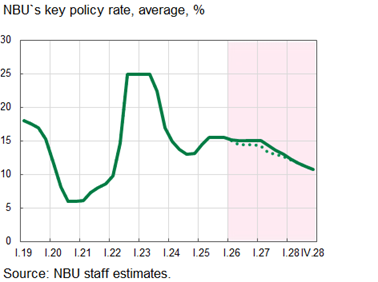
NBU rate forecast. Source: Inflation Report, April 2026.
The Ukrainian Institute for the Future revised its GDP growth estimate for 2026 and lowered its forecast for Ukraine’s economic growth in 2026 from 1.2% to 0.5%. This is lower than the current forecasts of the Government and the NBU.
The inflation forecast was also revised from 9.0% to 9.6%. This is slightly higher than the current forecasts of the Government and the NBU.
The Ukrainian Institute for the Future’s new forecast for nominal GDP in 2026 is UAH 10.071 trillion. We increased our GDP deflator forecast to 12.2%
GDP in US dollar terms in 2026 remained at USD 227 billion following the revision of the average USD/UAH exchange rate for 2026 from 44.0 to 44.3.
In the first 5 months of 2026, the consolidated budget deficit amounted to UAH 354.7 billion, compared with UAH 401.6 billion in 2025.
Tax revenues for the first 5 months of 2026 were UAH 180.6 billion higher than in 2025. Primarily due to higher revenues from personal income tax (nominal wage growth), excise tax (tax increases) and VAT (nominal growth of the economy and imports).
In May, corporate income tax revenues amounted to UAH 75.4 billion, along with a portion of the NBU’s profit. Significant military assistance was also received, which we estimate at UAH 80 billion.
These revenues were used to finance defense and domestic security expenditures totaling UAH 390 billion.
In June 2026 and on July 1, Ukraine received a record amount of financing, which was effectively twice the amount received in January — May 2026: approximately USD 16 billion.
In June 2026, financing was received from the following sources:
USD 11.270 billion in financing was received from the EU. Of this:
USD 2.843 billion was an EU loan under the Ukraine Facility programme for 2024–2027.
EUR 3.2 billion — the 1st tranche of macroeconomic assistance under the EUR 90 billion Ukraine Support Loan. (EUR 8.35 billion in total in 2026).
EUR 3.8 billion — the 1st tranche of military assistance under the EUR 90 billion Ukraine Support Loan (EUR 28.3 billion in total in 2026).
In addition, USD 3.124 billion in ERA financing was received in June. The funds were transferred through World Bank accounts. Of this, USD 2.350 billion was financing from the United States. The remaining financing was from the United States or Japan. There is currently no information on this matter because the Ministry of Finance did not disclose it in its reports. However, a total of USD 9.7 billion in ERA financing was received in the first half of the year. Overall, we expect approximately USD 11 billion in ERA financing in 2026.
In addition, USD 500 million in loan financing was received from the Government of Japan and USD 272 million from the Government of Sweden.
On July 1, USD 598 million in loan financing was received under the new Spirit programme — a social protection project. Of this, USD 300 million was provided by the Government of Japan and USD 298 million by the Government of the United Kingdom.
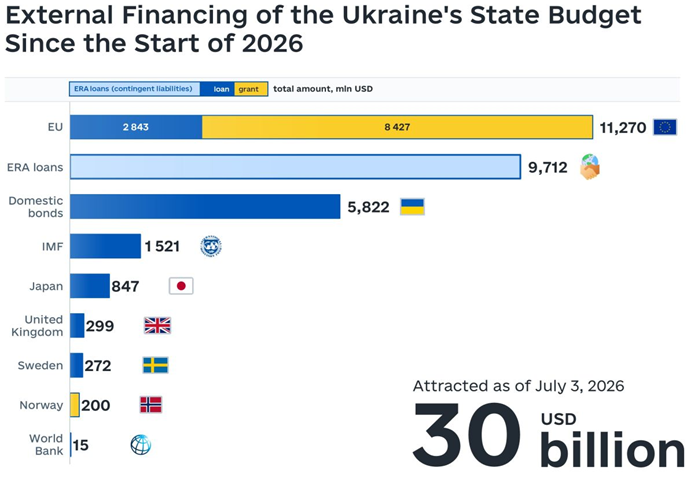
Financing for Ukraine as of July 3, 2026. Source: Ministry of Finance.
A total of USD 23.2 billion in financing was received in the first half of the year. We expect more than USD 48 billion in financing in the second half of the year.
In May 2026, Ukraine’s public and publicly guaranteed debt decreased from USD 212.0 billion to USD 210.7 billion (-USD 1.3 billion).
The debt decreased due to domestic government bonds (-USD 0.5 billion). The Ministry of Finance redeemed more domestic government bonds than it issued.
The debt also decreased due to the revaluation of EU-denominated debt in US dollars as the dollar strengthened against the euro.
On June 17, the Cabinet of Ministers of Ukraine approved the Budget Declaration for 2027–2029 — a medium-term fiscal document defining the principles of the state’s budget policy for the next three years.
The Declaration was developed based on the baseline scenario — a significant improvement in the security situation beginning in 2027. At the same time, it includes assumptions for a resilience scenario that accounts for the possibility that the active phase of hostilities could continue for a longer period.
The baseline scenario envisages the economy transitioning from recovery to sustainable growth, with expanded production capacity, the normalisation of infrastructure operations and the gradual recovery of the labour market. This scenario forms the basis of the indicators set out in the Budget Declaration.
The resilience scenario assumes a more prolonged course of hostilities. Under this scenario, security and defence sector expenditures would need to be revised.
Source: Ministry of Finance.
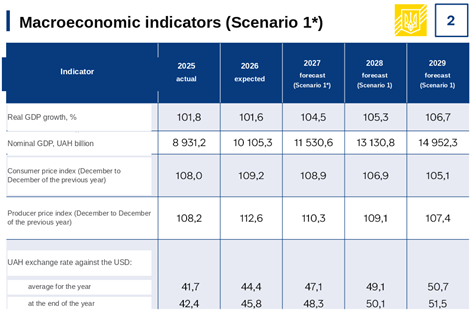
The economy will grow by 14% in nominal terms in 2027. Consumer prices — by 8.9%. The exchange rate is calculated at an average of UAH 47.1 / USD in 2027.
Source: Ministry of Finance.
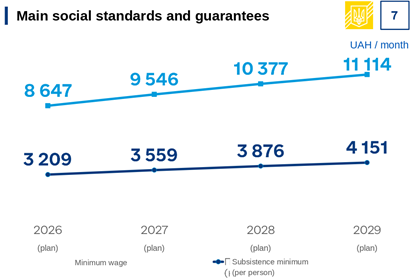
The minimum wage will increase by 10.4% in 2027, while the subsistence minimum will increase by 10.9%.
Source: Ministry of Finance.
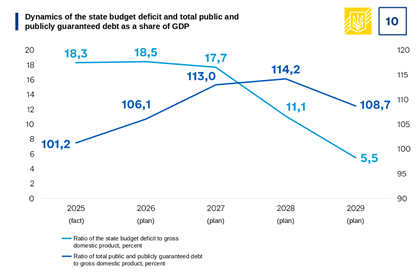
The Ministry of Finance plans the budget deficit at 17.7% of GDP in 2027, while public debt will increase to 113% of GDP by the end of 2027.
However, we have significant concerns regarding the figures presented in the Budget Declaration:
The Ukrainian Institute for the Future recalculated its forecast for the execution of consolidated public finances through the end of 2026.
Key points:
Our calculations are presented in greater detail in the tables below.
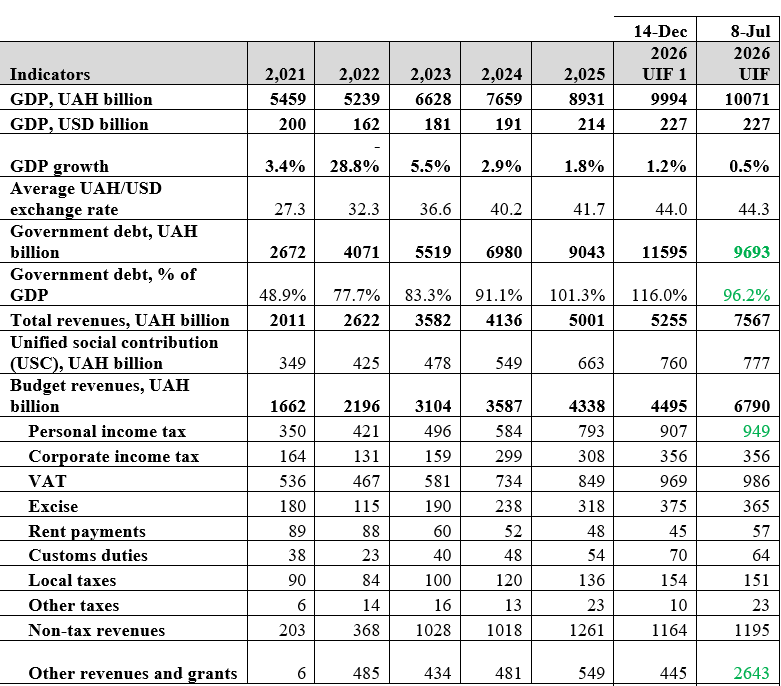
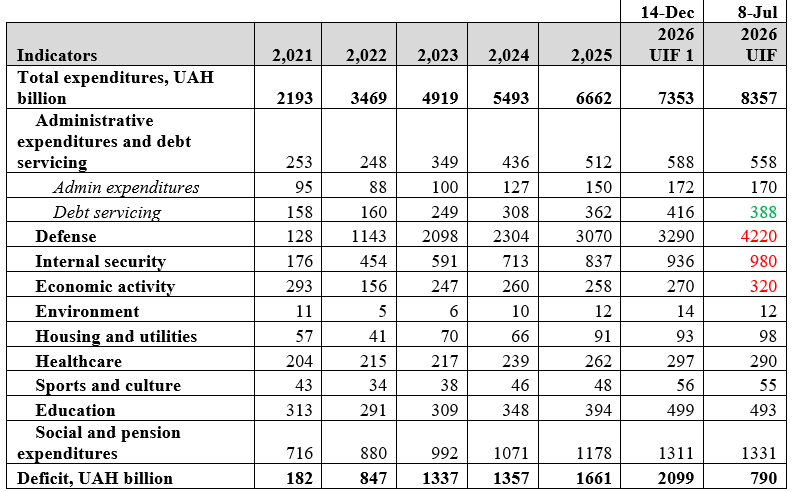
Ukraine’s consolidated budget, 2021–2026.
Source: Ministry of Finance. UIF calculations.
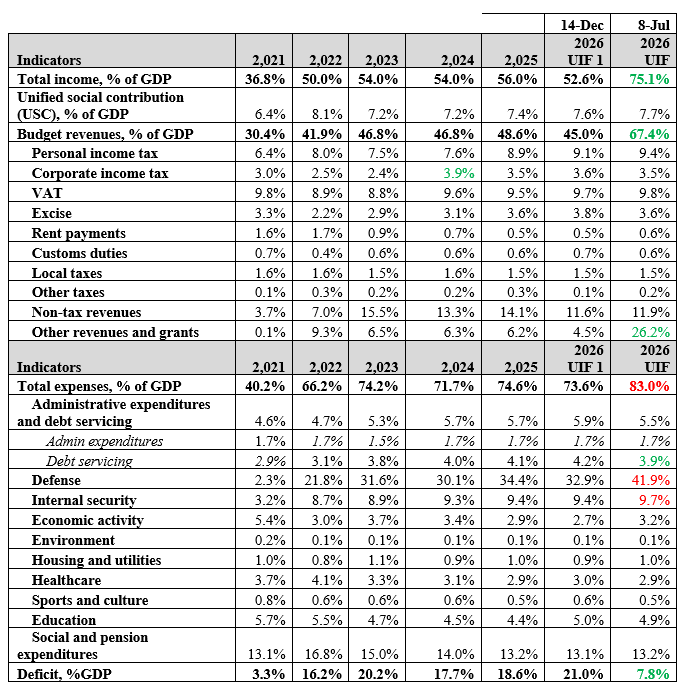
Ukraine’s consolidated budget, as % of GDP, 2021-2026.
Source: Ministry of Finance. UIF calculations.
Balance of payments
The balance of payments for the first 5 months of 2026 was negative. The trade deficit continued its negative trend. In the first 5 months of 2026, the trade deficit amounted to USD 29.3 billion, which was USD 8.9 billion higher than in 2025 (USD 20.4 billion). Imports of goods exceeded exports of goods by 2.5 times (USD 42.4 billion versus USD 16.5 billion).
Overall, the current account recorded a record deficit of USD 18.1 billion in the first 5 months of 2026, compared with USD 12.9 billion in 2025.
Excluding government loans, the financial account was positive at USD 6 billion over the first 5 months. Three items should be highlighted here — foreign direct investment, the repayment of trade credits extended in 2022, and the provision of new trade credits.
We have observed a significant change in exchange-rate formation since June 20, 2026. As we expected, before the arrival of EU financing, the hryvnia depreciated against the dollar to 44.98, and against the euro to UAH 52. However, after June 20, the NBU changed its exchange-rate policy. The NBU began keeping the exchange rate below 45 at a time when the dollar strengthened rapidly against the euro following the Federal Reserve meeting, from 1.16 to 1.13–1.14. Previously, under such conditions, the NBU increased the dollar exchange rate and reduced the euro exchange rate. Still, the NBU has now simply started lowering the euro exchange rate against the hryvnia, which has fallen below 51. Since the beginning of July, we have observed a slight strengthening of the hryvnia against both the dollar and the euro.
We believe that, given the catastrophic growth of the trade deficit in 2026, it makes no sense for the NBU to continue strengthening the hryvnia. Especially when inflation was -0.1% in June, and the NBU may achieve its inflation target for 2026. The Government also expects to convert a significant amount of EU financial assistance into hryvnias to finance budget expenditures.
Therefore, we see the following baseline scenario: an exchange rate of around 44.5 through the end of July and a euro exchange rate depending on fluctuations in the euro — dollar exchange rate, but with a baseline of UAH 50.5-51/euro.
The Ukrainian Institute for the Future also recalculated the average hryvnia exchange rate against the US dollar in 2026, increasing it from 44.0 to 44.3. This is close to the Government’s new forecast for 2026 — 44.4.
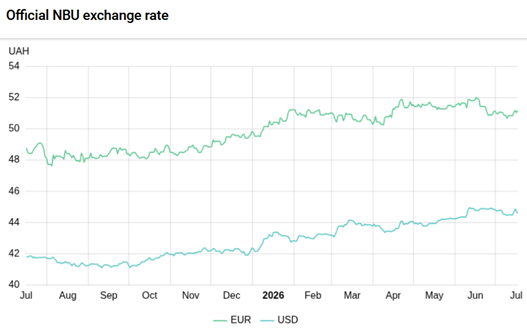
Hryvnia exchange rate against the US dollar and the euro over the past 12 months.
Source: NBU.
The Ukrainian Institute for the Future recalculated its balance-of-payments forecast through the end of 2026.
Key points:
1.1. Ukraine’s Balance of Payments: Analytical Presentation
(in accordance with BPM6)
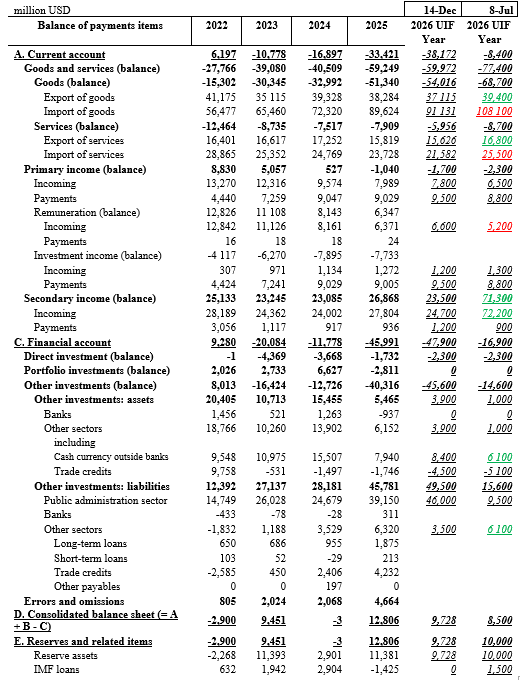
Balance of payments 2022–2026.
Source: NBU, UIF calculations.
Ukraine’s international reserves increased from USD 45.7 billion to USD 51.3 billion in June 2026.
According to balance-sheet data, the NBU sold USD 5,147 million on the foreign exchange market in May.
In June, USD 11,316.3 million was received in the Government’s foreign currency accounts at the National Bank, including:
USD 6,821.1 million — from the EU;
USD 4,495.2 million — through World Bank accounts.
In addition, Ukraine received USD 4.4 billion from the European Union. This was the first disbursement under the first tranche of the defence of Ukraine loan programme. These funds were not included in Ukraine’s international reserves due to restrictions on their designated use.
USD 269.7 million was paid for servicing and repaying public debt denominated in foreign currency, including:
In addition, Ukraine paid USD 171.5 million to the International Monetary Fund.
The current level of international reserves covers 5.2 months of future imports.
Mid-July. IMF. Update of forecasts and the programme for Ukraine—first review.
August 6. NBU. Inflation Report. Q3 2026.



Together we can change the future! Your support allows us to continue our research and provide objective analysis of key social issues. Join us today to build the future of our generations together.
Support