Series “Anatomy of an Empire” │ Ukrainian Institute of the Future
This material was prepared as part of work on the “Atlas of Russian Imperialism and Colonialism” — a UIF publication forthcoming this year.
This piece addresses the following questions:
→ What Molotov and Ribbentrop actually signed — and what was concealed in the secret protocol
→ Why the “voluntary accession” of Estonia, Latvia, and Lithuania is a fabrication built on staged elections
→ How Stalin used victory over Hitler to consolidate what he had obtained at the negotiating table
→ Why the “referendums” of 1940 and the “referendums” of 2022 are the same method
Two Predators at the Same Table
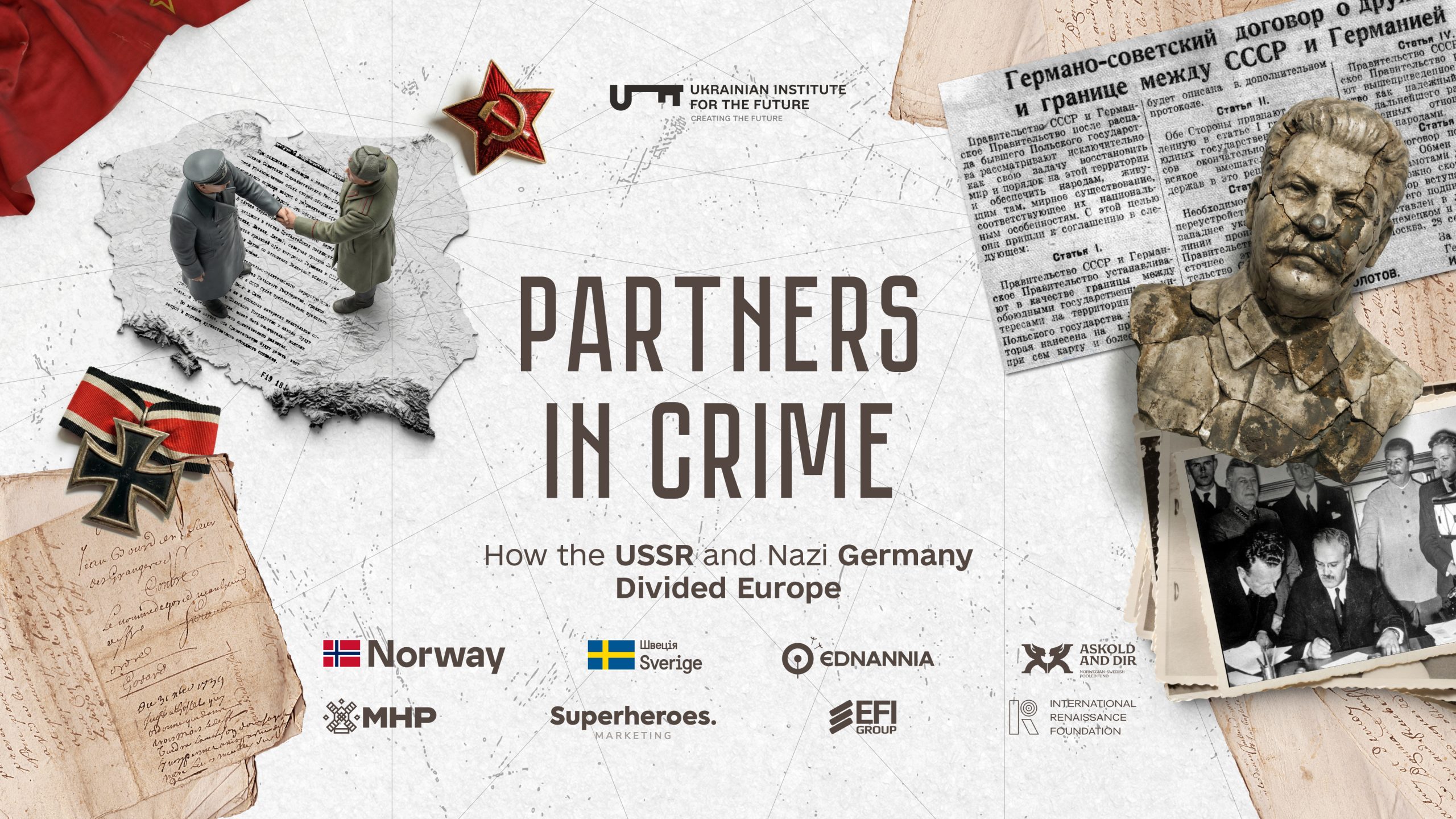
On 23 August 1939, two foreign ministers met in Moscow. The photograph is well known: Molotov signs, Ribbentrop stands beside him, Stalin smiles in the background.
The world learned of the non-aggression pact between the USSR and Nazi Germany. What it did not learn — not immediately — was what had been signed the same evening as a separate document: the secret protocol.
The secret protocol divided Eastern Europe into spheres of influence. Poland was partitioned between the two states. Finland, Estonia, and Latvia were assigned to the Soviet sphere. Lithuania was added in September.
The Molotov–Ribbentrop Pact is often presented as Stalin’s forced pragmatism — a means of “buying time” before an inevitable war with Hitler. The record points elsewhere: in the nine months following the signing, the USSR annexed or occupied more territory than in any comparable period in its history. Stalin was not buying time. He was executing a plan.
Poland: The First Victim of Both
On 1 September 1939, Germany attacked Poland from the west. The world recognized it as the beginning of the Second World War.
On 17 September, the USSR struck from the other direction — from the east.
Poland was fighting a defensive war against the most powerful army on the continent. It could not sustain two fronts simultaneously.
The Soviet command justified the invasion as a necessity to “protect” Belarusians and Ukrainians living in eastern Poland. This is standard framing: arriving to rescue those whom no one had asked to be rescued.
On 28 September 1939, the USSR and the Reich signed the “Treaty on Friendship and the Border.” Poland was partitioned along the line of the Narew, Bug, and San rivers. More than 51 percent of pre-war Polish territory — approximately 13 million people — passed to the USSR. The remainder, with a population of over 22 million, went to Germany.
The Polish state ceased to exist. Two aggressors exchanged a handshake over its corpse.
The same logic recurred in 2022, when Russia and Belarus — which provided its territory for the invasion — coordinated an offensive against Ukraine from two directions. The narrative repeated as well: “protection” from “nazis,” “liberation” of a population that had not requested it.
Finland: When a Small Country Held Its Ground
On 30 November 1939, Soviet forces crossed the Finnish border.
To mask the fact of aggression, the USSR had prepared in advance a “Finnish People’s Government” — a puppet structure headed by Finnish communist Otto Kuusinen. On 2 December, two days after the invasion began, a “treaty of friendship” was signed with this entity.
The model was the same as in Poland. The same as in the Baltic states shortly after. The same as in the “DNR” and “LNR” in 2014: first a “people’s authority” that nobody had elected, then legitimation through a document signed with it.
Finland, however, did not capitulate. Despite the overwhelming numerical advantage, the Soviet army suffered repeated defeats in the opening months. The Finns knew their terrain, fought with determination, and bled Soviet columns in the forests of Karelia.
After 105 days and over 125,000 Soviet dead, the USSR signed a peace agreement. Finland lost approximately 10 percent of its pre-war territory — but retained its independence.
The Finnish campaign was a warning that went unheeded. Small countries can fight. Even against great powers.
The Baltic States: Occupation in Six Steps
The Baltic scenario was executed methodically — and concealed with equal method for decades.
Step one: September–October 1939 — “mutual assistance pacts.” Estonia, Latvia, and Lithuania signed agreements permitting the USSR to station military bases on their territory. They signed under direct duress, with Soviet divisions positioned on their borders.
Step two: June 1940 — ultimatums. The Baltic Fleet blockaded Estonia. Moscow issued demands: change the governments, admit new Soviet contingents, guarantee “loyalty.” Deadlines: a matter of hours.
Step three: Soviet mechanized columns entered all three capitals.
Step four: Moscow-controlled governments organized “extraordinary elections” in which only pro-Soviet candidates were permitted to stand. Official turnout figures ranged from 92 to 99 percent.
Step five: The newly “elected” parliaments voted unanimously to “appply for accession to the USSR” and dispatched petitions to Moscow.
Step six: August 1940 — the Supreme Soviet of the USSR “satisfied the requests” and admitted three new republics.
From the first ultimatum to formal annexation: under two months.
In 2014 and 2022, the same six-step sequence was reproduced in Crimea and in the occupied territories of Ukraine: coercion, “people’s” structures, “referendums” with implausible results, a “petition” to Moscow, a decree on “acceptance.”
Yalta: How Stalin Converted Victory into New Annexation
When the Allies met at Yalta in 1945, Stalin arrived as the victor.
The USSR had lost millions in the Second World War — a price the Allies could not dismiss. Stalin understood this and used this as leverage.
He pressed for recognition of the 1941 borders — that is, everything the USSR had acquired in partnership with Hitler in 1939–1940: Poland, the Baltic states, Bessarabia.
Roosevelt and Churchill effectively agreed, in exchange for Soviet entry into the war against Japan and participation in the United Nations. The Declaration on Liberated Europe promised “free elections” in the liberated countries. The USSR signed it and did not honor it.
As early as October 1944, Stalin and Churchill had concluded an informal “percentages agreement” — a division of influence over Romania, Bulgaria, Hungary, Greece, and Yugoslavia. Written by hand, on a scrap of paper, in figures. Ninety percent Soviet influence in Romania. Fifty percent in Hungary.
The futures of entire peoples were settled by the arithmetic of two men.
Limitations in Standard Interpretations
The Soviet invasion of Poland on 17 September 1939 does not receive the same weight in commemorations as 1 September. The occupation of the Baltic states was described for decades as “voluntary accession.” The Finnish campaign was labeled the “Winter War” — as though it were a natural phenomenon rather than an act of aggression.
This terminology was not accidental. It took shape under conditions in which the USSR — an ally in the struggle against Nazism — was inconveniently similar to Nazism.
The record is unambiguous: in 1939–1940, the USSR annexed six states or parts of states. It employed fabricated elections to legitimize occupation. It used puppet “people’s governments” as legal cover.
The method has not changed. Only the actors and the victims.
This is the seventh piece in the “Anatomy of an Empire” series. The series is based on the “Atlas of Russian Imperialism and Colonialism” — a major UIF research project forthcoming in print and digital format. To be continued.
This project is implemented with the support of the International Renaissance Foundation.
The views, assessments, and conclusions expressed in this authored publication represent the personal position of the author and do not necessarily reflect the official position of the Ukrainian Institute of the Future, its partners, or its donors.
This publication was produced by the NGO “Ukrainian Institute of the Future” with the support of the Askold and Dir Foundation, administered by ISAR Ednannia within the project “A Strong Ukrainian Civil Society — A Driver of Reform and Democracy,” funded by Norway and Sweden. The content of this publication is the sole responsibility of the NGO “Ukrainian Institute of the Future” and does not represent the views of the governments of Norway or Sweden, or of ISAR Ednannia.