Digests • 07 September 2026

In August, the power system operated in a relatively stable mode. During the first week of the month, the air temperature rose significantly, leading to higher energy consumption. Despite widespread concerns, this period passed without any restrictions on customers’ energy consumption. The supply was limited by the fact that three nuclear power units were under repair, as well as by the low productivity of hydroelectric power plants due to record-low river levels.
However, even under such conditions, electricity was exported to neighboring countries, which experienced difficulties with electricity supply due to the shutdown of nuclear power plants caused by heat and a drop in river water levels, which are critical for cooling the power units.
In the second half of the month, electricity consumption decreased, and available capacity increased. The decrease in consumption was due to lower temperatures and reduced industrial use. Russian attacks on metallurgical enterprises, as well as problems with exports, forced them to suspend production and, accordingly, reduce electricity consumption. In addition, one nuclear power unit was connected to the grid after scheduled repairs.
According to the First Deputy Prime Minister of Ukraine, Minister of Energy Denys Shmyhal, 4 GW of generating capacity is planned to be repaired by winter. According to the government’s expectations, the available capacity of the power system will be 19.6 GW by November 1 and 21.4 GW by the end of the year.
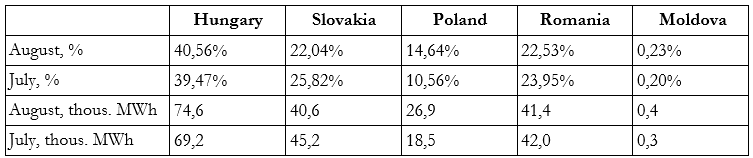
The decline in electricity demand, along with the withdrawal of an additional nuclear power unit from repair, led to increased exports and reduced electricity imports in the second half of the month. In August, electricity exports significantly exceeded imports. Specifically, 382.1 thousand MWh were exported in August, compared with 232.5 thousand MWh in July. At the same time, import volumes remained almost unchanged: 184.0 thousand MWh in August compared with 175.2 thousand MWh in July. The geographical structure of electricity trade remained unchanged compared with July.
Recall that in July, the Ukrainian power system became a net exporter for the first time since September 2025. At the same time, electricity exports remain below last year’s level. The main reasons are reduced available capacity due to Russian shelling and the impact of CBAM, which makes Ukrainian electricity more expensive.
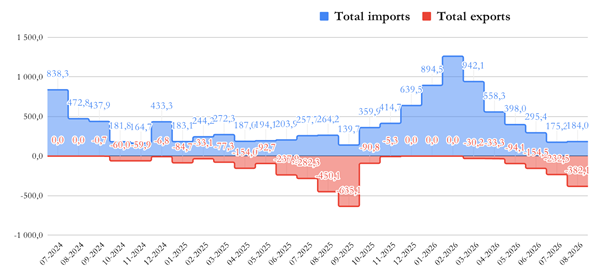
Monthly electricity export and import volumes for the recent year
(based on ENTSO-E data)
August and July export comparison (based on ENTSO-E data)
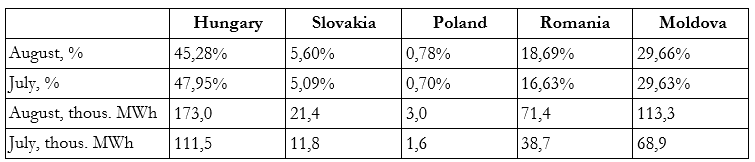
August and July import comparison (based on ENTSO-E data)
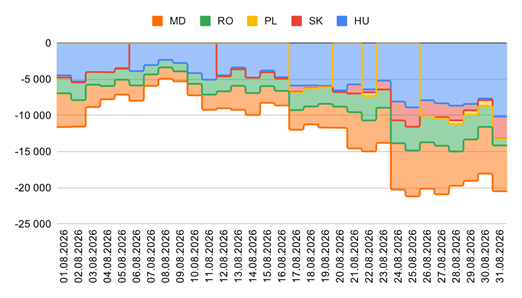
Daily volumes of electricity exports by countries of origin, MWh
(based on ENTSO-E data)
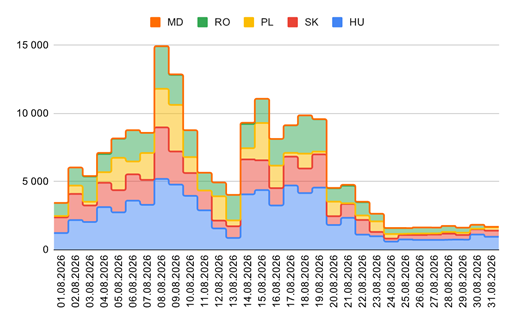
Daily volumes of electricity imports by countries of origin, MWh
(based on ENTSO-E data)
In August 2026, the weighted-average electricity prices in short-term market segments increased compared with the previous month. The weighted average price of electricity purchase and sale in the day-ahead market segment in August was 6,187.65 UAH/MWh, which is a third higher than the July figure of 4,654.88 UAH/MWh. In the intraday market, the weighted average price of accepted electricity in August was 6,129.85 UAH/MWh, 42% higher than the price in this segment in July – 4,311.33 UAH/MWh. The main reason for the price increase is high demand in the first half of the month and relatively lower electricity supply.
The energy regulator has appointed the state-owned JSC “Market Operator” as the first nominated electricity market operator (NEMO) in Ukraine. This decision is a prerequisite for launching the market coupling mechanism, which should ensure the integration of the Ukrainian and European electricity markets.
NEMO status is mandatory for cross-border trade under European rules. The appointment of the “Market Operator” was made in accordance with the requirements of the Law “On the Electricity Market” and will be valid for the next four years. At the same time, the legislation does not provide for monopolization of this status, so in the future other nominated operators will be able to operate in Ukraine to ensure competition.
The market coupling mechanism provides for the unification of the Ukrainian “day-ahead” and intraday markets with the relevant trading segments of the European Union countries. Thanks to this system, applications for the purchase and sale of electricity will be matched simultaneously, and inter-zonal capacity will be allocated. From a practical point of view, this means market participants will no longer have to purchase the right to cross the border separately from the electricity. Guaranteed capacity will become an integral part of the electricity supply exchange contract.
For trading within the unified market, traditional rigid administrative price restrictions – price caps – are also being abolished. Instead, technical price limits should be introduced and harmonized by the Ukrainian NEMO with other European operators. Such changes will contribute to more efficient use of inter-state capacity and will make pricing algorithms fully aligned with European practice.
The state-owned company “Guaranteed Buyer” announced electronic auctions in September to distribute state support quotas for the construction of new renewable energy facilities. The total capacity offered across these two auctions is 800 MW, intended for solar and wind generation projects. The auctions will be conducted entirely online via the Prozorro electronic trading system.
The main portion of the declared quota is dedicated to wind energy development, with 700 MW of new capacity planned for distribution. This auction is scheduled for September 30, 2026. An additional 100 MW has been allocated specifically for solar generation facilities, and a mandatory requirement for bidding on September 25 is the presence of integrated energy storage systems. Price caps have also been set: for investors in wind farms, the maximum is 8 eurocents per kilowatt-hour, while for solar power plants with storage, this limit is set at 12 eurocents.
Solar power plants are also subject to additional requirements. The financial support mechanism will work only in two time zones: from midnight to 11:59 and from 14:00 to the end of the day. The regulation of the characteristics of mandatory battery systems has been introduced: the capacity of the batteries must be at least 80% of the total power of the generating plant, and the working capacity must be at least 2 kilowatt-hours for each kilowatt of installed capacity.
At present, more than 7 GW of solar generation capacity has already been installed in Ukraine. During sunny periods of the year, this creates a significant excess supply of electricity during daytime hours, leading to a sharp collapse in market prices. Mandatory installation of storage systems is designed to solve this problem by absorbing the daily surplus. The accumulated energy will be supplied to the network during the evening hours of maximum consumption. During this period, the greatest capacity shortage is observed, and market prices reach their maximum.
Previous attempts to hold green auctions in Ukraine were often unsuccessful. The main reason was the non-payment crisis and the state’s multibillion-dollar debts to renewable energy producers, which significantly undermined investor confidence. The situation was further complicated by the high financial and security risks caused by the war. The lack of guarantees of timely payments and the constant threat of physical damage to infrastructure forced companies to refrain from participating in tenders.
The Ukrainian Parliament has adopted a bill on the reorganization of the only domestic producer of uranium concentrate – the transformation of the state-owned enterprise Skhidny Mining and Processing Plant (SkhidGZK) into a joint-stock company. The decision is aimed at the financial recovery of the strategic facility and its preparation for further accession to NNPGC Energoatom.
The adopted bill defines the legal mechanisms for transforming the plant into a joint-stock company, with 100% of whose shares remaining in state ownership. The law establishes a three-year moratorium on bankruptcy and forced recovery of property.
The next stage of the reform, after practical corporatization, should be the integration of the renewed enterprise into Energoatom’s structure. The government plans to create a single vertically integrated holding in the nuclear industry. It will control the entire nuclear energy cycle: from the extraction of uranium ore to the production of electricity at Ukrainian nuclear power plants.
In recent years, SkhidGZK has faced a deep financial crisis, marked by mine shutdowns and a decline in production volumes. The company’s accounts payable totals UAH 9.8 billion, which is almost three times the book value of fixed assets of UAH 3.6 billion. The company’s debt to NNEGC Energoatom is UAH 3.3 billion, and to the state budget is approximately UAH 400 million. Due to systematic non-payment of money, miners have repeatedly held protests.
At the end of August, Natural gas stock in Ukrainian underground storage facilities exceeded 14.6 billion cubic meters. Thus, Ukraine has achieved the government target set for the baseline scenario of the 2026/2027 heating season ahead of schedule. The storage capacity target was achieved two months ahead of schedule.
The volume of stock is 31%, or 3.48 billion cubic meters, higher than the year before. This is also the largest gas volume in UGS on the corresponding date over the last five years.
The reserve was formed primarily from domestically produced gas. Since the start of this year’s injection season (March 11), Ukraine has injected 5.18 billion cubic meters of natural gas into storage. According to the gas TSO’s data, natural gas imports for that period amounted to 0.69 bcm. For comparison, for the same period of 2025, natural gas imports amounted to 2,87 bcm.
Aside from stability in domestic gas production, a drop in consumption contributed to the rapid pace of gas storage for winter. For instance, in spring, the government canceled preferential gas prices for electricity producers. As a result, gas-powered generation operated mostly during the night peak hours, which decreased gas consumption.
Media reports indicate that the Security Service of Ukraine has authorized the Energy Customs Service to clear imported diesel fuel at ports and terminals on the sanctions list without any obstacles. Cargoes from high-risk routes will not undergo extra checks, and sampling procedures are being discontinued.
The easing of origin controls and the cancellation of additional checks should accelerate fuel supply to the Ukrainian market amid global supply disruptions. In addition, the ban on diesel fuel exports from Russian ports, effective July 8, will make such checks impractical for some time. Changes to the import clearance procedure will simplify fuel supply from ports and terminals in Turkey and Saudi Arabia.
The Cabinet of Ministers announced the launch of a new pilot project to store strategic fuel reserves underground. The initiative aims to increase the state’s energy security amid ongoing challenges to critical infrastructure. The document defines the key stages of transferring part of the fuel reserves to underground tanks. To accomplish this task, existing infrastructure will be used and will undergo a preliminary check for compliance with technical and safety standards.
Until now, a significant part of strategic reserves has been stored at on-site oil depots, which remain highly vulnerable. The new approach will allow for the dispersion of reserves, hiding them from potential damage.
In August, Russian forces launched a series of targeted strikes on key facilities in Ukraine’s energy infrastructure. Russian forces attacked one of the thermal power plants, damaging components and units and causing the plant to shut down. The Kherson thermal power plant also suffered critical damage after being hit by guided bombs. As a result of these attacks, all power-generating and heat-engineering equipment at the Kherson facility was destroyed.
In parallel with strikes on generation, systematic attacks were carried out on the distribution infrastructure. In the Odessa region, enemy shelling damaged energy facilities, causing a temporary power outage for some consumers. At the same time, regular shelling of the electricity distribution system was recorded in border and frontline regions. This led to frequent power outages in these regions, which emergency crews addressed during breaks between shelling. A separate area of Russian military pressure was gas stations in frontline areas. Russian drones and artillery regularly struck fuel infrastructure, destroying tanks, pumps, and nearby buildings.
The national energy company Ukrenergo has initiated the debt management process for sustainable development bonds issued in 2021, totaling $825 million at a 6.875% annual rate. This step became possible after reaching an agreement in principle with a group of owners who control over 45% of the nominal value of the securities. The debt settlement proposal was announced in April 2025. However, for a long time, one of the bondholders did not agree to the restructuring terms.
Ukrainian banks have begun financing energy projects for businesses and households, totaling UAH 60.4 billion, under a memorandum aimed at restoring energy infrastructure following Russian attacks. Specifically, UAH 56.1 billion was allocated to business projects, and UAH 4.3 billion to households.
Banks had provided financing for business projects to restore and develop energy generation with a total capacity of 1.938 GW. The main lending volumes are for solar power plants, gas generation, hydro, bio, and wind installations, as well as the purchase of generators. Banks also finance energy storage projects, covering the installation of energy storage systems, inverters, and batteries, as well as the modernization of thermal power equipment. The combined capacity of these projects totaled 813 MW.
This publication was created by the Ukrainian Institute of the Future with the support of the Askold and Dir Foundation, administered by ISAR Unity as part of the project “Strong Civil Society in Ukraine – a Driver of Reforms and Democracy” funded by Norway and Sweden. The content of the publication is the responsibility of the Ukrainian Institute of the Future and does not reflect the views of the governments of Norway, Sweden, or ISAR Unity.



Together we can change the future! Your support allows us to continue our research and provide objective analysis of key social issues. Join us today to build the future of our generations together.
Support