Digests • 16 June 2026
On 27 May, Parliament ratified the EUR 90 billion loan to Ukraine. Part of the funds is subject to question regarding receipt, due to the actions of the Ministry of Finance.
The Verkhovna Rada of Ukraine failed to meet the benchmarks of the new IMF programme. What are the consequences? Continued work with amendments.
The Verkhovna Rada adopted draft law No. 15224 amending the State Budget for 2026. The revenue side has increased by UAH 2,291 billion (EU grants). Expenditure will increase by UAH 1.7 trillion. Primarily due to additional security spending of UAH 1.6 trillion.
International reserves for May 2026 decreased from USD 48.2 billion to USD 45.7 billion.
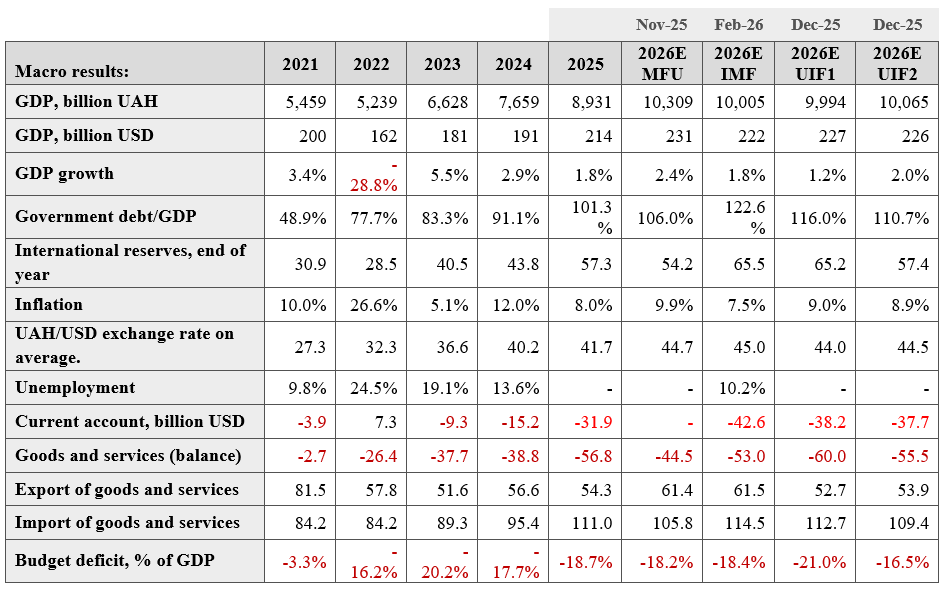
EUR 90 billion loan from the EU.
On 28 May, one month after the European Council’s decision to provide Ukraine with a EUR 90 billion loan from the European Union, the Ukrainian Parliament ratified this decision.
Ukraine, regarding this loan as reparations funded by Russia, decided that it would not be recorded as a loan from the EU, and that the money under this loan would be credited to Ukraine’s budget as a grant. This very significantly changes the state of the Ukrainian budget for 2026–2027, as well as the assessment of public debt at the end of 2026.
The Government of Ukraine submitted draft law No. 15224 to Parliament, which changes the revenue side of the State Budget by UAH 2,291 billion, increasing revenues (effectively, this is more than USD 50 billion in grant financing from the EU). The Government also proposed increasing security expenditure by UAH 1.6 trillion, of which UAH 1.4 trillion is allocated to strengthening the country’s defence capability (procurement of military products). Parliament adopted this law on 10 June 2026.
In 2026, the loan is planned to be received through three channels:
EUR 8.35 billion — through macro-financial assistance;
EUR 8.35 billion — through the Ukraine Facility programme;
EUR 28.3 billion — to support Ukraine’s defence-industrial potential.
Together with the ratification of the loan, Ukraine and the EU agreed on a Memorandum of Understanding outlining the conditions for Ukraine to receive macro-financial assistance in the form of three tranches of EUR 3.2 billion, EUR 3.7 billion and EUR 1.45 billion.
However, we believe that due to the actions of the Ministry of Finance, which once again included tax increases and measures worsening the operating rules for small businesses as a condition (before the agreement was ratified, these initiatives had been rejected by Parliament), the receipt of the second and third tranches of macro-financial assistance is highly questionable. This amounts to EUR 5.15 billion, or around UAH 265 billion at the current exchange rate.
IMF programme.
On 12 June, the IMF and the Ukrainian authorities reached a staff-level agreement (SLA) on the first review of the 4-year Extended Fund Facility (EFF) arrangement worth USD 8.1 billion. Subject to approval by the IMF Executive Board, Ukraine will have access to approximately USD 690 million (SDR 503 million), bringing total disbursements under the programme to USD 2.2 billion.
The IMF lowered its economic growth forecast for 2026 to 1.0-1.6% (in practical terms, this means 1% in the calculations).
From the official press release on the IMF website, we would like to highlight the following points regarding the continuation of the programme:
“Fiscal policy must be implemented in line with financing constraints and aligned with restoring debt sustainability. The authorities need to prevent expenditure overruns, be prepared to mobilise additional domestic revenues, identify potential sources of savings to offset spending and be ready to increase domestic financing. As expenditure will remain high over the medium term, particularly for defence and reconstruction, sustained efforts are needed to improve tax administration and tax policy to mobilise revenues.
Reducing the scale of the shadow economy — an important foundation of the programme — remains the fairest and most effective way to mobilise critically important revenues while supporting economic growth. Such reforms will help level the playing field, improve the business environment and better prepare Ukraine to compete successfully in the EU single market. Implementing this agenda will require decisive action to align legislative changes and introduce administrative reforms.
Commitments under the programme include abolishing the VAT exemption at customs for parcels, which will close a loophole and help reduce non-critical imports, as well as measures to counter international transfer pricing to eliminate opportunities for companies to engage in unfair tax arbitrage to avoid paying taxes in Ukraine. Reforms aimed at curbing abuses of the simplified tax system remain critically important, including rules to combat business fragmentation and opportunistic switching between tax regimes, as well as to eliminate hidden employment. To support these objectives and, in particular, to successfully reform the simplified tax system, the authorities agreed on a package of measures to optimise tax administration and reduce compliance costs for honest taxpayers while strengthening risk-based controls. Supporting institutional changes at the Bureau of Economic Security and the State Customs Service will also be of significant importance in combating tax evasion”.
“The independence of the National Bank of Ukraine (NBU) remains the most important pillar supporting macrofinancial stability. Amid supply shocks, the NBU quite rightly postponed the monetary policy easing cycle and moved to a tighter stance to manage expectations. The exchange rate has become more flexible, strengthening its role as a shock absorber, helping to protect reserves and preventing the accumulation of external imbalances. The approach to foreign exchange liberalisation, based on an assessment of current conditions, should continue, in line with the overall mix of monetary and exchange rate policy, as well as external stability objectives”.
“In the energy sector, attention is shifting towards reforms to prepare for market liberalisation. The current system of utility tariffs for households and the related public service obligations (PSOs) has weakened the financial position of state-owned energy companies, limiting resources for critical investment and repairs. To address the situation, the authorities are preparing, with IMF technical assistance, a “roadmap” for the gradual liberalisation of the energy market that will include social protection mechanisms for vulnerable groups in the population. Once these mechanisms are ready and based on this “roadmap”, household tariffs should be gradually adjusted to resolve the sector’s financial problems and improve its ability to attract investment. Strengthening the integrity and independence of the energy regulator (NEURC) will additionally contribute to the long-term resilience of the sector”.
Consumer market inflation in May 2026 compared with April stood at 0.9%, and compared with May 2025, 8.2%.
Core inflation in May 2026 compared with April stood at 0.7%, and compared with May 2025, 7.9%.
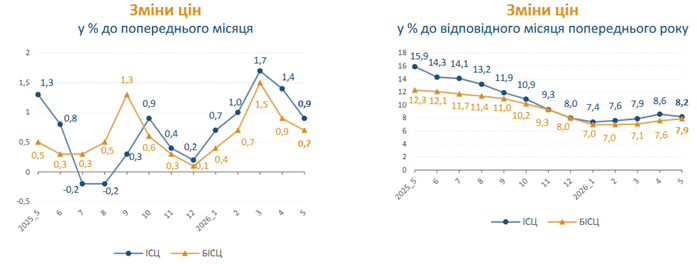
Price changes over the last 12 months. Source: Ukrstat.
Figure translation
Price changes
as a % of the previous month
Price changes
as a % of the corresponding month of the previous year
CPI
Core CPI
In May, prices in the consumer market rose by 1.2%. Fruit increased the most (by 11.1%). Prices for grain processing products, bread, sunflower oil, pasta, fish and fish products, non-alcoholic beverages, beef, and sugar rose by 6.4–1.2%. At the same time, egg prices fell by 15.3%, while prices for vegetables, milk, pork, butter, and lard decreased by 0.2–1.7%.
Prices for alcoholic beverages and tobacco products increased by 1.9%, including tobacco products by 2.1%, and alcoholic beverages by 1.6%.
Clothing and footwear became cheaper by 1.8%, with footwear down 2.0% and clothing down 1.6%.
Transport prices rose by 0.7%, mainly due to a 2.7% increase in fares for road passenger transport and a 0.6% increase in fuel and lubricants.
Over the first 4 months of 2026, the consolidated budget deficit amounted to UAH 236 billion, compared with UAH 255.7 billion in 2025.
Tax revenues for the first 4 months of 2026 were UAH 135 billion higher than in 2025. First of all, this was due to growth in personal income tax revenues (nominal wage growth), excise duty (tax increases), and VAT (nominal growth of the economy and imports).
Also in 2026, the budget received UAH 230 billion in grants, compared with UAH 169 billion in 2025.
In April, defence expenditure exceeded that of 2025. Primarily due to increased transfers of military products by the West. Over the first 4 months of 2026, defence expenditure amounted to UAH 940 billion, compared with UAH 898 billion in 2025.
An increase in social expenditure should also be noted. Whereas over the first 2 months it was at the level of 2025, it is now already UAH 21.8 billion higher than in 2025. We believe that these are populist actions by the Government and the President regarding social programmes. These funds had not been included in the budget, and most likely, the reserve fund is being used for the payments.
In May 2026, financing was received from the following sources:
Around USD 500 million (UAH 21.7 billion) under ERA. We believe that this is financing from the US under ERA. In total, since the beginning of the year, around USD 4.6 billion of such financing has been received. In 2026, according to our estimate, another USD 2 billion should be received from the US.
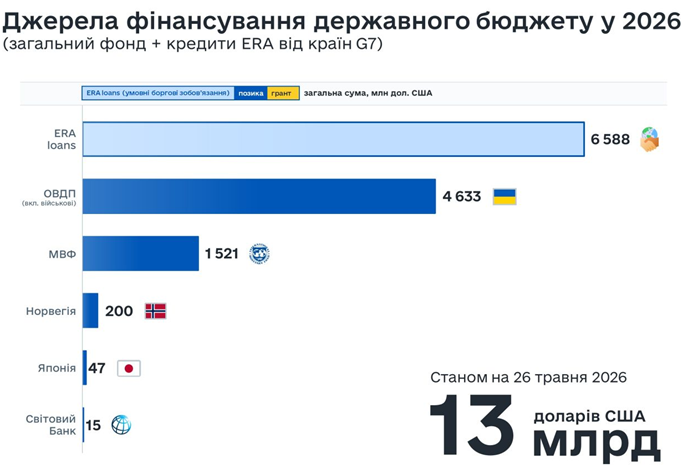
Financing of Ukraine as of 26 May 2026. Source: Ministry of Finance.
Figure translation
Sources of state budget financing in 2026
(General Fund + ERA loans from G7 countries)
ERA conditional credit obligations Loan Grant Total amount, million USD
ERA loans
Domestic government bonds (including military bonds)
IMF
Norway
Japan
World Bank
As of May 26, 2026: USD 13 billion
At the beginning of May, balances in state and local budget accounts amounted to UAH 279 billion. Taking into account payments by the NBU and state-owned enterprises to the budget, these funds are sufficient to finance the budget until mid-July 2026.
At the same time, EU financing, if the full assistance package is disbursed, could amount to more than USD 50 billion for the period June — December 2026.
In April 2026, Ukraine’s public and publicly guaranteed debt increased from USD 210.8 billion to USD 212 billion (+USD 1.2 billion).
Debt increased mainly due to the revaluation of euro-denominated debt against the US dollar (+USD 1.45 billion)
Debt decreased due to domestic government bonds (-USD 0.4 billion). The Ministry of Finance redeemed more domestic government bonds than it issued in new bonds.
Overall, it is now clear that Ukraine’s public debt at the end of 2026 will be reduced due to the replacement of the EU loan with EU grants. Our new forecast for public debt at the end of 2026 will be published in the next digest.
The balance of payments for the first 4 months of 2026 was negative. The trade deficit continues its negative trend. Over the first 4 months of 2026, the trade deficit amounted to USD 23.4 billion, which is USD 7.2 billion more than in 2025 (USD 16.2 billion). Imports of goods exceed exports of goods by 2.5 times (USD 33.9 billion versus USD 13.1 billion).
Several factors helped balance the situation in the balance of payments:
Overall, the current account was negative by USD 14.4 billion over the first 4 months of 2026, compared with USD 9.3 billion in 2025. However, since the EU loan is planned to be received as a grant, we believe that the current account may decrease and even move into surplus. We will present our new balance of payments forecast through to the end of 2026 in the next digest.
Overall, our forecast for the USD/EUR exchange rate in the previous digest proved correct. The US dollar exchange rate in May was around 44, while the EUR was 51–52 UAH.
However, we must acknowledge that under our baseline forecast, the EU was expected to provide Ukraine with the first tranche of financing as early as May, which would have given the NBU confidence that it would receive financing through the end of the current year. However, the agreement was ratified only on 28 May, and the failed vote on the Government’s tax bills is shaping negative forecasts at the NBU. And although we understand that the main amount of financing from the EU does not depend in any way on Parliament’s vote on the laws, we nevertheless allow that the delay in the receipt of financial assistance from the EU is shaping a policy of hryvnia devaluation against the US dollar.
Therefore, we believe that in June, before the first tranche of EU funds is received, the UAH/USD exchange rate may depreciate. But as soon as EU financing begins to arrive (EUR 2.8 billion was received on 8 June), the NBU may keep the hryvnia/dollar exchange rate at the same level until the end of the year.
As for the EUR exchange rate, the situation in the Middle East remains in a state of peace, but without long-term stabilisation. Therefore, for now, the EUR/USD exchange rate continues to fluctuate on news within the range of 1.15–1.18.
The baseline scenario is an increase in the UAH / USD exchange rate to 44.50-45.00 before the tranche from the EU is received, and stabilisation at 44.0–44.5 after financing is received. The baseline scenario for the UAH / EUR exchange rate is 51–52.
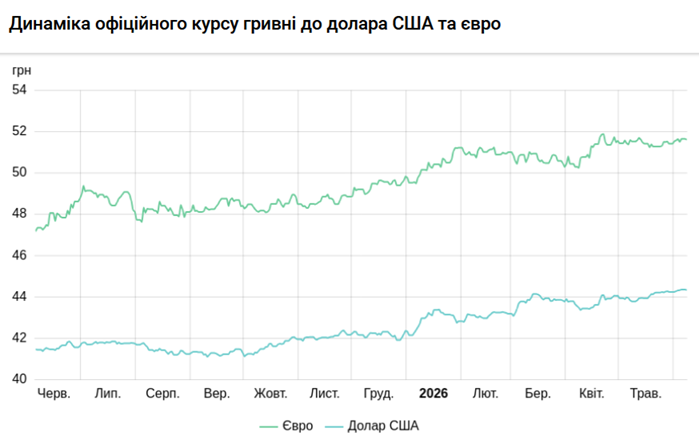
Hryvnia exchange rate against the USD and EUR over 12 months. Source: NBU.
Figure translation
Dynamics of the official exchange rate of UAH against USD and EUR
Jun. Jul. Aug. Sept. Oct. Nov. Dec. 2026 Feb. Mar. Apr. May.
EUR
USD
Ukraine’s international reserves decreased from USD 48.2 billion to USD 45.7 billion in May 2026.
According to balance sheet data, in May, the NBU sold USD 3,134.9 million on the foreign exchange market.
In May, USD 599.2 million was received into the Government’s foreign currency accounts at the National Bank, including:
USD 126.2 million was paid for servicing and repayment of public debt in foreign currency, including:
In addition, Ukraine paid USD 274.9 million to the International Monetary Fund.
The current volume of international reserves covers the financing of 4.7 months of future imports.
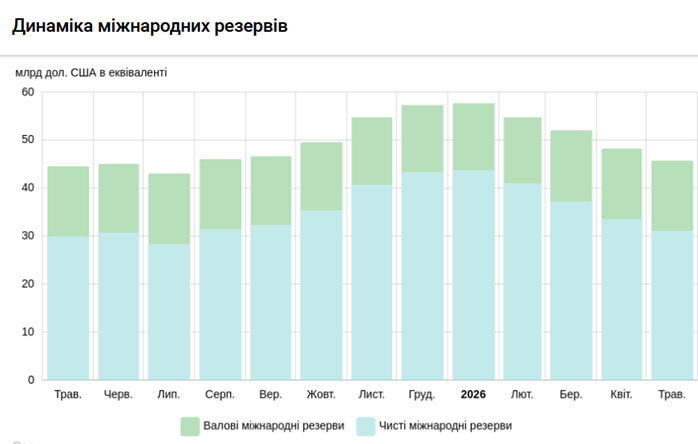
Change in international reserves over the past 12 months. Source: NBU.
Figure translation
International reserves dynamics
billion USD equivalent
May. Jun. Jul. Aug. Sept. Oct. Nov. Dec. 2026 Feb. Mar. Apr. May.
gross international reserves
net international reserves
June 18. NBU. Decision on the key policy rate.
End of June — early July. IMF. Update of forecasts and the programme for Ukraine.
July 10. New forecast by the Ukrainian Institute for the Future on macroeconomic indicators of Ukraine’s economy, budget and balance of payments through to the end of 2026.
This publication was created by the Ukrainian Institute of the Future with the support of the Askold and Dir Foundation, administered by ISAR Unity as part of the project “Strong Civil Society in Ukraine – a Driver of Reforms and Democracy” funded by Norway and Sweden. The content of the publication is the responsibility of the Ukrainian Institute of the Future and does not reflect the views of the governments of Norway, Sweden, or ISAR Unity.



Together we can change the future! Your support allows us to continue our research and provide objective analysis of key social issues. Join us today to build the future of our generations together.
Support