Digests • 08 July 2026
The situation regarding the volume of available capacity in the Ukrainian power system in June did not change significantly. In the second half of the month, one of the nuclear power units was connected to the network after planned and preventive repairs. Thus, 7 power units were operating in the system. Electricity production at hydroelectric power plants is low due to declining reservoir water levels, and electricity production at thermal power plants is at a low seasonal level due to a repair campaign and restoration work following damage.
Moderate temperatures during the first weeks of June resulted in relatively low consumption and no deficit in the power system. However, at the end of the month, consumption increased due to the heat. At the same time, prices in neighboring European countries also increased due to the heat and high demand. This reduced commercially available imports, and together with the lack of domestic power generation, this led to a deficit in the power system. Due to the heat and increased load, emergencies occurred, necessitating emergency disconnections for consumers. The end of the month brought a temporary return to power supply restrictions.
In June, Ukraine imported 295,4 thousand MWh, which is 25.8% less than in May. At the same time, exports rose by 64.2%, but the physical volume remained relatively low at 154,5 thousand MWh.
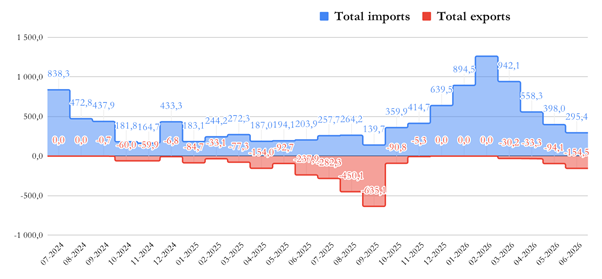
Monthly electricity export and import volumes for the recent year
(based on ENTSO-E data)
Hungary remained a key trading partner. Power lines connecting Ukraine and Poland were suspended for maintenance, contributing to a drop in the country’s share of the trade. By turn, Slovakia’s share increased as the power line was put into operation after the maintenance
June and May export comparison (based on ENTSO-E data)
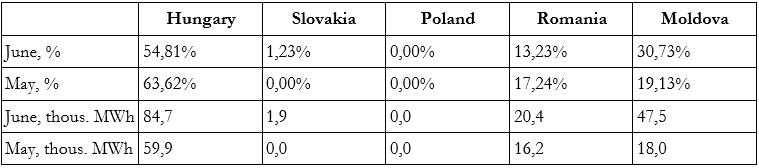
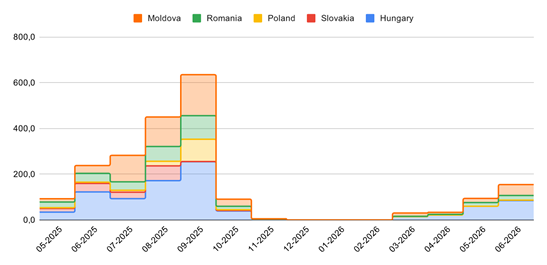
Monthly electricity exports volumes by partner countries
(based on ENTSO-E data)
June and May import comparison (based on ENTSO-E data)
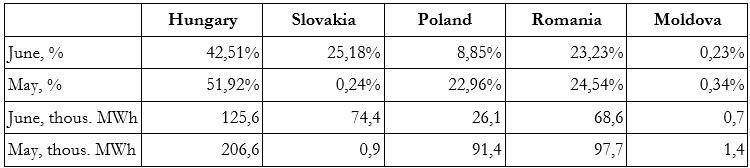
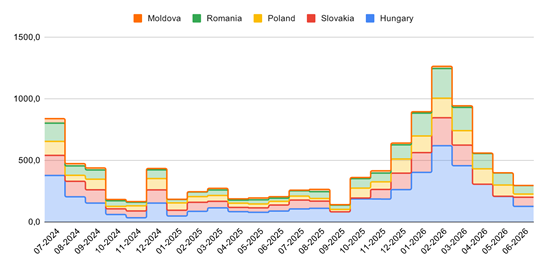
Monthly electricity imports volumes by partner countries
The first monthly auctions for allocating interstate capacity for electricity exports from Ukraine in July 2026 were held on the European Joint Allocation Office platform. Long-term auctions provide greater predictability for market participants. This step is another stage in the technical and regulatory synchronization of the Ukrainian energy market with the European space.
According to the auction results, Ukrainian and international traders, for the first time, received medium-term access to interstate crossings at the borders with Hungary, Slovakia, and Romania under common European rules. The largest volume of export resource was allocated by market participants at the Ukraine-Hungary crossing, totaling 167 MW, and the average access price was set at 3.21 euros per MW. On export routes to Slovakia and Romania, companies purchased 44 MW of capacity each, where average prices were 0.36 euros per MW and 1.89 euros per MW, respectively. The Polish transmission system operator refused to participate in long-term auctions for the distribution of cross-border capacities with Ukraine last year, before these were introduced.
Simultaneously, monthly auctions for electricity imports to Ukraine for the same summer period were held on the European platform. The Hungarian route also became the leader in this segment, with the volume of distributed capacity at the crossing reaching 431 MW.
The weighted average price of electricity purchase and sale on the day-ahead market in June 202 amounted to 5 808,64 UAH/MWh, which is 11.2% higher than in May. The key driver of growth was the increase in electricity prices in Europe, particularly during peak hours, when the Ukrainian power system relies on imports to cover deficits and maintain system balance. In June, electricity prices in Europe rose significantly due to the heat.
In fact, in June, the market situation returned to what it was in April. Let us recall that in May the price of the DAM increased by 10% compared to April.
The British government will provide financial guarantees of 210 million pounds to ensure stable supplies of enriched uranium to Ukrainian nuclear power plants. Raised funds will ensure an uninterrupted supply of fuel for domestic nuclear power plants for the next two years.
Credit guarantees are issued through the British government department, UK Export Finance. This will allow Urenco, which specializes in uranium enrichment, to supply raw materials to the state-owned enterprise Energoatom. The new financial deal increases London’s total support for Ukraine’s energy security to more than £490 million.
For the first time in almost two decades, the Ministry of Energy of Ukraine has invested funds from the financial reserve for decommissioning nuclear facilities in domestic government bonds. Currently, almost UAH 400 million has already been invested in government securities. In total, in 2026, the volume of such investments should reach about UAH 785 million.
The reserve is established to finance future decommissioning of nuclear facilities after the end of their operational life. It is funded by JSC NNEGC Energoatom’s contributions: the company is obliged to transfer 65.4 million hryvnias to the special fund every month. However, in some years the company failed to make these payments. In particular, for the periods 2007–2009 and 2020–2024, the total non-payment to the special fund amounted to more than 4.5 billion hryvnias.
The Cabinet of Ministers has decided to launch long-term contracts on the electricity market, which will allow non-household consumers to fix the price of electricity for a quarter, half a year, or a year in advance. Electricity will be sold through transparent, competitive auctions. As part of the pilot launch, 4% of the generation volumes of state-owned producers – Energoatom and UkrHydroEnergo – will be put up for auction: 2% through quarterly contracts, 1% through semiannual contracts, and another 1% through annual contracts.
The government believes that large energy consumers may benefit from this by having more predictable and potentially lower electricity prices.
The total capacity of distributed gas generation facilities put into operation in Ukraine as of June 18 reached 1,806.3 MW. The largest capacities of distributed gas generation were put into operation in the Kyiv region (212.3 MW) and the Cherkasy region (124.6 MW).
Over the past 3.5 months, new generating facilities totaling 338.7 MW have been launched across the regions. The largest share of new capacity has been added in the Kyiv and Zhytomyr regions.
Work is underway to install an additional 249 units, bringing an additional 522.8 MW to the power system. Construction of most facilities is expected to be completed between September and November 2026.
Ukraine has become the first country to enter Europe’s top five battery energy storage (BESS) markets. In 2025, the country will have installed nearly 3 GWh of new battery storage capacity, according to a new study, European Battery Market Outlook 2026-2030, published by SolarPower Europe. Official data indicate that the installed BESS capacity in Ukraine is nearly 700 MW.
First Deputy Prime Minister and Minister of Energy Denys Shmyhal, at the Ukraine Recovery Conference, stated that Ukraine has a strategic goal of returning to 54 GW of generating capacity by 2035, its level before Russia’s military aggression in 2014. Half of the capacity is planned to be nuclear, 30% — renewables, and the rest – gas-fired power generation
It is unclear how these capacities can be developed by 2035 and what funding sources should be used. The plan to double existing nuclear capacity (within controlled territories) within ten years sounds unrealistic. Another question that no one has an answer to: who should consume such a huge amount of electricity?
The Supervisory Board of JSC Energoatom announced the start of an international competitive selection for the position of Chairman of the Board of the company. The search, assessment, and selection of candidates will be conducted by the international consulting firm Korn Ferry.
The Government has ordered the termination of the powers of the members of the Supervisory Board of Ukrhydroenergo PJSC, Valentyn Hvozdiy, Natalia Mykolska, Oleh Terletskyi, and Stephen Walsh, as independent members, as well as of Vitaliy Kushnirov, a member of the Supervisory Board and a representative of the state, effective July 7, 2026.
The Cabinet of Ministers, by Order No. 450-r dated May 13, 2026, announced a competitive selection of candidates for four positions as independent members of the UkrHydroEnergo Supervisory Board. Earlier, the Prime Minister of Ukraine, Yulia Svyrydenko, announced a competition in connection with the expiration of the terms of office of the majority of the members of the company’s Supervisory Board. Earlier, by Order No. 401-r dated April 24, 2026, the Cabinet of Ministers appointed Vitaliy Petruk (Deputy Minister of Economy, Environment and Agriculture) and Eduard Denisov (Director of the State Enterprise Southern Marine Oil Terminal (Odesa region)) as state representatives on the National Board of UkrHydroEnergo, effective May 5.
The Agency for Support of Public-Private Partnerships has begun preparing an investment project to construct the Kaniv Pumped Storage Power Plant. This initiative is being implemented under the special Ukraine Government PPF (Project Preparation Facility) program, which supports public investments in Ukraine with assistance from the World Bank. The Interdepartmental Working Group for the Preparation of Public Investment Projects decided to begin development, with PJSC “UkrHydroEnergo” as the main initiator.
During the initial stage, the Agency will focus on developing a detailed, structured feasibility study. Specialists will conduct a thorough assessment of the future facility’s environmental and social impacts, ensuring full compliance with strict international standards. To complete these tasks successfully, the state institution plans to attract qualified experts on a competitive basis.
Romanian gas transmission system operator Transgaz tcapacity-booking tariffs and begin offering annual export capacity to Ukraine at the Isaccea-1/Orlovka point from the 2026/2027 gas year (October 1, 2026). Transgaz has reduced annual capacity booking tariffs by an average of 10% and eliminated the difference between intra-seasonal tariffs. This means that in peak consumption months, in particular in January, tariffs could drop by around 50%.
Transgaz also has revised its gas quality standards, now mandating a minimum methane content of 70%. This update is particularly significant for the transportation of gas from south to north along the Trans-Balkan route, especially towards Ukraine and Moldova.
The capacity should be offered on a competitive basis. Such a step could allow companies in Ukraine and Moldova to import gas from the Romanian market, not only via southern transit.
Ukraine has secured a long-term reservation of liquefied natural gas (LNG) supplies via the Klaipeda terminal. The agreement was reached during the Ukrainian government delegation’s visit to Lithuania, led by Prime Minister Yulia Svyrydenko. Earlier this year, Naftogaz imported LNG from the United States to Ukraine via the Klaipeda terminal for the first time.
Besides, Naftogaz has booked long-term LNG regasification capacity at the Klaipeda LNG terminal (Lithuania) for the first time. The company has booked capacity for 2033 to 2044. The terminal operator, KN Energies, has successfully completed the relevant allocation procedure.
Naftogaz of Ukraine has reached agreements in principle with a special committee of holders of two Eurobond series regarding the restructuring of liabilities totaling approximately €1.2 billion. Under the agreements, the maturity of the Eurobond series will be extended to January 2032, and the dollar series to January 2033.
The agreements relate to two Eurobond issues that Naftogaz issued through Kondor Finance plc. These are the loan participation bonds with a current principal amount of €695 million, originally maturing in 2024 and previously extended until July 19, 2026, as well as the $584 million bonds, originally maturing in 2026 and previously extended until November 8, 2028. The preliminary restructuring of these obligations was agreed at the end of July 2023.
This step will help Naftogaz save money to buy imported gas and be prepared for the next winter.
Russian oil supplies to Hungary and Slovakia via the Ukrainian section of the Druzhba pipeline returned to normal levels in May, after resuming in late April. According to consulting firm ExPro, May was the first full month of shipments since a halt in late January following a Russian attack on pipeline infrastructure in Ukraine. Hungary and Slovakia received 165,000 barrels of oil per day (about 700,000 tons) in May, compared with about 55,000 barrels per day (220,000 tons) in April. April deliveries lasted only a week. However, May shipments remain slightly below the pre-suspension level of about 235,000 barrels per day (about 1 million tons per month).
The state program Fuel Cashback has ended in Ukraine. Nearly 2.3 million citizens used it. Fuel Cashback was a temporary anti-crisis measure to provide financial support to Ukrainians during the worst global oil crisis in the last 50 years. The program was in effect from March 20 to May 31 and offered savings of 5% to 15%, depending on the fuel type.
The State Property Fund of Ukraine has initiated the cancellation of arrests on the Ukrainian section of the Samara-Western oil product pipeline. The facility includes more than 1,400 km of oil product pipeline, pumping stations, tanks, production complexes, and technological infrastructure.
This asset has been linked to the entourage of traitor Viktor Medvedchuk for years. Ukrainian courts, including the Supreme Court, have already confirmed the state’s ownership of this property.
The State Property Fund has now filed a petition with the High Anti-Corruption Court (HACC) seeking to have the arrests imposed in 2021 and 2023 canceled. After the asset was returned to the state, the need for restrictions disappeared. After the removal of these arrests, the Fund plans to transfer the asset to the management of JSC UkrTransNafta for full-fledged operations in the interests of the state.
During June 2026, the temporarily occupied Zaporizhzhia NPP completely lost contact with the external power system four times. These incidents forced the plant to switch to emergency diesel generators to provide critical cooling systems. The total number of blackouts at Europe’s largest nuclear power plant since it was captured by Russian troops has reached 20.
The first summer outage was recorded on the night of June 3 due to the shutdown of the high-voltage power transmission line “ZaTES – Ferosplovna No. 1”. The next incident occurred on June 5, when, after shelling of the energy infrastructure, power was unavailable for 15 hours. The third supply outage occurred on the evening of June 10 during an air raid, and restoration work continued until midday on June 13. The last blackout in a month, the twentieth since the start of the full-scale invasion, occurred on June 20 due to technical malfunctions in the internal networks of the facility itself.
Each loss of external power significantly increases the risk of a nuclear accident, since the plant remains dependent on autonomous generators. According to experts, constant voltage drops and line outages severely wear out ZNPP equipment and pose constant risks to the region’s radiation safety. The Ukrainian side emphasizes the need for immediate demilitarization and return of the facility to the control of a legitimate operator to avoid a global catastrophe.
In June, Russian forces continued to conduct systematic combined and localized attacks on Ukrainian fuel and energy facilities, using missiles and a large number of strike drones. Russia shifted its ballistic missiles toward Ukraine’s natural gas production sites. In addition, fueling infrastructure became a more frequent target, especially in regions near the border and the frontline.
On the night of June 7, a Russian strike drone attacked the site of the Centralized Used Nuclear Fuel Storage Facility in the Kyiv region. As a result of the hit, partial destruction of one of the infrastructure buildings and a local fire were recorded. According to Energoatom’s statement, there is no threat to radiation safety, and background indicators on the facility’s territory remain within normal limits.
The affected facility was used for technical needs, and no spent nuclear fuel was stored directly in it at the time of the attack. There were no injuries or deaths among the storage facility’s operational personnel. The General Staff of the Armed Forces of Ukraine clarified that the incident occurred 15 km from the Chornobyl NPP.
Norway is allocating 100 million kroner ($10.6 million) to repair the new safe confinement covering the 4th reactor at the Chornobyl nuclear power plant. The structure was damaged in a Russian drone strike in February 2025. The assistance will be provided through the European Bank for Reconstruction and Development (EBRD) International Chornobyl Cooperation Account (ICCA).
The International Conference on the Recovery of Ukraine (URC 2026), held on June 25-26, 2026, in the Polish city of Gdansk, concluded with the signing of about 160 international agreements, memoranda, and letters of intent. The total financial volume of the recorded agreements exceeds 10 billion euros. The main feature of this year’s event was the shift in emphasis from purely humanitarian recovery to the systemic integration of Ukrainian infrastructure into the European space, attracting private capital and introducing a separate security dimension.
The effectiveness of international conferences on Ukraine’s reconstruction is often debated. Despite fair criticism, such platforms remain a critically important tool for reminding the world of Russia’s energy terror and mobilizing international efforts to repair the damage and prepare Ukraine for the next heating season.
Within the framework of the URC 2026 energy platform, 28 international agreements aimed at decentralizing generation and restoring damaged capacities were signed, totaling about 2 billion euros. Additionally, within the conference framework, international partners mobilized more than 550 million euros to prepare the sector for the next heating season, and the Energy Community Secretariat called on donors to allocate another 650 million euros to the Energy Support Fund for Ukraine.
This publication was created by the Ukrainian Institute of the Future with the support of the Askold and Dir Foundation, administered by ISAR Unity as part of the project “Strong Civil Society in Ukraine – a Driver of Reforms and Democracy” funded by Norway and Sweden. The content of the publication is the responsibility of the Ukrainian Institute of the Future and does not reflect the views of the governments of Norway, Sweden, or ISAR Unity.



Together we can change the future! Your support allows us to continue our research and provide objective analysis of key social issues. Join us today to build the future of our generations together.
Support