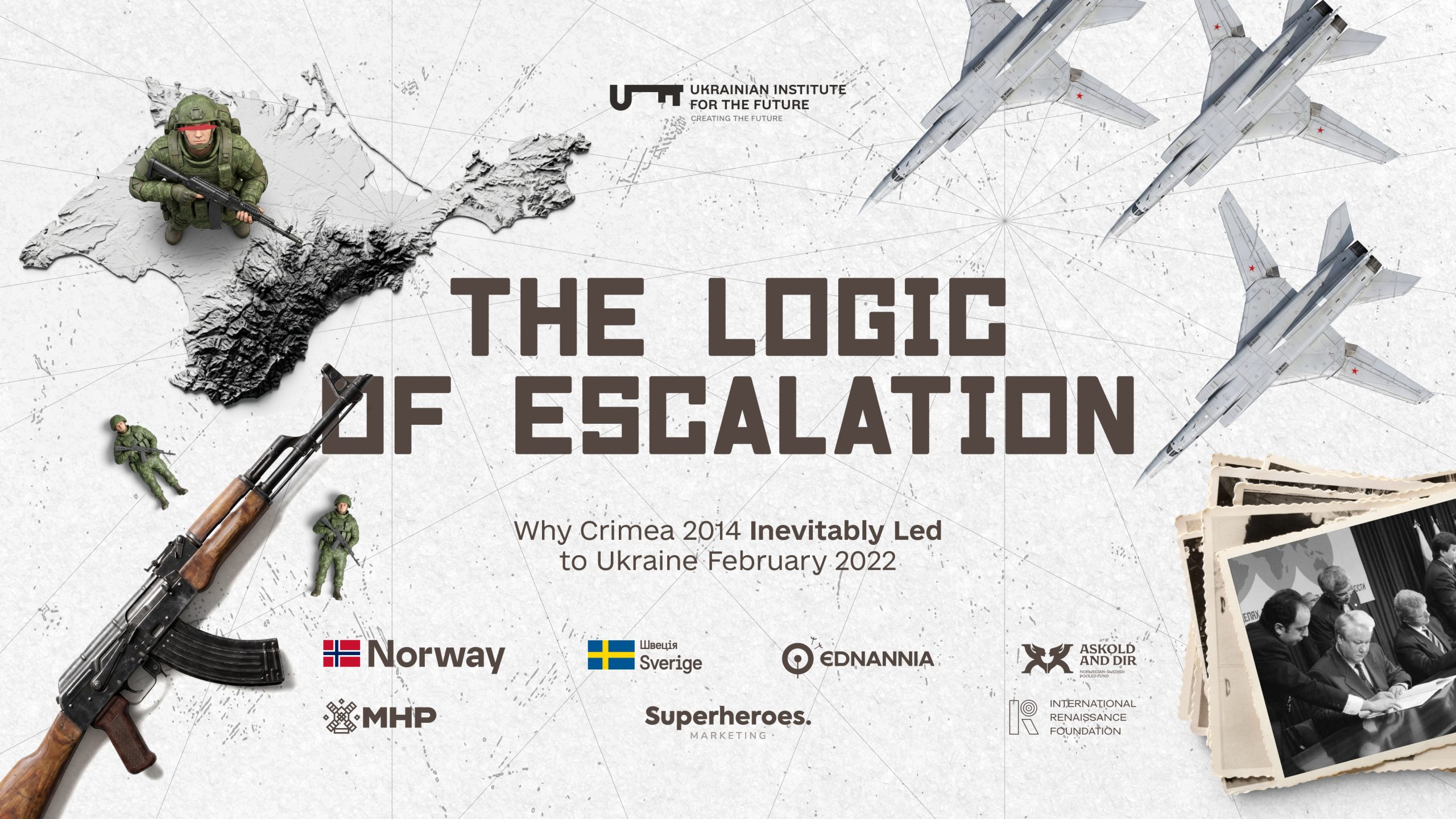
Series “Anatomy of an Empire” │ Ukrainian Institute of the Future
This material was prepared as part of work on the “Atlas of Russian Imperialism and Colonialism” — a UIF publication forthcoming this year.
This piece addresses the following questions:
→ How Russia prepared the annexation of Crimea — and why the West had no time to respond
→ Why the “little green men” and the “DNR/LNR” are links in the same chain
→ What the Minsk agreements actually were — and why they could not work
→ How each unanswered step became the basis for the next
→ What “security guarantees” from Russia mean — and why the Budapest Memorandum is a standing warning
Why 2014 Began Much Earlier
In February 2014, when “little green men” blockaded Simferopol airport, the move was read as a sudden reaction to the Maidan Revolution. But everything that followed required preparation — months, if not years, of it.
The “Crimean self-defense” began forming on 23 February 2014 — the day after Yanukovych fled, before the new Ukrainian authorities had taken a single step. Russian citizens were among the “volunteers” from the outset.
On 27 February, armed men without insignia seized the buildings of the Crimean parliament and government. Under their “protection,” deputies voted to hold a referendum on Crimea’s status.
On 16 March, the “referendum” was held. Without international observers. Without a normal campaign period. With armed personnel at polling stations. Ninety-seven percent “in favor of joining Russia” — a result not achieved even in uncontested Soviet elections.
On 18 March, Putin signed the decree on “accepting” Crimea.
Three Weeks That Redrew Europe
The entire cycle — from the onset of the crisis to legal annexation — took under a month.
This is only possible under one condition: the scenario had been prepared in advance. Personnel, structures, logistics, legal justifications — all of it readied for the moment when it could be activated.
Putin later confirmed this in an interview: the decision to annex was taken on the night of 22–23 February 2014, following Yanukovych’s flight. That is, before the “Crimean self-defense” had appeared on the streets.
The Budapest Memorandum of 1994, by which Russia guaranteed Ukraine’s territorial integrity in exchange for Ukraine’s relinquishment of nuclear weapons — violated. The Treaty of Friendship of 1997, by which Russia recognized Ukrainian borders — violated.
No enforcement mechanism for the guarantees existed. None of the signatories — neither the United States nor the United Kingdom — held any obligation to physically defend Ukraine. The lesson of Budapest: a guarantee without an enforcement mechanism is not a guarantee. It is a promise that can be set aside when convenient.
The Donbas: The Same Model, a Slower Pace
The success in Crimea opened a second front.
In April 2014, armed men appeared in Sloviansk and Kramatorsk, seizing administrative buildings. The leader in Sloviansk was Igor Girkin (Strelkov) — a former FSB officer and Russian citizen.
In Donetsk and Luhansk, with the involvement of Russian security services, government buildings were seized and “people’s republics” proclaimed. There was no mass popular support — these were the actions of small groups of activists, fringe figures, and imported Russian nationals.
Attempts to spread the “Russian Spring” to other cities failed. In Kharkiv — 8 April. In Odesa — 2 May.
By the summer of 2014, Ukrainian forces had begun retaking occupied cities. By August, it was clear: without direct Russian participation, the “republics” would fall.
Russia deployed regular units onto Ukrainian territory. Without formally acknowledging it.
Minsk: An Agreement That Could Not Deliver Peace
September 2014 — Minsk I. February 2015 — Minsk II. A ceasefire, prisoner exchange, withdrawal of heavy weapons. And above all: “special status” for the occupied districts.
The Minsk agreements drew criticism from both sides. But there is a structural reason why they could not produce peace.
The agreements required Ukraine to amend its Constitution — entrenching the “special status” of Donetsk and Luhansk — before those territories returned to Kyiv’s control. The sequence was explicit: first embed pro-Russian enclaves with veto rights in your foundational law, then you will regain control of the border.
Who controls the “special status”? Moscow, through compliant local “leadership.” What can “special status” do? Block any decision Moscow objects to — including NATO and EU accession.
Minsk offered Ukraine not peace but a gradual capitulation through a legal mechanism — with Russia’s leverage formalized in law.
This is why Jean-Claude Juncker subsequently said: “We knew Minsk would not work. We needed time.”
The Logic of Escalation: Each Unanswered Step
Between 2014 and 2022, the sequence is unambiguous:
2014: Annexation of Crimea. The West imposed sanctions, but did not restore the Budapest Memorandum, did not supply Ukraine with weapons, did not accelerate NATO integration.
2014–2015: The “DNR” and “LNR,” despite their manifest dependence on Moscow, continued to exist as “parties to the conflict.” Minsk froze the situation.
2015–2021: Russia paid no real price. Sanctions, yes — but insufficient to change behavior. Russian gas continued flowing through Ukraine to Europe. Nord Stream 2 was under construction.
2021: Putin published his article “On the Historical Unity of Russians and Ukrainians” — laying the ideological groundwork for the next step. “Ukraine is not a state, but part of Russia.”
November 2021 – February 2022: Concentration of Russian forces on the border. The Kremlin’s diplomatic “demands” — not the cancellation of NATO enlargement even as a future prospect, but immediate “guarantees” from the United States and NATO that no new country would ever join.
24 February 2022: Full-scale invasion.
Why Agreements Are Not Enough
After February 2022, negotiations took place in Istanbul. In April 2022, the parties reportedly came close to a “framework agreement.”
The agreement envisaged Ukraine’s neutral status, the suspension of claims over Crimea “for a period,” and “special status” for newly occupied territories.
In other words: Minsk 3.0. The same logic — Russia retains what it has seized, receives legal guarantees of neutrality, preserves its levers for the next move.
This is why Ukraine refused. And this is why Boris Johnson, according to multiple accounts, conveyed to Zelensky: “a deal now is not a deal.”
The logic of escalation that produced 2022 is not the logic of misunderstanding. It is the logic of a system that responds only to real cost — not to legal obligations.
A guarantee without an enforcement mechanism is a promise. A treaty with a state that systematically violates treaties is paper. Peace without the defeat of the aggressor is a pause before the next offensive.
Budapest, Minsk, Istanbul — three versions of one lesson.
A piece from the “Anatomy of an Empire” series. The series is based on the “Atlas of Russian Imperialism and Colonialism” — a major UIF research project forthcoming in print and digital format.
This text was prepared with the assistance of artificial intelligence on the basis of the “Atlas of Russian Imperialism and Colonialism.” This project is implemented with the financial support of the International Renaissance Foundation.
“Anatomy of Empire” Series — Ukrainian Institute of the Future
This text has been adapted with the use of AI tools. The original text of the “Atlas of Russian Imperialism and Colonialism” may differ in style.
This publication was produced by the NGO “Ukrainian Institute of the Future” with the support of the Askold and Dir Foundation, administered by ISAR Ednannia within the project “A Strong Ukrainian Civil Society — A Driver of Reform and Democracy,” funded by Norway and Sweden. The content of this publication is the sole responsibility of the NGO “Ukrainian Institute of the Future” and does not represent the views of the governments of Norway or Sweden, or of ISAR Ednannia.