Digests • 10 August 2026
The Verkhovna Rada approved Prime Minister Yulia Svyrydenko’s resignation following President Zelensky’s proposal for her to step down. On July 16, 2026, the Verkhovna Rada appointed Serhiy Koretsky as Prime Minister of Ukraine. 289 MPs voted in favor of the appointment. Koretsky’s candidacy was submitted to parliament by the President of Ukraine, Volodymyr Zelensky. Before his appointment, he headed the state-owned NJSC Naftogaz of Ukraine and previously led JSC UkrNafta and PJSC UkrTatNafta.
At the same time, Denys Shmyhal will retain his position as First Deputy Prime Minister and Minister of Energy. His team will remain in the ministry, ensuring continuity in personnel and technical management of the industry. Given Koretsky’s experience in state administration, Shmyhal may become Koretsky’s main supporter in the Cabinet.
After Koretsky’s transfer to the government, Serhiy Fedorenko, previously the company’s commercial director, was appointed acting chairman of the board of Naftogaz of Ukraine.
In July, the power system operated in a relatively stable mode. The generation mix remained largely unchanged. 2 nuclear power units were under repair, hydroelectric generation was low due to low water and fuel levels, and thermal power plants were also under repair. The productivity of renewable energy plants remained at a high seasonal level.
In the first days of July, high temperatures caused a sharp increase in demand and a power shortage, leading to restrictions on consumers in some regions for several days. In the remaining days of the month, there was virtually no shortage, thanks to the ability to import electricity.
In frontline regions, power supply was frequently cut off and limited due to strikes by Russian drones and missiles.
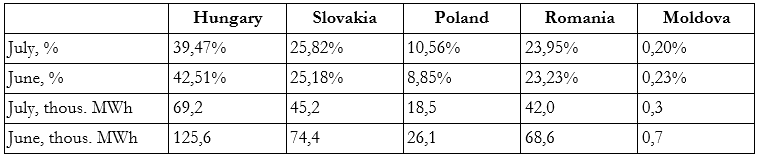
In July, Ukraine exported 232.5 thousand MWh, which is 1.5 times higher than in June. In contrast, only 175.2 MWh were imported, which is only 59.3% of the June import. Before that, electricity exports exceeded imports only in September 20205, and since October, amid new Russian attacks on the Ukrainian power system, electricity imports have sharply increased while exports have decreased.
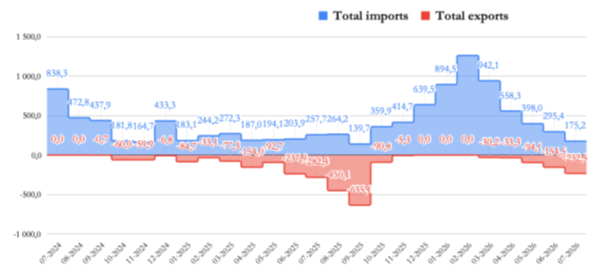
Monthly electricity export and import volumes in recent years
(based on ENTSO-E data)
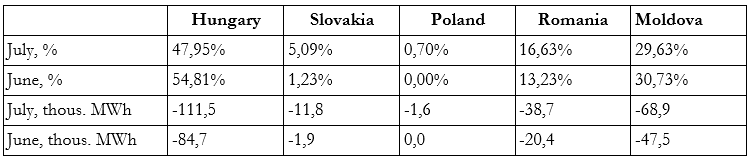
Traditionally, Hungary was the main trading partner. Almost 30% of electricity was exported to Moldova
July and June export comparison (based on ENTSO-E data)
July and June import comparison (based on ENTSO-E data)
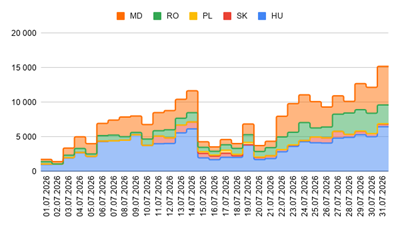
Daily volumes of electricity exports by countries of origin, MWh
(based on ENTSO-E data)
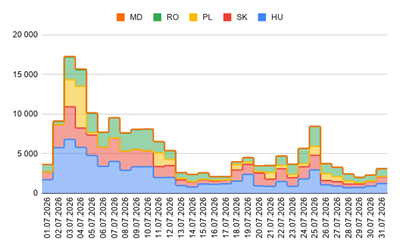
Daily volumes of electricity imports by countries of origin, MWh
(based on ENTSO-E data)
As of July 10, 2026, the total debt of balancing market participants to Ukrenergo reached UAH 46.5 billion. The largest share of debt is traditionally formed by balance responsible parties (BRPs). Their debt as of July 10 amounted to UAH 46.41 billion.
At the same time, NPC Ukrenergo’s total debt to balancing market participants reached UAH 32.09 billion, including UAH 26.09 billion owed to balancing service providers and UAH 6.0 billion owed to balance-responsible parties.
Since the beginning of 2026, Ukrenergo’s debt to balancing service providers has increased by more than UAH 7 billion, and the debt of parties responsible for balance has increased by more than UAH 4.2 billion since the beginning of 2025.
On July 28, the National Energy and Utilities Regulating Commission adopted a decision to revise the tariff for electricity transmission services for NPC Ukrenergo. For most commercial users of the transmission system, the tariff is set at UAH 928.45/MWh (excluding VAT), which is approximately 25% higher than the current level. For green electrometallurgy enterprises, the tariff will be UAH 563.26/MWh (excluding VAT), which is almost 49% higher than the previous one.
The structure of the new tariff includes a component to fulfill special obligations (PSO) to support the production of electricity from renewable sources, amounting to UAH 365.19/MWh. The total cost of implementing PSO in the tariff structure is UAH 32.52 billion, of which UAH 19.69 billion is allocated to support electricity producers from renewable sources (excluding private households).
The regulator planned to increase this indicator as of July 1. But refused due to a legislative conflict that arose after the adoption of the law on market coupling: the parliament enacted a rule prohibiting the inclusion of any public service obligation in Ukrenergo’s tariff. The secretariat of the energy committee made a technical mistake due to a lack of time and haste. On July 16, the Verkhovna Rada of Ukraine resolved a legal issue that had long prevented the revision of tariffs for electricity transmission services for the national company Ukrenergo.
Earlier, on June 30, the energy regulator approved a new tariff for dispatching (operational and technological) management services of NPC Ukrenergo. From July 1, 2026, the tariff will be 118.64 UAH/MWh (excluding VAT), which is 7.83% more than the current level of 110.03 UAH/MWh.
The electricity price index of the BASE period on the DAM in July reached 4,443.89 UAH/MWh. For comparison, in June 2026, the similar price index was 5,599.19 UAH/MWh. The decrease in the weighted average price on the DAM in July, compared with the June indicator, was almost 20%. On the intraday market (IDM) in July, the weighted average cost of accepted electricity was 4,311.33 UAH/MWh. In June, this same indicator was 5,106.08 UAH/MWh.
Given the summer heat, there were previous reasons to believe that the price in July would remain at the June level. However, in July, market collapses occurred, leading to accusations of market manipulation.
As Ukraine enters the fifth year of Russian energy terror, it is strengthening its power systems with additional distributed power generating capacities. In the first half of 2026, almost 1.3 GW of new generating capacity was connected in Ukraine. The largest contribution was made by wind power plants, cogeneration plants and solar generation.
The total capacity of distributed gas generation installed in the country is currently about 1.8 GW. The largest installations of cogeneration gas plants are located in the Kyiv region, where the capacity exceeded 219 MW. Capacity over 100 MW was also provided in Cherkasy (129.3 MW), Dnipropetrovsk (118.2 MW), Volyn (113.6 MW), Ivano-Frankivsk (108.8 MW), Sumy (103.6 MW), and Zakarpattia (100.3 MW). As part of the implementation of regional sustainability plans, starting in March 2026, 388.8 MW of gas capacity has been brought into operation, and construction and installation work is currently underway at another 247 facilities totaling 532.2 MW.
In the first half of 2026, the power system was replenished with 70 new wind turbines totaling 414.8 MW, increasing the total wind generation capacity to 1.115 GW. The main sites for this development remain the Mykolaiv and Odesa regions, which generate over 400 MW and 200 MW, respectively.
The total capacity of solar power plants in Ukraine reached 7.3 GW, of which 5.4 GW is attributed to industrial producers and 2.25 GW to active consumers. The leaders in solar generation are the Dnipropetrovsk (947 MW), Mykolaiv (782 MW), and Odesa (515 MW) regions.
A separate area of dynamic growth is the storage infrastructure. Over the past year, the total capacity of energy storage installations has increased more than 300-fold, exceeding 600 MW and providing an additional tool for system balancing and stabilizing electricity supply.
Energoatom and UkrHydroEnergo successfully held the first series of auctions to sell electricity under bilateral long-term contracts. These auctions are conducted in accordance with the relevant decision of the Cabinet of Ministers of Ukraine. According to the government resolution, both state-owned generating companies are obliged to sell 4% of their annual electricity generation at long-term auctions.
Products are offered to buyers with fixed supply periods of 3, 6 and 12 months. The auctions themselves are held on the Ukrainian Energy Exchange in the format of special sessions. At the July sessions, generating companies offered basic products with supply periods for August–September and August–December 2026. This launched a new market mechanism that allows participants to fix electricity prices for extended periods. At the same time, these small sales volumes are unlikely to significantly change the market situation. In addition, industrial consumers expected lower prices and did not become the main buyers of electricity at auctions.
The Cabinet of Ministers of Ukraine completed the formation of the Supervisory Board of NPGC Energoatom, appointing two independent members – Dominic Minier and Matthew Murray. The new appointments follow the early termination of the mandates of two independent members of the Supervisory Board – Brice Bouyon and Patrick Fragman, who left their positions in May 2026.
Dominique Minier is a French-Canadian citizen and a nuclear energy executive with more than 35 years of experience. He previously held senior positions at the French energy company EDF, where he managed nuclear power plants. Matthew Murray is a U.S. citizen and an expert in corporate governance, anti-corruption policy, and compliance, with over 30 years of experience. He also has experience in Ukraine, including public sector reform and the implementation of good corporate governance standards.
Natural gas consumption in Ukraine fluctuated between 15 and 20 million cubic meters per day. Meanwhile, imports remain minimal, with just 43 m3 imported in July. Gas continues to be injected into underground storage as usual. The level of natural gas reserves in Ukraine’s underground storage facilities is gradually increasing and, as of the end of the month, exceeds the previous year’s figure by 39%. These levels align with the Ministry of Energy’s baseline scenario to accumulate 14.6 billion m3 in underground storage facilities by the beginning of the 2026/27 heating season.
Ukraine intends to partially resume exports of domestically produced natural gas, which have been banned for 4.5 years since early March 2022, when Russia launched a full-scale invasion of Ukraine. Talks about resuming exports of Ukrainian gas have circulated in the market for the past few years, but since mid-June, a number of meetings have been held between representatives of producers and the government.
Domestic gas consumption has fallen with the outbreak of the full-scale war. Gas reserves in Ukrainian storage facilities exceeded 13 billion cubic meters in the second half of July, which is more than 40% higher than last year and the highest level of storage fill in the last 5 years. By the beginning of November, Ukraine may accumulate more than 15 billion cubic meters of gas in underground storage facilities, which, according to government estimates, will be enough to last through the heating season. Gas in Ukraine is more than 30% cheaper than in Europe. Under these conditions, the Ukrainian gas market has become isolated from the European market, making gas imports economically infeasible. Therefore, partial exports will help energy companies earn additional revenues to finance repair work.
On July 7, 2026, the Court of the Astana International Financial Center (AIFC) revoked its previous order for the enforcement of an arbitral award in the case of NJSC Naftogaz of Ukraine against Russian PJSC Gazprom. The corresponding decision was made by Lord Foulkes, citing the court’s lack of jurisdiction to validate such foreign arbitration awards.
During the trial, the central issue was the AIFC’s authority to recognize and enforce the award of the International Court of Arbitration (ICC) issued in Switzerland. After analyzing the parties’ arguments, the court concluded that the Constitutional Law of the center severely limits its competence. According to the case materials, neither Article 13 nor Article 14 provides a legal basis for implementing decisions of foreign authorities that do not fall under clearly established statutory criteria. As a result, the previously issued enforcement order was officially revoked.
NJSC Naftogaz of Ukraine stated that it continues to enforce the more than $1.4 billion awarded by international arbitration against Russia’s Gazprom. The company is using all available legal mechanisms across various jurisdictions, including Kazakhstan.
The International Monetary Fund proposes that the Ukrainian authorities begin a phased increase in gas and electricity prices for the population from 2027. A key condition for starting this process is the early creation of an effective system of targeted social assistance to protect vulnerable segments of the population. This is mentioned in the memorandum between the government and the IMF.
According to the Fund’s experts, a gradual transition to market prices for energy resources will allow the necessary funds to be directed toward restoring damaged energy infrastructure. This step is also intended to reduce industry debt and the amount of hidden subsidies from the state budget. In the long term, tariff liberalization should attract private investment in the Ukrainian energy sector.
Currently, Ukraine has a legislative moratorium on increasing tariffs for natural gas, heating, and hot water for the population, in effect during martial law and for 6 months after its termination. At the same time, this ban does not apply to electricity and cold water supply services. The Ministry of Energy denied plans to raise gas and electricity tariffs until the end of martial law. The Ministry of Energy reported that Ukraine did not make a separate commitment to increase tariffs during martial law.
Naftogaz Group has completed the restructuring of two Eurobond issues totaling approximately EUR 1.2 billion. The decisions were officially supported by over 90% of the holders of securities of each series. The agreement allowed the company to move the maturity dates of its debt obligations forward by several years.
The restructuring process directly affected the company’s outstanding Euro- and USD-denominated bonds issued through Kondor Finance plc. These are EUR 600 million bonds scheduled to mature in July 2026 and USD 500 million bonds with an initial maturity in November 2028. Under the agreements reached, the maturity dates for these bonds have been extended to January 15, 2032, and January 15, 2033, respectively.
This step became one of the key measures to ensure the financial stability of the state-owned company amid a full-scale war and constant attacks on Ukraine’s energy infrastructure. The payment deferral will allow the state holding to maintain liquidity and fulfill current obligations to consumers. In particular, the released resources will be directed toward preparing for and successfully completing the next heating season.
On July 27, at noon, a two-day internet shutdown at the NPP began. This is the longest interruption of communication since the IAEA deployed its permanent mission to the plant almost four years ago. The reasons for the failure were not immediately established.
Zaporizhzhia NPP also continued to face water supply problems following last week’s disruptions. At the same time, groundwater wells continue to provide the needs of systems necessary for the safe operation and physical protection of the plant.
In July, Russian forces used a systematic approach to disrupt Ukraine’s fuel and energy sector, focusing the main combined strikes on gas production facilities and fuel infrastructure. During the month, massive attacks by strike drones and missiles were recorded on the production assets of the Naftogaz group, mainly in the Kharkiv region. This led to the forced shutdown of several key enterprises and losses in production volumes. In parallel, the enemy carried out targeted attacks on the civilian retail and logistics fuel supply network, including gas stations and fuel depots, to create an artificial shortage and complicate logistics.
At the same time, the intensity of artillery and drone attacks on power infrastructure along the line of combat operations and in border regions remained high. The greatest damage to distribution networks and substations occurred in the Donetsk, Sumy, Kharkiv, Zaporizhzhia, and Mykolaiv regions, resulting in regular local power outages and complicating emergency restoration efforts. The combination of strikes targeting gas production, fuel nodes, and local distribution networks indicates an intention to exhaust the energy system on the eve of the heating season.
This publication was created by the Ukrainian Institute of the Future with the support of the Askold and Dir Foundation, administered by ISAR Unity as part of the project “Strong Civil Society in Ukraine – a Driver of Reforms and Democracy” funded by Norway and Sweden. The content of the publication is the responsibility of the Ukrainian Institute of the Future and does not reflect the views of the governments of Norway, Sweden, or ISAR Unity.



Together we can change the future! Your support allows us to continue our research and provide objective analysis of key social issues. Join us today to build the future of our generations together.
Support