Monthly Energy Digest – April 2026
On March 31, the NEURC’s resolution to temporarily raise price caps, which had been in effect since January 16, expired. The cancellation of this decision automatically lowered the maximum prices, immediately reducing electricity imports. Since purchasing resources from external markets became economically infeasible for suppliers, the power system lost a significant share of its necessary imports. Ukraine sharply reduced electricity imports on April 1 to 12.7 thousand MWh, down 56% from the previous day (March 31). The situation was complicated by two nuclear power units being offline for maintenance.
The situation worsened when the government eliminated the PSO mechanism for electricity producers using natural gas. Without these special conditions, gas and gas turbine plants became unprofitable for most hours of the day, leading to their shutdown. The combination of reduced external supplies and the failure of domestic gas-fired power generation led to a critical capacity shortfall, resulting in a sharp increase in electricity outages. Cloudy weather on some days only exacerbated the power system deficit.
On April 1, 2026, Ukrenergo implemented consumption restriction measures for industrial consumers from 12:00 to 17:00 across all regions. On some days, rolling blackouts and emergency cutoffs were performed. Because of the deficit, consumption restrictions were imposed on some days for almost two weeks. Later, restrictions were not applied, but cold weather and low temperatures affected power demand for almost the entire month.
The technical condition of the networks and the reliability of energy supply were under pressure due to systematic shelling of energy infrastructure. As a result of shelling and air strikes, consumers in border and frontline regions were regularly left without electricity.
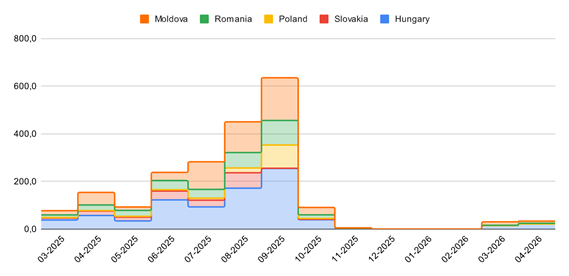
In April, electricity imports dropped by 40 %, while electricity exports remained low
In April, Ukraine imported 558.3 thousand MWh, 40% less than in March. At the same time, electricity exports remained almost unchanged – 33.3 thousand MWh compared with 30.2 in March.
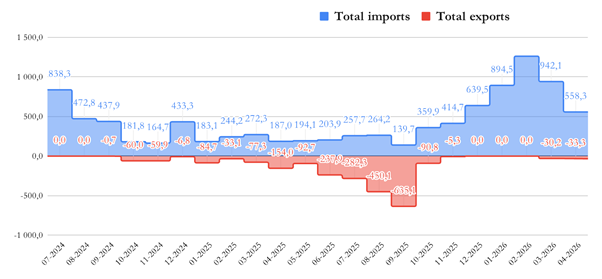
Monthly electricity export and import volumes for the recent year
(based on ENTSO-E data)
Electricity trade with Slovakia in April was at a minimal level due to maintenance on the power line connecting the two countries. Supplies from Hungary increased, while from all other directions they dropped.
Import-export dynamics were heavily dependent on price comparisons between Ukraine and neighboring countries. At the end of April, electricity prices in Europe dropped due to a large increase in solar power output, thereby restricting electricity exports from Ukraine. At the same time, the electricity price situation in Ukraine is deeply dependent on capacity shortages, caused by Russian air attacks in recent months and the start of the maintenance campaign at nuclear power plants.
April and March import comparison (based on ENTSO-E data)
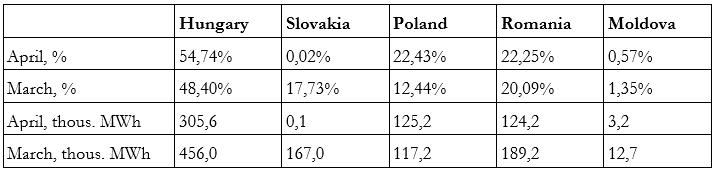
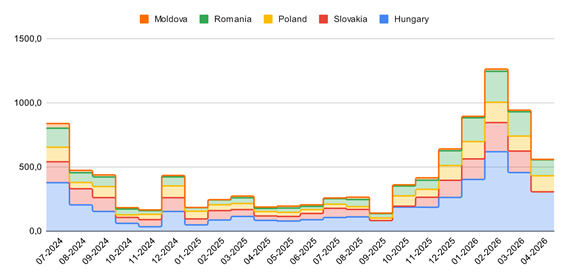
Monthly electricity import volumes by partner countries
April and March export comparison (based on ENTSO-E data)
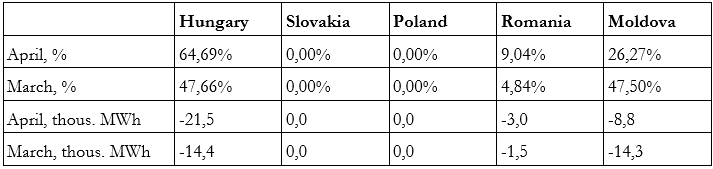
Monthly electricity export volumes by partner countries
(based on ENTSO-E data)
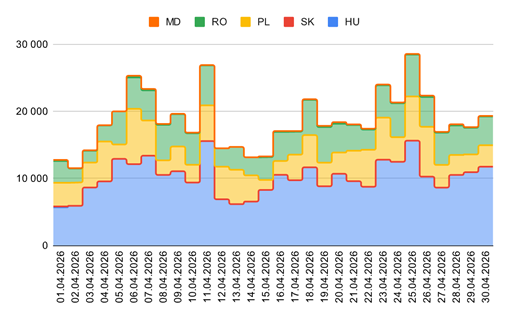
Daily volumes of electricity exports by countries of origin, MWh
(based on ENTSO-E data)
Ukrenergo’s debt to balancing market participants has reached a record UAH 30.9 billion. Since the beginning of 2026, Ukrenergo’s debt has increased by 40%. As a result, companies that traded electricity in the balancing market have to wait more than a year to receive their revenue. At the same time, the debt of the balancing market participants to Ukrenergo has reached UAH 46.3 billion. Since the beginning of the year, this debt has increased by 9.5%.
Prohibiting the halt of power supply to some customers, mostly state-owned enterprises and utility companies, is the main reason for the growing debt. It undermines efforts to build new capacity and ensure the stability of the power system.
On April 23, the NEURC increased the maximum electricity prices for the day-ahead, intraday, and balancing markets, effective May 1, 2026.
In the day-ahead and intraday markets, the price caps will be UAH 15,000.00/MWh (maximum) and UAH 10.00/MWh (minimum) for all hours. In the balancing market, the price caps will be UAH 17,000.00/MWh (maximum) and UAH 0.01/MWh (minimum) for all hours. Hence, in the day-ahead and intraday markets, the price caps will be at the level they were from January 16 to March 31. In the balancing market, the price cap will be slightly higher than in the mentioned period.
On April 28, the Cabinet of Ministers of Ukraine decided to extend the current electricity tariffs for household consumers until October 31, 2026. According to the resolution, the price for the population will remain at 4.32 UAH per kWh, regardless of consumption volume. Current level does not cover the cost of electricity production, its transition, distribution, and supply.
The extension of the current tariff is being implemented under the mechanism for imposing public special obligations (PSO) on electricity market participants. State-owned companies Energoatom and UkrHydroEnergo will continue to compensate for the difference between the regulated price for the population and the market price of electricity. For electric heating users, the government offers favorable rates during the winter heating season. From October 1 to April 30, they pay UAH 2.64 per kWh for up to 2,000 kWh per month. Excess or non-heating-season use costs UAH 4.32.
The NEURC has issued technical conditions for 2.7 GW of new distributed power generation facilities under a simplified procedure, of which approximately 0.8 GW has been implemented. In addition, technical conditions for 3.3 GW were issued under the usual procedure, of which over 0.6 GW have been implemented. In total, these capacities include RES, BESS, and gas-fired power generation.
Ukraine has already issued technical conditions for 1.4 GW of energy storage facilities. Currently, more than 600 MW of power storage capacity is operating in the power system. The main driver of the development of storage facilities has been Ukrenergo’s auctions for auxiliary services. For comparison, there were no power generation facilities in Ukraine in 2022, and only 2 MW in 2023.
President of Ukraine Volodymyr Zelenskyy signed the Law on Amendments to Certain Laws of Ukraine on the Implementation of European Law on the Integration of Energy Markets, Improving Security of Supply and Competitiveness in the Energy Sector (Registration No. 12087-d). The law is also known as on-market coupling.
As previously reported, the law provides for:
The introduction of market coupling will enable automatic capacity allocation at interstate cross-border capacities. This process directs electricity to areas with higher demand and prices, helping to stabilize the market and maintain transparent pricing in line with European standards.
The NEURC has begun implementing the Law’s provisions. In particular, this includes introducing the market coupling mechanism, which unifies the day-ahead and intraday markets. To implement the Law’s provisions in a timely manner, the NEURC is developing a comprehensive action plan that includes updating the current regulatory framework and drafting new acts of secondary legislation in accordance with European law.
State Enterprise “Guaranteed Buyer” has successfully completed reorganization and has been granted joint-stock company status, with 100% of the shares state-owned. This decision aims to implement modern corporate governance standards and increase the transparency of the activities of a key participant in the Ukrainian electricity market. The transition to a new form of ownership is part of the nationwide reform of the energy sector and the management of state assets. Vladislav Novikov was appointed Acting Chairman of the Board. Despite the change in legal status, the company continues to fully fulfill its obligations to renewable energy producers.
The next key reform stage is forming the supervisory board, comprising independent members and state representatives, to provide professional oversight, meet the requirements of Ukraine’s international partners, and support the energy sector’s integration into Europe. Work will also begin establishing other management bodies in accordance with the company’s charter.
FGSZ, Hungary’s gas transmission operator, began proposing to reserve capacity for entry into Ukraine’s gas network in Q3 2026, despite the Hungarian government’s previous ban on such auctions. Although the Hungarian operator made no official statement, the auction announcement suggests that the prohibition on gas supplies from Hungary to Ukraine for Q3 2026 will likely not be implemented.
As a reminder, in March, Hungarian Prime Minister Viktor Orban announced the suspension of gas supplies to Ukraine from Hungary in response to the suspension of Russian oil transit through Ukraine to Hungary. Read a separate explanation why this demand was illegal.
The next auction for booking quarterly capacity for gas imports to Ukraine from Hungary will be held on May 4. The Hungarian operator is offering 9.76 million cubic meters of capacity per day for booking, matching the level offered at previous auctions. Gas import capacity to Ukraine will also be available for booking through monthly or daily auctions. At present, Ukraine does not import gas from Hungary because European gas prices exceed Ukraine’s, rendering imports unprofitable.
Ukraine plans to accumulate 14.6 billion cubic meters of gas by the beginning of the 2026/2027 heating season, and the minimum required reserve should be at the level of previous years, 13.2 billion cubic meters. To ensure a stable passage through the next autumn-winter period, the key tasks remain timely contracting for imported natural gas supplies, pumping the resource into underground storage facilities during periods of lowest market prices, and diversifying supply routes.
The Cabinet of Ministers of Ukraine has approved the Biomethane Production Development Program for the period until 2035. According to the program, Ukraine’s goal is to reach biomethane production of 1 billion cubic meters per year by 2030 and increase it to 2.1 billion cubic meters in the next 5 years – by 2035.
The program supports the construction of new biomethane plants, the modernization of existing biogas plants, the creation of investment incentives for businesses, and the deregulation of connections for biomethane producers to gas transportation and distribution networks. It unlocks Ukraine’s opportunities to become a major biogas producer and exporter to the European Union, helping Europe reduce its dependence on Russian hydrocarbons.
In the first stage of the program’s implementation, it is planned to launch eight biomethane plants and establish an institutional framework to ensure the full functioning of the biomethane sector. To remind, 6 facilities now operate in Ukraine with an annual capacity of 106 million cubic meters of biomethane.
According to official statements, Ukraine has completed repairs to the section of the Druzhba oil pipeline damaged by a Russian strike. On the morning of April 22, the pipeline began to be pressurized and filled with oil from the Belarusian side. The transit of Russian oil through the Ukrainian section of the Druzhba oil pipeline resumed. Later, Hungary and Slovakia confirmed the resumption of oil flows.
At the same time, as President Zelensky states, no one can currently guarantee that Russian strikes on the pipeline infrastructure will not be repeated, our specialists have provided the basic conditions for the restoration of the pipeline system and equipment.
The Government of Ukraine is launching a state support mechanism for large and medium-sized businesses to develop distributed generation under the Local Resilience Plans.
The program provides for the possibility of obtaining loans with an effective interest rate of 10% per annum for the construction and commissioning of energy facilities. These include, in particular, gas turbine and gas piston plants (including cogeneration), renewable energy facilities (biomass, biogas, geothermal energy), energy storage systems, as well as microgrids and local autonomous energy systems.
The difference between the market and preferential rates will be compensated by the state.
This publication was created by the Ukrainian Institute of the Future with the support of the Askold and Dir Foundation, administered by ISAR Unity as part of the project “Strong Civil Society in Ukraine – a Driver of Reforms and Democracy” funded by Norway and Sweden. The content of the publication is
the responsibility of the Ukrainian Institute of the Future and does not reflect the views of the governments of Norway, Sweden, or ISAR Unity.



Together we can change the future! Your support allows us to continue our research and provide objective analysis of key social issues. Join us today to build the future of our generations together.
Support