Digests • 13 October 2026
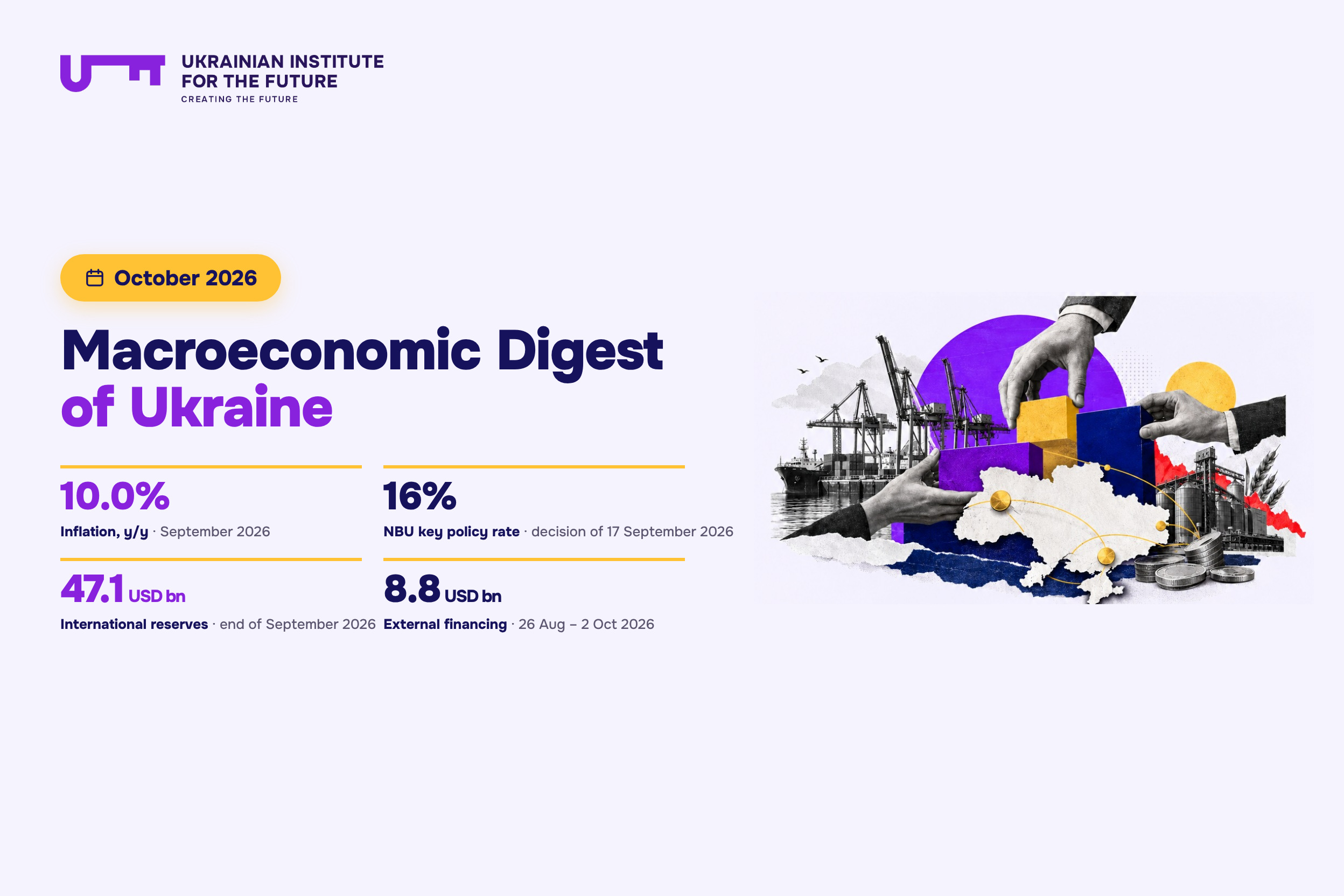
On 17 September, the Board of the National Bank of Ukraine (NBU) decided to raise the key policy rate to 16%.
On 2 October, following negotiations, representatives of the European Union (EU) and Ukraine concluded that there is no financing gap for Ukraine this year, effectively rejecting Ukraine’s request for an additional USD 27 billion in financing.
Between 26 August and 2 October 2026, Ukraine received around USD 8.8 billion in financing from the EU and other donors. Since the beginning of 2026, Ukraine has received around USD 39.3 billion in financing.
Amid logistical disruptions and enemy strikes on business facilities, inflation rose sharply in September to 2.1%, and to 10% year-on-year.
International reserves in September 2026 decreased from USD 48.7 billion to USD 47.1 billion.
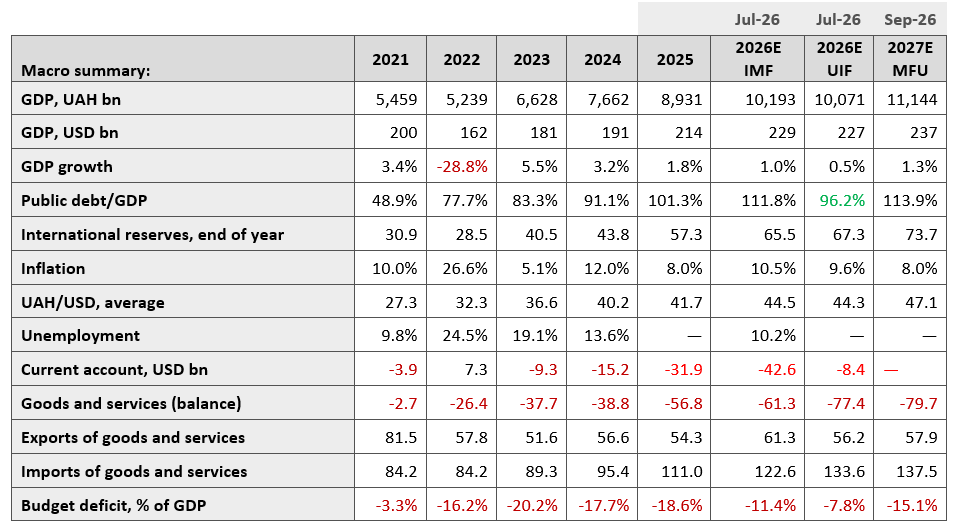
Source: Ministry of Finance, NBU. Ukrainian Institute for the Future (UIF) calculations.
Jul-26 2026E IMF – IMF calculation (1 review for 2026)
Jul-26 2026E UIF — UIF calculations (July forecast for 2026)
Sep-26 2027E MFU — 2027 budget of 15 September 2026 from the Ministry of Finance, with UIF calculations, international reserves — NBU forecast (Inflation Report, Q3 2026)
Consumer market inflation in September 2026 compared with August stood at 2.1%, and compared with September 2025, at 10.0%.
Core inflation stood at 2.0% (compared with August 2026) and 8.8% (compared with September 2025).
We believe the rise in inflation is driven by strikes on business facilities and logistical disruptions. Businesses have begun passing additional costs and losses through to prices.
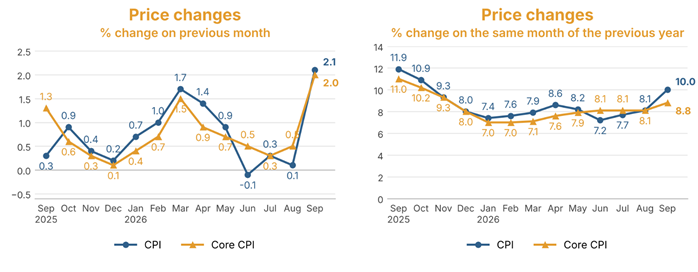
Price changes over the past 12 months. Source: Ukrstat.
In the consumer market, food and non-alcoholic beverage prices increased by 1.9% in September. Eggs rose the most (by 43.6%). Prices for sugar, rice, products of grain processing, lard, milk, non-alcoholic beverages, fish and fish products, sunflower oil, and meat and meat products increased by 8.3–1.7%. At the same time, fruit and vegetables fell in price by 5.7% and 2.3%, respectively.
Clothing and footwear prices increased by 8.5%, including clothing by 9.4% and footwear by 7.6%.
The 0.8% rise in prices (tariffs) for housing, water, electricity, gas and other fuels was mainly driven by higher tariffs for water supply (by 5.6%) and sewerage (by 5.5%).
On 17 September, the Board of the National Bank of Ukraine decided to raise the key policy rate to 16% in view of persistent underlying price pressures, second-round effects of supply shocks and growing medium-term inflationary risks.
The NBU noted that inflation may follow a somewhat higher path in the coming months than envisaged in its previous forecast. Inflationary pressure will be fuelled by the consequences of intensified Russian attacks on logistics, production and energy infrastructure facilities. In addition, prices will be affected by fuel that is more expensive than previously expected. Global price conditions remain inflationary, in particular given developments in the Middle East. Against this background, a growing number of central banks are raising their key rates. At the same time, inflation is likely to be restrained by an ample supply of food on the domestic market, partly owing to difficulties with exporting harvests via the Black Sea. Inflation is expected to return to a downward trajectory in 2027, owing in part to the NBU’s monetary tightening measures.
Should risks to price dynamics and inflation expectations increase significantly, the NBU will be ready to take additional measures to curb inflation. However, if a deteriorating security situation leads to a marked cooling of consumer demand and the labour market in the coming months, the NBU will consider easing monetary conditions.
We would highlight record budget expenditure in August 2026. The consolidated budget deficit in August amounted to UAH 344.6 billion. As a result, the consolidated budget deficit for the first eight months of 2026 amounted to UAH 470.6 billion. This is, however, lower than the budget deficit for the first eight months of 2025, which stood at UAH 768.6 billion.
The main reason for the August deficit was record spending on defence and internal security. In August 2026, UAH 459 billion was spent on defence, against average spending of UAH 280 billion per month over the first seven months. Spending on internal security in August amounted to UAH 96 billion, against an average of UAH 75 billion per month over the first seven months.
Amid corruption scandals, virtually no financing was received in August, which led to a substantial decrease in balances in the state and local budget accounts from UAH 714 billion (a record) to UAH 377 billion.
Tax revenues for the first eight months of 2026 were UAH 321 billion higher than in 2025. This was primarily due to growth in personal income tax revenues (nominal wage growth), excise tax revenues (tax increases), and VAT revenues (nominal growth of the economy and imports).
In the first eight months of 2026, the budget received UAH 1,006 billion in grants.
We note that the Ministry of Finance has again changed the way it recorded EU financing between 25 August and 29 September. While on 25 August all financing was recorded as Ukraine Support Loan (USL) funds, USD 2.843 billion has now again been allocated as a loan under the Ukraine Facility.
Between 26 August and the end of September, Ukraine received around USD 5.5 billion in financing from the following sources:
EUR 3.3 billion, or around USD 3.8 billion, from the EU under the Ukraine Support Loan — for military needs.
USD 839 million from Canada — a loan.
USD 774 million under ERA. The Ministry of Finance did not specify who provided the funds. We believe these are funds from the United States.
USD 111 million from Japan — a loan.
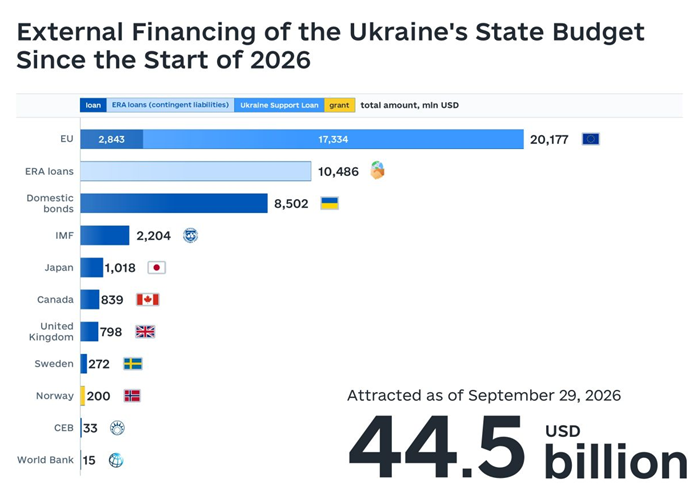
Source: Ministry of Finance.
In addition, on 2 October Ukraine received EUR 2.9 billion, or around USD 3.3 billion, under the Ukraine Facility. Thus, between 26 August and 2 October, Ukraine received around USD 8.8 billion in financing. Since the beginning of the year, total financing has reached USD 39.3 billion.
In August 2026, Ukraine’s public and publicly guaranteed debt increased from USD 214.2 billion to USD 215.5 billion (+USD 1.3 billion).
The debt increased due to the revaluation of euro-denominated debt against the US dollar (+USD 1.25 billion).
On 2 October 2026, European Commission spokesperson for budget Balázs Ujvári, together with the Chief Spokesperson of the European Commission Paula Pinho, made an important statement on financial support for Ukraine:
We would highlight the following regarding this situation:
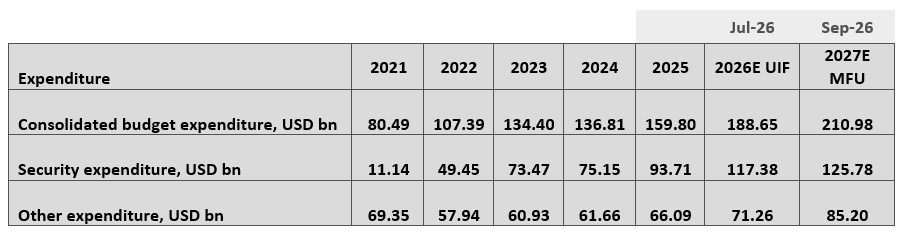
Source: Ministry of Finance. UIF calculations.
Thus, we see that the vast number of legislative changes required to obtain grant financing is a major problem this year. Mitigating it requires either talks with the EU so that part of the military financing can be used to finance non-military budget expenditure, or another solution for financing non-military expenditure.
The balance of payments was negative in August 2026. There was no external financing in August, while the trade deficit continues to widen. Due to Russian strikes on Ukrainian ports, exports in August effectively fell by 20–25% compared with July 2026.
The trade deficit continues to break records: in the first eight months of 2026 it amounted to USD 47.13 billion, USD 13.5 billion more than in the same period of 2025 (USD 33.626 billion). In August, imports of goods were more than three times higher than exports: USD 8.141 billion versus USD 2.355 billion.
As a result, the current account in August was recorded as negative at USD 4.8 billion.
The financial account in August was positive at USD 1.7 billion, primarily due to the crediting to reserves of funds previously received from the EU under the defence tranche.
Our forecast for September 2026 — that in the baseline scenario the NBU would, for political reasons, hold the exchange rate below 45 — proved correct, with the rate holding at 44.5–45.0.
However, we now see a sharp shift in EUR/USD exchange rate dynamics following the Federal Reserve’s 25-basis-point rate hike at its latest meeting on 15 September. The EUR/USD rate fell from the 1.15–1.17 range to below 1.12. On 6 October, the NBU set the official UAH/USD exchange rate at 45.06, above the 45 mark. The hryvnia strengthened against the euro, with the rate moving from the 51.5–52.0 range to 50.5–51.0.
We also see that the EU has decided to finance Ukraine in the previously agreed format and continues to delay the disbursement of EUR 45 billion, while as of 2 October Ukraine had received only around EUR 20.5 billion. At the level of the Ukrainian authorities, this is already leading to spending cuts across budget items other than weapons procurement.
With financing constrained in October, it would be more advantageous for the budget to convert the euros that entered the country at a rate of 51–52 rather than 50–51. However, we do not expect the NBU to devalue the hryvnia against the dollar to 46. Our baseline scenario is therefore a UAH/USD rate of 45.0–45.5 in October, with the euro rate following changes in the EUR/USD rate, but at 50.0–51.0 in the baseline forecast.
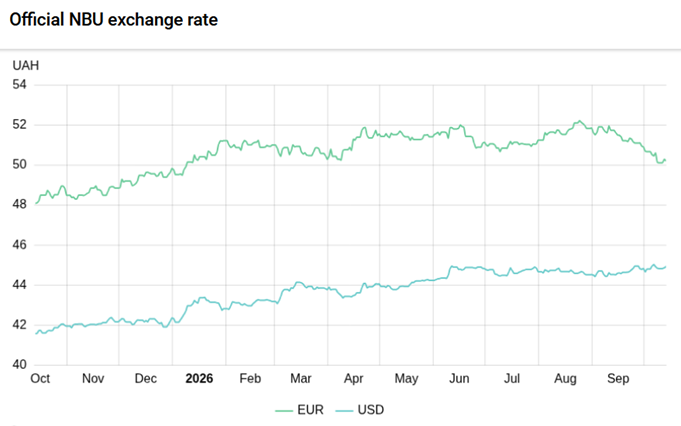
Hryvnia exchange rate against the USD and EUR over 12 months. Source: NBU.
Ukraine’s international reserves decreased from USD 48.7 billion to USD 47.1 billion in September 2026.
According to the balance sheet data, in September, the NBU sold USD 5,449.9 million on the foreign exchange market.
In September, USD 890.4 million was received into the government’s foreign currency accounts at the National Bank — through World Bank accounts.
In addition, Ukraine received USD 3.81 billion from the European Union under the defence tranche of the Ukraine Support Loan. These funds are not included in Ukraine’s international reserves due to their restricted (earmarked) purpose of use. However, if the government sells them to the National Bank for hryvnias for further use as intended, international reserves increase by the corresponding amount. In September, the government converted USD 3.81 billion of these funds into hryvnias, which accordingly contributed to the increase in international reserves.
USD 195.7 million was paid for servicing and repayment of public debt in foreign currency, including:
In addition, Ukraine paid USD 254.3 million to the International Monetary Fund.
The current volume of international reserves covers 4.0 months of future imports.
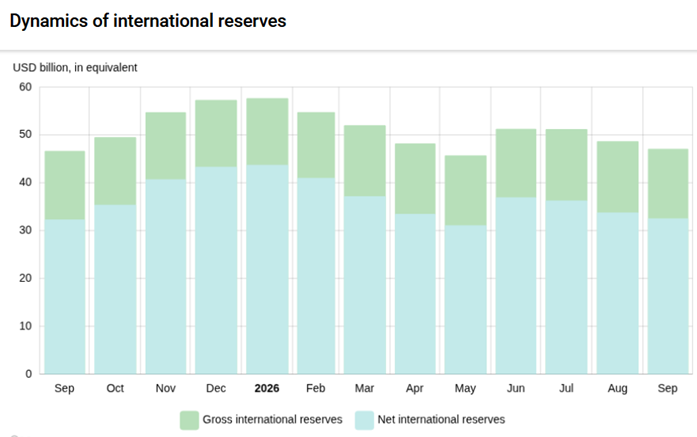
Change in international reserves over the last 12 months. Source: NBU.
29 October. NBU. Key policy rate decision.
5 November. NBU. Inflation Report, Q4 2026.
This publication was created by the Ukrainian Institute of the Future with the support of the Askold and Dir Foundation, administered by ISAR Unity as part of the project “Strong Civil Society in Ukraine – a Driver of Reforms and Democracy” funded by Norway and Sweden. The content of the publication is the responsibility of the Ukrainian Institute of the Future and does not reflect the views of the governments of Norway, Sweden, or ISAR Unity.



Together we can change the future! Your support allows us to continue our research and provide objective analysis of key social issues. Join us today to build the future of our generations together.
Support