Digests • 07 October 2026
In September, Ukraine’s power system operated relatively steadily. Moderate temperatures helped lower electricity demand and prevent shortages. Demand also declined because metallurgical enterprises sharply reduced production amid Russian attacks and difficulties exporting goods through the Black Sea, reaching record lows. This surplus occurred despite some power system capacity remaining unavailable: three nuclear power units were undergoing repairs ahead of winter. As a result, Ukraine substantially reduced electricity imports and increased exports.
This period of relative stability ended late in the month. On 30 September, Russian forces launched a large-scale attack on power generation and transmission infrastructure—the first such attack since the end of the previous autumn-winter season. Temporary consumption restrictions followed, but were lifted the next day.
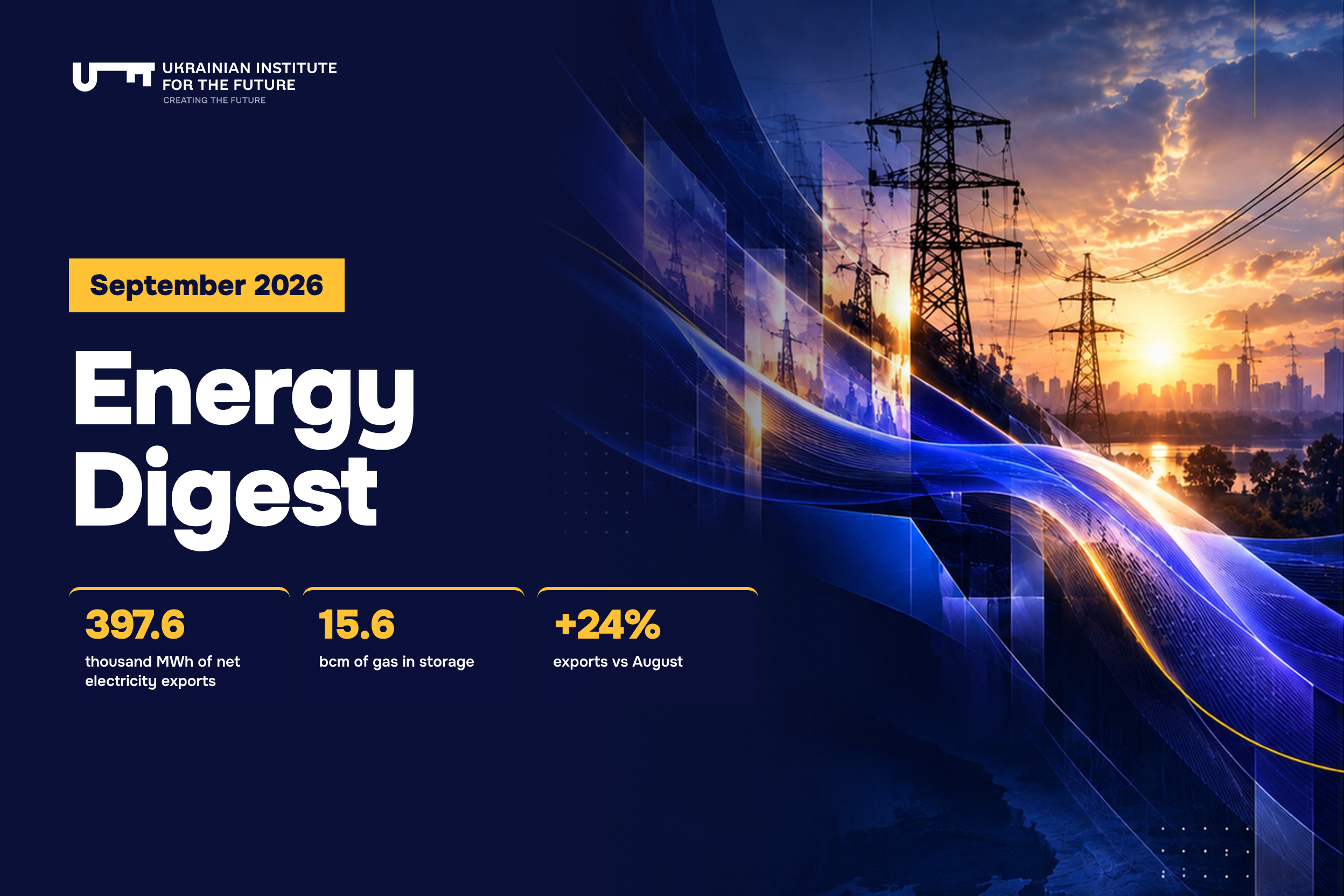
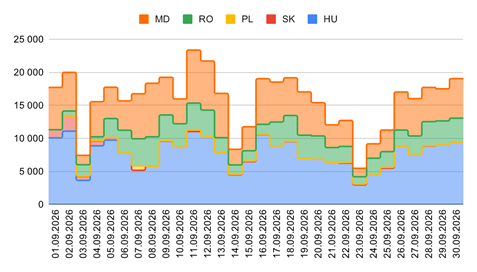
In September, Ukraine exported 473.7 thousand MWh, up 24% from August. At the same time, electricity imports dropped significantly—by nearly 60%—to 76.1 thousand MWh. Consequently, net electricity exports in September stood at 397.6 thousand MWh, compared with 198.1 thousand MWh in August.
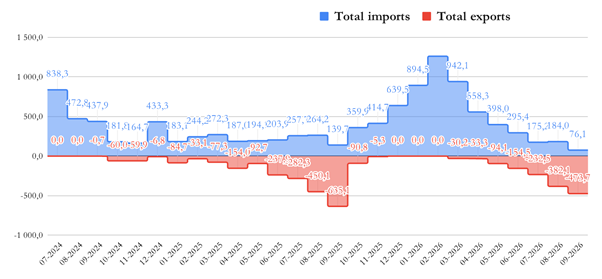
Monthly electricity export and import volumes over the past year
(based on ENTSO-E data)
September and August export comparison (based on ENTSO-E data)
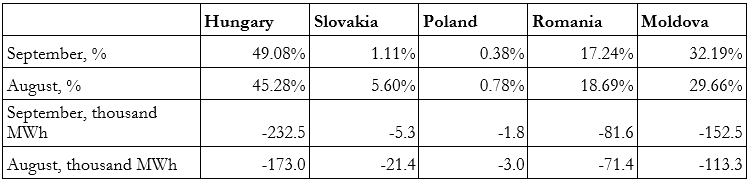
September and August import comparison (based on ENTSO-E data)
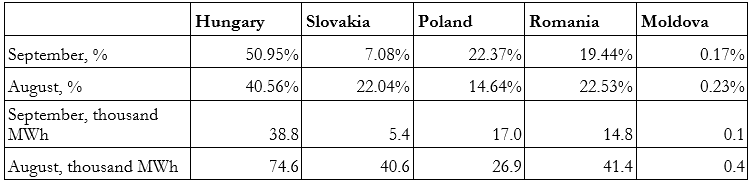
Daily volumes of electricity exports by countries of origin, MWh
(based on ENTSO-E data)
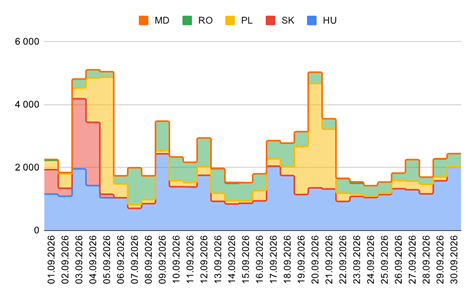
Daily volumes of electricity imports by countries of origin, MWh
(based on ENTSO-E data)
In October, electricity exports are likely to decrease while imports increase. The main drivers will be higher consumption in Ukraine due to lower temperatures, reduced solar power plant output, and potential damage to infrastructure from shelling.
In late September, Ukraine held auctions to allocate support quotas for new wind and solar power projects. Demand for participation significantly exceeded the offered capacity, leading to a substantial drop in investor bids.
On 25 September, Ukraine held an auction to allocate a 100 MW quota for solar power plants. Each plant was required to include an energy storage system with a power rating of at least 80% of the installed generation capacity and an energy capacity of at least 2 kWh per kilowatt. Twenty-four companies competed for this lot, submitting 26 bids totalling nearly 386 MW—3.86 times the available quota. Intense competition drove bids down by 22.5–50.25% from the price cap of 12 eurocents per kilowatt-hour.
On 30 September, an auction allocated a 700 MW support quota for wind power projects. Nine companies submitted 93 bids totalling 1,218.1 MW. Bidders competed under a price cap of 8 eurocents per kilowatt-hour (excluding VAT). Ultimately, investor bids ranged from 2.98 to 7.59 eurocents per kilowatt-hour. Naftogaz VES offered the lowest price, submitting 10 lots totalling 300 MW of new capacity. In addition to the lowest price offers, the wind energy auction was notable for large-scale bids from major market players. DTEK Poltava Wind Power Plant submitted the largest volume, offering 496 MW of generation capacity across 56 separate bids.
The Supervisory Board of NNEGC Energoatom has concluded the competitive selection process for executive positions, appointing Yuriy Tkachuk as Director General (CEO) and Pavlo Pavlyshyn as Director of Nuclear Safety (Chief Nuclear Officer, CNO). This move is part of a new corporate governance model that entails separating operational management from radiation safety oversight. Under this model, Energoatom’s CEO is not required to hold a licence to operate nuclear power installations.
The selection process ran from June to September 2026, with 78 candidates considered for the Director General position alone. Tkachuk will now oversee the state-owned enterprise’s overall operations and strategic development. Meanwhile, Pavlyshyn will have full independence on nuclear and radiation safety matters. Supervisory Board Chair Rumina Velshi said this division of responsibilities aligns with the practices of leading global operators.
Prior to this appointment, Yuriy Tkachuk led JSC UkrGazVydobuvannia and previously served as CFO and acting head of Ukrnafta. Pavlo Pavlyshyn has over 30 years of industry experience; notably, he headed the Rivne NPP from 2012 to 2022. He also has prior experience managing the entire company, having served as Acting President of Energoatom in 2019–2020.
Many experts have criticised the idea of exempting the head of Energoatom from the requirement to possess knowledge and experience in the nuclear energy sector. Industry experts have expressed concern that the CEO is not required to hold the relevant licence to manage such specialised facilities amid war challenges. In their view, the company head’s lack of specialised experience could create additional risks when making complex management decisions. However, the Supervisory Board believes creating a dedicated Nuclear Safety Director position should offset these challenges.
Shortly after that, the Supervisory Board of Energoatom terminated Pavlo Kovtonyuk’s duties as Chairman and member of the company’s Management Board and appointed Oleksandr Ostapovets as the interim acting Chairman of the Management Board. Ostapovets will lead Energoatom until the company’s Management Board begins work with its new permanent composition. As Energoatom reported, the decision regarding Pavlo Kovtonyuk followed an assessment of how well he implemented the Supervisory Board’s decisions and instructions. Based on those results, the Supervisory Board declared a loss of confidence in Kovtonyuk’s ability to ensure the proper implementation of its decisions and to continue managing the company.
At the end of the month, Ukrainian storage facilities held 15.6 billion cubic metres of gas. That’s 2.9 billion cubic metres more than a year earlier and above the government’s baseline target of 14.6 billion cubic metres for gas injection by November.
Because of the surplus, the government has resumed considering a partial reopening of exports of domestically produced natural gas. In mid-September, gas in Ukraine was trading at 2.5 times the European price. Prices on European hubs are rising amid low storage levels and the war in the Middle East, while domestic prices are falling. Natural gas imports from Europe are nearly nonexistent and economically unviable because of high prices on European hubs.
In September, Naftogaz officially announced the agreement with MOL regarding the joint project. The initiative provided for the construction of terminals and storage of Ukrainian fuel near the Ukrainian-Hungarian border. The memorandum became one of the agreements reached during the Carpathian Economic Forum.
Shortly after the agreement was made public, Hungary’s Prime Minister, Péter Magyar, issued a demarche. He said the government categorically does not support building oil storage facilities for Ukraine’s needs on Hungarian territory. The politician emphasised that MOL management conducted these negotiations without the Hungarian government’s consent, which is unacceptable. Since the state owns 25% of the company’s shares, the prime minister urged MOL to consider the main shareholder’s position and warned of possible consequences.
The International Atomic Energy Agency received the results of an independent examination of satellite images of the Zaporizhzhia NPP. A study initiated by Greenpeace Ukraine completely refutes Russian propaganda claims of Ukrainian strikes on the occupied plant.
Specialists at McKenzie Intelligence Services analysed images of the site from October 2025 to June 2026. Experts found no evidence of the 10 February artillery strike and the 4 June drone attack that Russia had previously claimed. There are no characteristic craters at the site of the alleged artillery shelling, and the destruction of infrastructure recorded by experts existed even before the stated date of the drone attack.
The Greenpeace organisation emphasises that the real threat to nuclear safety comes exclusively from the occupiers. The Russian military uses the territory of the ZNPP as a platform for launching weapons on Ukrainian cities and is involved in the intentional damage to the plant’s power line. Ukraine continues to demand the facility’s complete de-occupation and the imposition of international sanctions against the Rosatom corporation.
In September 2026, Russian forces launched a series of attacks on Ukraine’s energy and fuel infrastructure. Throughout the month, Russia expanded the geographic scope of its strikes. On multiple occasions, the Russian army targeted production facilities belonging to Ukrnafta and Naftogaz. At least three direct hits completely destroyed a 36.6 MW power generation facility, depriving the Sumy region of nearly a quarter of its available generation capacity.
A systematic campaign to destroy retail fuel infrastructure continued throughout September. For the first time in a long period of the war, petrol stations in Kyiv were attacked; specifically, filling station complexes belonging to the Ukrnafta and OKKO chains were damaged by jet-powered drones.
Infrastructure belonging to the state-owned enterprise “Market Operator” was hit, disrupting electricity trading systems. Electricity distribution systems in border and frontline regions were subjected to daily fire from drones and artillery, resulting in regular local power outages.
The culmination of Russia’s actions that month was the attack on 30 September. This strike marked the first large-scale assault on the Ukrainian power grid since the end of the previous heating season. For the first time, Russia deployed a drone carrying a specialised warhead designed to destroy high-voltage transmission line pylons. Ukrainian intelligence had previously reported this development.
In mid-September, Donald Trump made a statement, saying that Ukraine and Russia are allegedly willing to strike a deal to mutually halt attacks on energy infrastructure. However, officials in both Kyiv and Moscow have publicly denied this, noting that no final agreements have been reached. Both sides emphasise the lack of concrete decisions or agreed-upon parameters for such a move, despite the American politician’s optimistic claims.
Trump’s active push to halt energy-sector attacks is directly tied to the political situation in the US ahead of the elections. Even a partial truce would let him present voters with a tangible outcome of his diplomatic efforts. Furthermore, de-escalating risks to the oil, gas, and energy sectors is intended to help lower fuel costs in the US market, where retail prices are at record highs and put significant pressure on voter sentiment.
At the end of September, media reported that, in private conversations, Donald Trump was very sceptical about Russia’s readiness to agree to an energy truce.
The US Development Finance Corporation (DFC) has approved an €85 million loan for DTEK to finance a portfolio of energy storage systems in Ukraine with a total capacity of 200 MW and 400 MWh. The DFC Board of Directors made the decision on 16 September. This is one of DFC’s largest debt financing agreements for Ukraine and the largest in the Ukrainian energy sector since the start of the full-scale war in 2022. This financing actually refinances DTEK’s existing battery energy storage system (BESS) project. The portfolio includes energy storage systems at six sites in central Ukraine. For the project, DTEK utilised GridStack systems from the US company Fluence. Construction was completed in six months, and the entire portfolio was commissioned in September 2025.
According to Draft Law No. 16000 of 15 September on the 2027 state budget, UAH 97.3 billion is allocated to support the energy sector next year.
The Ukrainian Parliament has passed, in the first reading, Bill No. 14282, which aims to significantly strengthen the independence guarantees for the National Energy and Public Utilities Regulatory Commission (NEURC). The document calls for a complete overhaul of the state agency, changes to the procedure for appointing its members, and the depoliticisation of decision-making in the energy market.
A key feature of the bill is a major revision of the mechanism for selecting commission members. Plans are in place to involve representatives from the European Commission and the Energy Community in the competitive selection process to ensure transparency and impartiality. Furthermore, the document proposes new approaches to candidate assessment and mandates a rotation of all current members of the regulator, to be carried out sequentially in three stages.
Strengthening the independence of the energy regulator is a crucial component of Ukraine’s international commitments. These changes are explicitly enshrined in the Memorandum with the International Monetary Fund and are also stipulated by the Ukraine Facility macro-financial support programme. Representatives of the relevant parliamentary committee note that the document will undergo further refinement before the second reading, incorporating constructive provisions from alternative bills. The final adoption of the law is expected to reduce risks and prevent future political interference in regulating energy and public utility markets. When manipulations in the energy sector were exposed, also known as Mindichgate, President Zelensky demanded that energy companies and the NEURC be rebooted.
This publication was created by the Ukrainian Institute of the Future with the support of the Askold and Dir Foundation, administered by ISAR Unity as part of the project “Strong Civil Society in Ukraine – a Driver of Reforms and Democracy” funded by Norway and Sweden. The content of the publication is the responsibility of the Ukrainian Institute of the Future and does not reflect the views of the governments of Norway, Sweden, or ISAR Unity.



Together we can change the future! Your support allows us to continue our research and provide objective analysis of key social issues. Join us today to build the future of our generations together.
Support