Digests • 06 November 2026
Because of massive Russian attacks on Ukraine’s power system in late September, from the very beginning of October, some Ukrainian regions, but mostly Kyiv, suffered from power shortages and experienced restrictions on power supply to customers. Bottlenecks in the power transmission system caused the shortages. In general, there were no power shortages in production, but damage made it impossible to deliver the required volumes. Such a situation caused a partial increase in electricity exports.
Additional nuclear power units were connected to the grid after the maintenance. By the end of the month, all 9 units within the controlled territory were operating on the grid.
In the middle of October, Russian armed forces attacked power transmission at the right bank of the Dnipro River. On the one hand, this created bottlenecks in electricity transmission to the western market and for further exports. But, in addition, the transmission system operator partially restricted exports.
In some cases, excess capacity from nuclear power units operating under transmission restrictions created surpluses, which lowered prices.
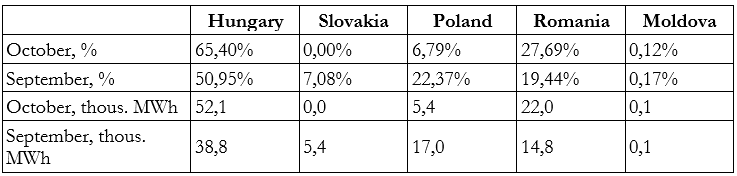
In October, electricity exports totaled 423,5 thousand MWh, compared with 473,7 thousand MWh in September. Imports totaled 79,6 thousand MWh, compared with 76,1 thousand MWh in September.
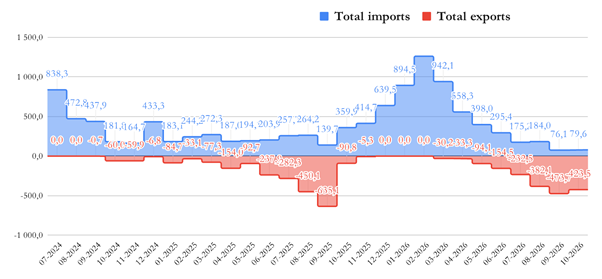
Monthly electricity export and import volumes for the recent year
(based on ENTSO-E data)
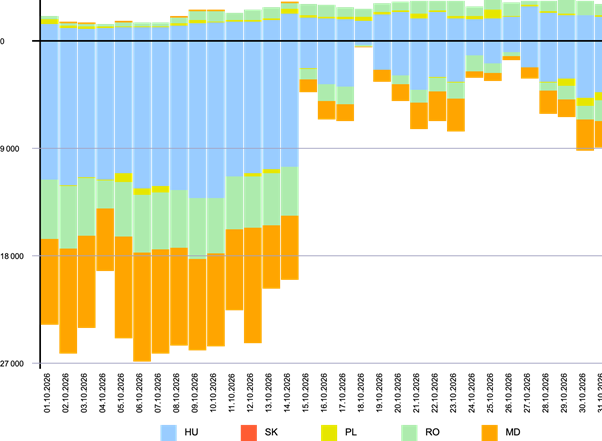
Daily volumes of electricity exports (below) and imports (above) by countries of origin, MWh (based on ENTSO-E data)
Amid power supply shortages in some Ukrainian regions, imports could not prevent them because Russian strikes caused bottlenecks in the power transmission systems. As a result, electricity exports dropped drastically. In fact, Russian strikes in mid-October caused a drop in exports and kept them relatively low overall in October. Bottlenecks restricted exports, and the TSO also imposed restrictions on electricity exports.
Traditionally, Hungary held the largest share of imports and exports. There was no trade with the second-largest importer and exporter– Slovakia: the Velke Kapucany–Mukchevo power line connecting the Ukrainian and Slovak power systems has remained under maintenance from mid-September to the end of October.
October and September export comparison (based on ENTSO-E data)
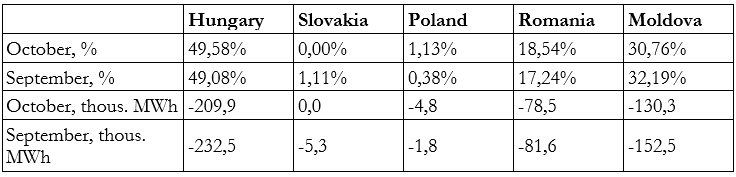
October and September import comparison (based on ENTSO-E data)
During the first nine months of 2026, balancing market participants’ debt to NPC Ukrenergo rose to UAH 47.34 billion. As of September 30, it was UAH 5.29 billion, or 12.6%, higher than at the end of 2025. Nearly all of the total—UAH 47.26 billion—is owed by balance-responsible parties. Ukrenergo’s own debts rose much faster: over the nine-month period, they increased by UAH 13.76 billion, or 60%, to UAH 36.7 billion.
In October 2026, the Ukrainian spot electricity market recorded a significant price decline compared with the previous month. The BASE period price index on the day-ahead market fell to UAH 4,631.30/MWh, down from UAH 5,988.28/MWh in September. Total electricity volumes sold in both market segments also decreased, reflecting current shifts in the supply-demand structure. A similar price decrease was observed in the intraday market, where the weighted average price of accepted electricity fell from UAH 6,073.81/MWh in September to UAH 4,534.00/MWh.
Trading volumes across segments showed mixed trends. Unpredictability of power supply due to Russian strikes on the power system affected trade and the shares of electricity traded in the day-ahead and intraday markets. In the day-ahead market, sales volume fell 12.58% in October from September. By contrast, participant activity in the intraday market increased, driving a 17.27% rise in volumes. In total, both segments accepted 2,248,967.4 MWh in October, significantly less than September’s 2,490,040.6 MWh.
Ukraine’s Cabinet of Ministers has extended the special service obligations (PSO) in the electricity market through April 30, 2027, keeping the current household electricity tariff of 4.32 UAH/kWh in place. The household price will remain unchanged throughout the 2026/2027 heating season. The preferential rate of 2.64 UAH/kWh will also continue to apply to homes with electric heating and to homes without gas connections or centralized heating.
The Cabinet of Ministers of Ukraine approved the financing mechanism for a new energy project by Ukrnafta, which includes the construction of four gas-piston power plants. These power plants, with a total capacity of about 60 MW, will be located in the Lviv and Ivano-Frankivsk regions. The project will be implemented using the credit resources of the Finnish-Ukrainian Investment Fund. These funds are allocated to the state budget under the framework intergovernmental agreement between Ukraine and Finland, signed in November 2024.
Earlier, Ukrnafta signed an agreement with the European Bank for Reconstruction and Development to secure 45 million euros in donor funds to build 17 additional distributed generation facilities with a total capacity of 63 MW. According to Bohdan Kukura, the company’s board chairman, the company should deliver and install part of this additional equipment by the end of 2026.
Pavlo Pavlyshyn has assumed his role as a board member and Chief Nuclear Officer (CNO) of JSC NNEGC Energoatom. The company’s supervisory board selected him earlier through an independent competition. In his new position, Pavlyshyn will oversee nuclear safety, NPP operations, engineering management, technical policy, and maintenance of nuclear assets. Pavlyshyn will work with Ukraine’s State Nuclear Regulatory Commission to obtain the required regulatory permits, including an individual license. Until the permits are obtained, authorized employees will perform functions that require special approval.
The Supervisory Board of JSC NNEGC Energoatom has selected Anton Yakovenko as the winner of the competition for Member of the Management Board for Financial Affairs (CFO), and Alona Perepelytsia as the winner for Member of the Management Board for Legal Affairs (CLO).
Yakovenko has more than 20 years of management experience at major Ukrainian and international companies. Previously, Mr. Yakovenko served as CEO of Agricom Group, Agrii Ukraine, part of the Origin Enterprises group, and Terra Food Group, and served as CFO of Roshen Group. He began his career at KPMG. Perepelytsia has more than 20 years of experience in corporate and regulatory law, with a particular focus on the oil and gas sector. Before her selection, she held the position of Director of Legal and Regulatory Affairs at JSC UkrGazvVydobuvannya. Before joining the company, she spent more than two decades in senior legal leadership roles at JSC Ukrnafta.
By month-end, gas reserves in underground storage facilities reached 16 billion cubic meters—the highest level since 2020. Naftogaz has also contracted for more than 1 billion cubic meters. Current reserves exceed the 13.2 billion cubic meters the government has set as the minimum needed to get through the winter. By comparison, Ukraine began the previous heating season with less than 14 billion cubic meters in reserve.
Sufficient natural gas reserves in underground storage to last through next winter prompted the government to permit limited, controlled gas exports. On October 7, 2026, the Cabinet of Ministers of Ukraine decided to partially lift the ban on exports of domestically produced natural gas. Exports of Ukrainian-produced gas had been banned since Russia’s full-scale invasion began in 2022. Active discussions about whether to resume gas exports began this summer.
Gas producers may export up to 15% of the volume they produced in the previous month, with exports allowed each month from March 1 to November 30 of that year. The mechanism excludes gas produced under production sharing agreements (PSAs), which are governed by separate legislation, and market participants with special obligations under Cabinet of Ministers Resolution No. 222 (UkrGazVydobuvannya and Ukrnafta). It therefore applies to private gas producers. Because only privately owned companies may export, the potential export volume would be limited to about 50 million cubic meters per month.
In the event of a crisis, exports could be temporarily suspended. The Crisis Committee under the Ministry of Energy would make the decision, either on the Ministry’s initiative or at the request of Naftogaz or the Gas TSO of Ukraine, and the Ministry of Energy would then approve it.
In October 2026, private gas-producing companies sold 54.5 million cubic meters of natural gas for export at specialized auctions on the Ukrainian Energy Exchange (UEB). The total value of the concluded agreements was €45.59 million (excluding VAT). Gas was sold by 29 producing companies. The weighted average price across all sales was €78.63/MWh (excluding VAT), with individual agreement prices ranging from €69 to €90.01/MWh.
Moldova has purchased 2 million cubic meters of natural gas on the Ukrainian market at a price below the spot rate. Energocom bought the gas for approximately €10/MWh less than the spot price at the Dutch TTF hub. After exports were partially opened to private producers, Energocom quickly gained access to the Ukrainian exchange to buy gas directly. The 2 million-cubic-meter batch was purchased to test the mechanism and assess whether gas could be bought on more favorable terms.
The Cabinet of Ministers has established an Interdepartmental Coordination Headquarters to ensure the supply of petroleum products. It will include representatives from relevant ministries, state-owned companies, and the largest gas station chains. The headquarters’ main task will be to coordinate the actions of authorities and fuel market participants, ensure the market operates steadily, respond promptly to supply problems, and prepare relevant government decisions. In particular, the headquarters will assess current petroleum product flows and stock levels, explore ways to expand fuel supply routes to Ukraine, and address the protection of gas stations, oil depots, and transport infrastructure.
US President Donald Trump has announced the establishment of a so-called “energy truce” between Russia and Ukraine. White House officials subsequently clarified that, in their view, the initiative entails a mutual agreement for both sides to refrain from striking oil refineries. However, the plan is inherently asymmetrical, since Ukraine has virtually no operational oil refineries. But Russia did not suspend attacking Ukraine’s energy infrastructure, and Ukraine continued attacking Russian oil production, processing, and export facilities. Later, President Trump stated the idea of an energy ceasefire was his own, and he did not discuss it with other parties.
In October, Russia continued its campaign of massive attacks on Ukraine’s energy infrastructure, which started in late September.
In October, Russia’s key targets were nodes in the power transmission system. The attacks were designed to cut off major cities like Kyiv and Dnipro from the power grid.
In the first half of the month, Russian attacks targeted electricity transmission and distribution infrastructure powering Kyiv. In the second half of the month, Russians also targeted other regions across the country.In addition to power transmission infrastructure, co-generative thermal power plants, mostly in Kyiv, were heavily attacked. Some thermal power plants were also damaged during the month.
International rating agency Fitch Ratings has upgraded the Long-Term Issuer Default Rating (IDR) of the National Power Company “Ukrenergo” from “RD” (Restricted Default) to “CCC.” This decision follows the successful restructuring of the company’s Eurobonds. The move has significantly reduced the power system operator’s debt burden, freeing up funds to restore damaged infrastructure.
Analysts at Fitch Ratings note that the company continues to face significant challenges stemming from attacks on energy infrastructure and limited access to capital. Experts forecast that the operator’s EBITDA will decline to 4 billion hryvnias by the end of 2026. At the same time, financial results are expected to improve as early as 2027, driven in part by a projected 17% increase in the electricity transmission tariff.
The International Atomic Energy Agency (IAEA) will deploy monitoring missions at 19 electrical substations in Ukraine that are critical to the safe operation of domestic nuclear power plants. The decision was reached after negotiations between the Minister of Foreign Affairs of Ukraine, Andrii Sybiga, and the agency’s general director, Raphael Grossi, in Warsaw. This deployment will be the largest IAEA mission of its type at energy sites.
The main purpose of the presence of international specialists is to ensure nuclear and physical security against the background of long-term targeted Russian attacks on Ukraine’s energy system. The power transmission system substations selected for monitoring play a strategic role, since Ukrainian nuclear power plants depend on their stable operation.
The G7 nations have pledged 260 million euros to repair the New Safe Confinement at the Chornobyl Nuclear Power Plant. The decision followed significant damage to the steel structure from a Russian drone strike in February 2025. The funds will be disbursed through the EBRD.
This publication was created by the Ukrainian Institute of the Future with the support of the Askold and Dir Foundation, administered by ISAR Unity as part of the project “Strong Civil Society in Ukraine – a Driver of Reforms and Democracy” funded by Norway and Sweden. The content of the publication is the responsibility of the Ukrainian Institute of the Future and does not reflect the views of the governments of Norway, Sweden, or ISAR Unity.



Together we can change the future! Your support allows us to continue our research and provide objective analysis of key social issues. Join us today to build the future of our generations together.
Support