Digests • 12 November 2026
On 28 October, the Verkhovna Rada of Ukraine adopted at first reading Draft Law No. 16000 on the State Budget for 2027.
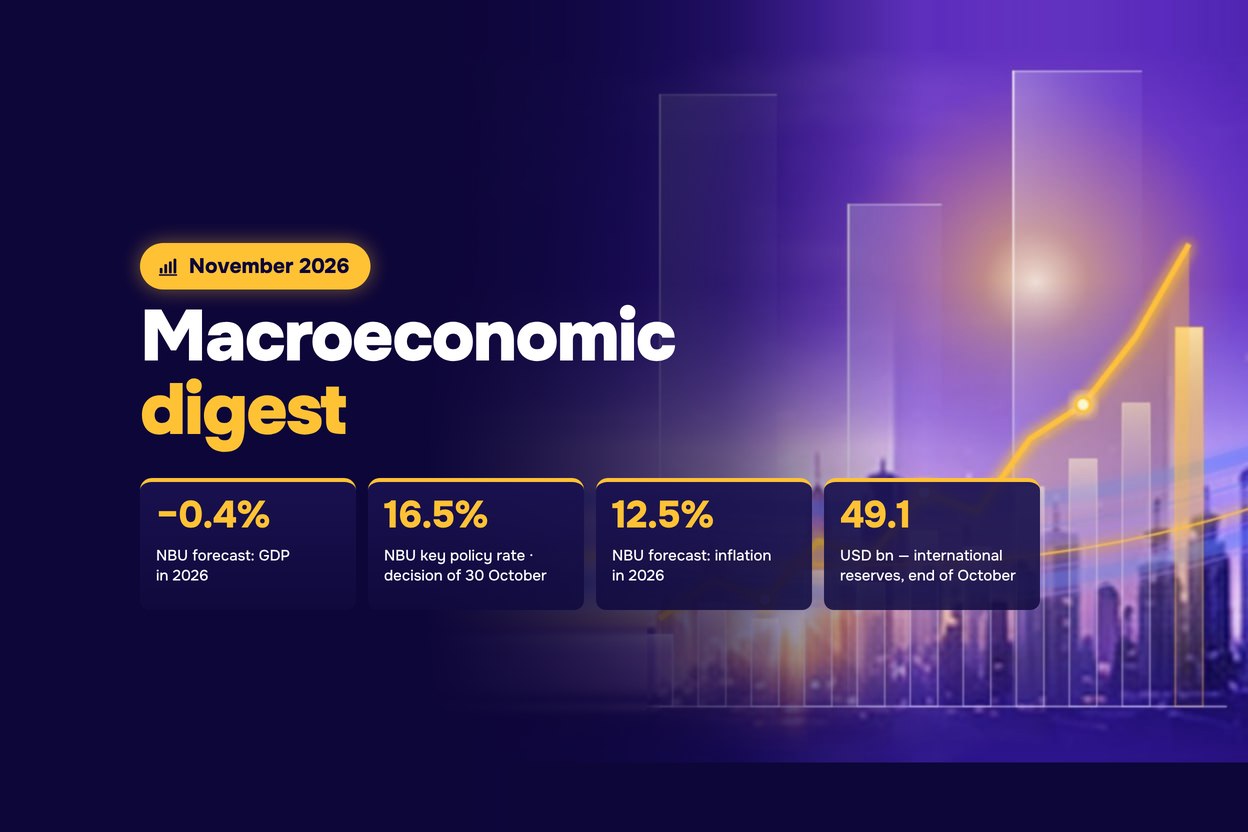
On 30 October, the Board of the National Bank of Ukraine (NBU) decided to raise the key policy rate from 16% to 16.5%.
The NBU lowered its 2026 GDP growth forecast from 1.8% to −0.4%. Its 2026 inflation forecast was raised from 10% to 12.5%. On 5 November, the NBU published its new Inflation Report, Q4 2026. The NBU’s forecasts are discussed in more detail in this digest.
On 4 November, Ukrstat published its preliminary estimate of GDP growth in Q3 2026. GDP decreased by 0.7%.
International reserves increased from USD 47.1 billion to USD 49.1 billion in October 2026.
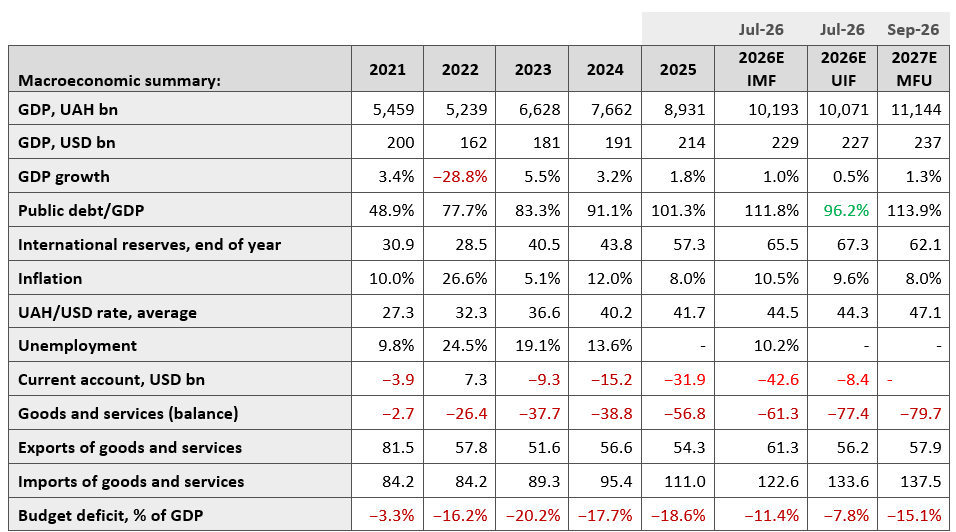
Source: Ministry of Finance, NBU. Ukrainian Institute for the Future (UIF) calculations.
Jul-26 2026E UIF — UIF calculations (July forecast for 2026)
Sep-26 2027E MFU — 2027 budget of 15 September 2026 from the Ministry of Finance, with UIF calculations; international reserves — NBU forecast (Inflation Report, Q4 2026)
The NBU lowered its 2026 GDP growth forecast from 1.8% to −0.4%.
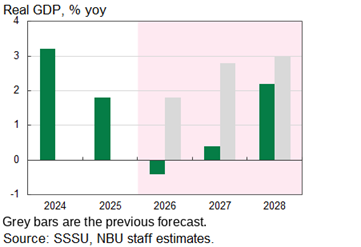
Actual and forecast GDP of Ukraine, 2024–2028. Source: NBU, Inflation Report, Q4 2026.
According to NBU estimates, real GDP contracted by 0.5% y/y in Q3. This was driven primarily by the consequences of the blockade of seaports and Russian attacks on production capacity and logistics. Metallurgical and mining enterprises suffered the heaviest losses. At the same time, performance also deteriorated in other industrial sectors, trade and agriculture. As a result, the NBU revised its 2026 real GDP forecast downwards to −0.4%. The deterioration of the forecast was driven mostly by the intensification of shelling, whose negative contribution to GDP is estimated at 1.9 pp.
Ukrstat estimated GDP growth in Q3. According to Ukrstat, GDP decreased by 0.7% in Q3.
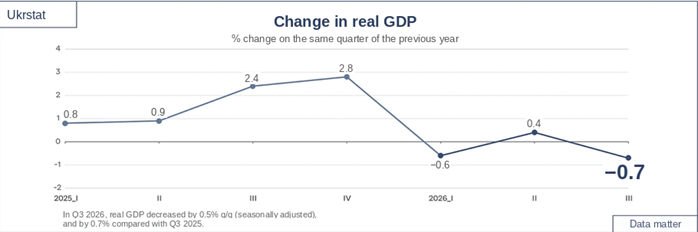
Source: Ukrstat.
Consumer price inflation in October 2026 stood at 1.8% compared with September and at 11.0% compared with October 2025.
Core inflation stood at 1.4% (compared with September 2026) and 9.7% (compared with October 2025).
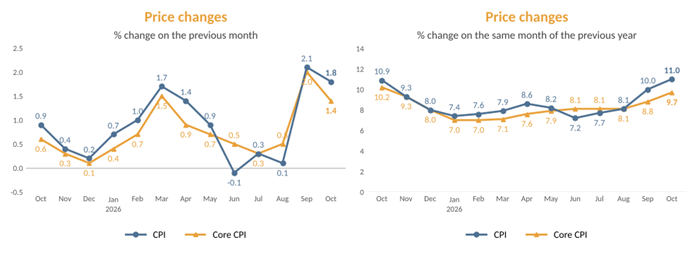
Price changes over the past 12 months. Source: Ukrstat.
In the consumer market, food and non-alcoholic beverage prices increased by 2.0% in October. Vegetables rose the most (by 10.2%). Prices for products of grain processing, sugar, rice, lard, fermented milk products, milk, cheese, fish and fish products, pasta, poultry, non-alcoholic beverages, bread and butter increased by 5.5–1.2%. At the same time, eggs and pork fell in price by 4.6% and 0.3%, respectively.
The 1.3% rise in prices (tariffs) for housing, water, electricity, gas and other fuels was mainly driven by higher tariffs for water supply (by 10.1%) and sewerage (by 8.8%).
Fuel and lubricants became 5.3% more expensive, and road passenger transport fares rose by 2.0%.
The NBU raised its 2026 inflation forecast to 12.5%. According to NBU estimates, the consequences of shelling alone will add around 0.7 pp to annual inflation. Other important factors affecting price dynamics include the effects of more expensive fuel and expanded budget stimulus.
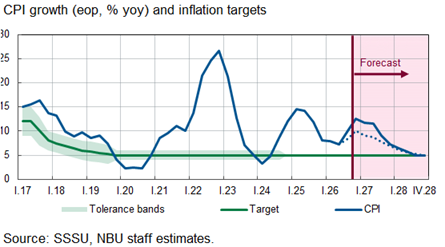
Inflation forecast. Source: NBU, Inflation Report, Q4 2026.
On 30 October, the Board of the National Bank of Ukraine decided to raise the key policy rate from 16% to 16.5% in view of a significant intensification of price pressures and worsening inflation expectations. This decision will support the attractiveness of hryvnia assets and the stability of the foreign exchange market, which will help keep inflation expectations and price dynamics under control. The NBU stands ready to respond flexibly to further changes in the balance of risks, taking into account both the persistence of price pressures and the likely effects of weakening economic activity.
The NBU noted that the course of the full-scale war remains the key risk to inflation dynamics and economic development, although a protracted conflict in the Middle East could also have a significant impact.
The NBU stands ready to respond flexibly to further changes in the balance of risks, taking into account both the persistence of price pressures and the likely effects of weakening economic activity.
The NBU’s forecast envisages keeping the key policy rate at its current level until Q2 2027. At the same time, the NBU will respond flexibly to actual developments, taking into account the impact of Russian attacks on inflation dynamics and economic activity.
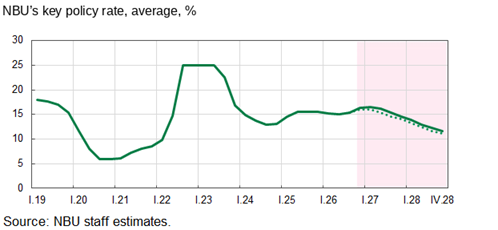
NBU rate. Source: Inflation Report, Q4 2026.
In September, the authorities began talking about delaying part of budget expenditure and shifting it to December. However, our analysis of consolidated budget expenditure in September shows no cuts. In September, consolidated budget revenues amounted to UAH 564 billion, of which UAH 200 billion were grants, while expenditure amounted to UAH 667 billion, of which UAH 395 billion went to defence.
We would highlight the following regarding budget execution for the first nine months of 2026:
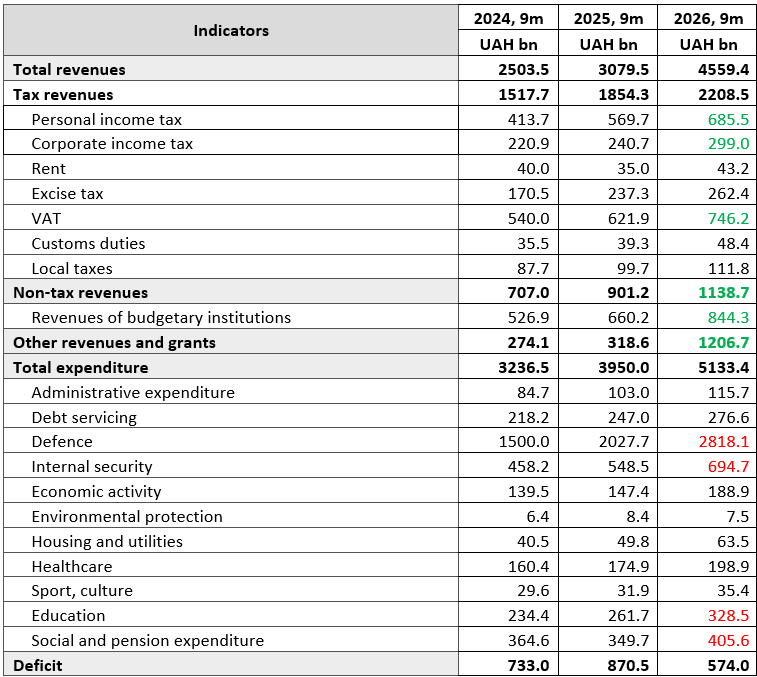
Source: Ministry of Finance
In October 2026, Ukraine received around USD 8.3 billion in financing from the following sources:
In addition, on 5 November Ukraine received the second EU tranche of EUR 3.7 billion, or around USD 4.1 billion, under the Ukraine MacroFinance programme. Including the second tranche, EUR 6.9 billion of the EUR 8.35 billion available under this programme has already been disbursed.
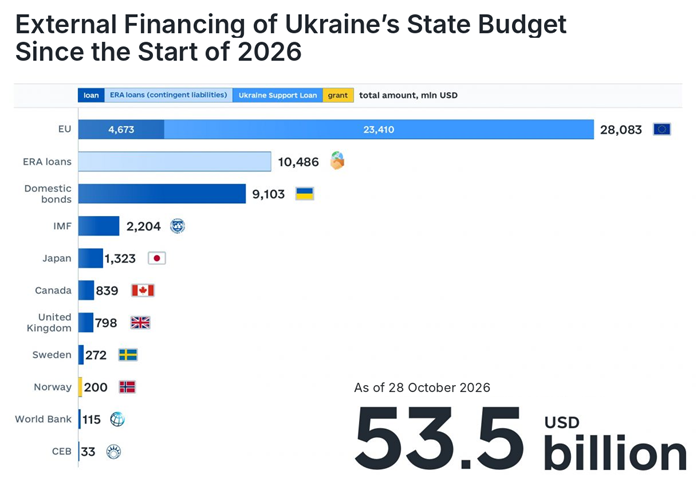
Source: Ministry of Finance of Ukraine.
In September 2026, Ukraine’s public and publicly guaranteed debt decreased from USD 215.5 billion to USD 212.6 billion (−USD 2.9 billion).
The debt decreased due to the revaluation of hryvnia-denominated debt against the US dollar (−USD 0.5 billion) and euro-denominated debt against the US dollar (−USD 2.7 billion).
The debt increased due to a loan received through World Bank accounts (+USD 0.8 billion).
The balance of payments was neutral in September 2026. The trade deficit set a new monthly record of USD 7 billion. However, we should also note the stabilisation of goods exports. In September, exports of goods rose from USD 2.35 billion to USD 2.73 billion, which is positive news.
Remittances from Ukrainians working abroad continue to decline and have already fallen to USD 400 million per month. This is 2.5–3 times less than before the start of the war in 2022.
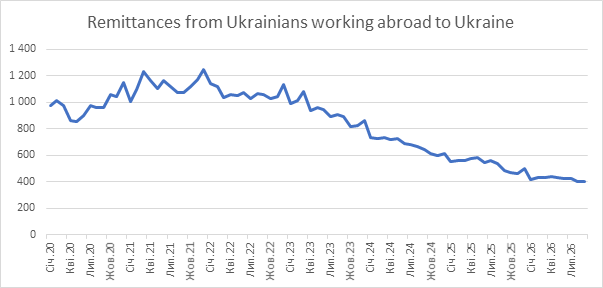
Source: NBU.
The financial account was positive at USD 1.2 billion in September. However, we should note growing household demand for foreign currency. While in summer the balance of foreign currency purchases and sales by households ranged from USD 490 million to USD 570 million per month, in September it reached USD 860 million.
Comparing the first three quarters of 2025 and 2026, we should note a record trade deficit, which has already reached USD 54 billion over nine months, against USD 39 billion. This increase was driven mainly by growth in imports of goods from USD 60 billion to USD 75.2 billion. Secondary income, which captures grant assistance, amounted to USD 38.8 billion in the first nine months of 2026, against USD 16.6 billion in 2025.
As a result, the current account for the first nine months was negative at USD 17 billion.
The financial account for the first nine months of 2026 was positive at USD 6.6 billion. Delays in EU financing led to a decline in international reserves.
In its Inflation Report, the National Bank updated its 2026 current account forecast, narrowing the projected deficit from USD 16.1 billion to USD 3.6 billion. The NBU thus expects large grant inflows in Q4 2026 to outweigh the widening trade deficit.
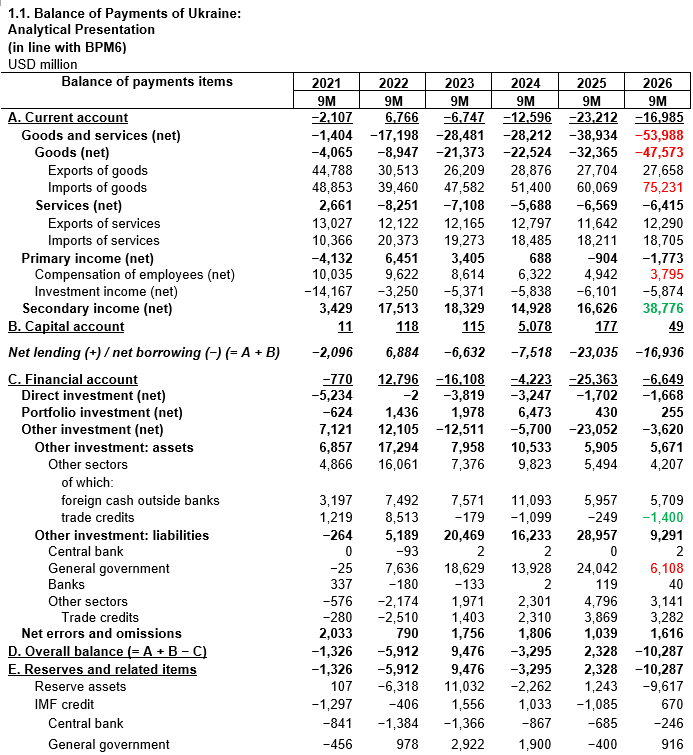
Source: NBU.
In October, the hryvnia crossed the politically significant mark of UAH 45 per US dollar, which the NBU had held for several months, so political decisions will now play a smaller role in exchange-rate formation.
We are optimistic about the hryvnia’s exchange rate against the US dollar in November. We believe that the delay in financing for Ukraine should finally end and that Ukraine should receive USD 25–30 billion in financing from the EU over the last two months of the year.
On 5 November, Ukraine received EUR 3.7 billion from the EU. Talks with the EU are already under way on the disbursement of around EUR 8 billion under the Ukraine Facility in November. This would add another USD 9 billion.
In addition, a further EUR 12 billion is expected from the EU for military procurement by the end of the year.
Accordingly, more than USD 13 billion, or even more than USD 15 billion, in Western financing may arrive in November. The hryvnia will therefore no longer be under pressure, as it was in October.
On the other hand, the NBU has raised its inflation forecast to 12.5% for the year, which means that it does not intend to curb inflation through a temporary strengthening of the hryvnia on the back of large external assistance.
Our baseline forecast for the UAH/USD rate in November is therefore 45.0–45.5.
As for the euro, the hryvnia strengthened against the euro in October owing to the strengthening of the EUR/USD rate, to 1.11–1.12.
Following the Democrats’ victory in the 3 November US elections, EUR/USD dynamics may change, and with falling oil prices the euro may start strengthening against the dollar again. In that case, a rate of 51–52 is expected. However, the baseline forecast is 50.5–51.5.
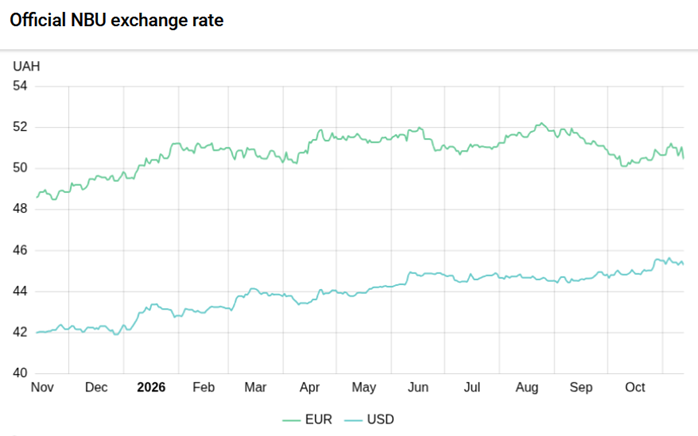
Hryvnia exchange rate against the USD and EUR over 12 months. Source: NBU.
International reserves increased from USD 47.1 billion to USD 49.1 billion in October 2026.
According to the balance sheet data, in October the NBU sold USD 6,051.2 million and bought USD 0.4 million on the foreign exchange market. Net sales of foreign currency amounted to USD 6,050.8 million.
In October, USD 3,690.5 million was received into the government’s foreign currency accounts at the National Bank, including:
USD 3,285.9 million — from the EU;
USD 404.6 million — through World Bank accounts.
In addition, Ukraine received USD 4.6 billion from the European Union under the defence tranche of the Ukraine Support Loan. These funds are not included in Ukraine’s international reserves due to their restricted (earmarked) purpose of use. However, if the government sells them to the National Bank for hryvnias for further use as intended, international reserves increase by the corresponding amount. In October, the government converted USD 4.6 billion of these funds into hryvnias, which accordingly contributed to the increase in international reserves.
USD 242.3 million was paid for servicing and repayment of public debt in foreign currency, including:
In addition, Ukraine paid USD 252.8 million to the International Monetary Fund.
The current volume of international reserves covers 4.2 months of future imports.
The NBU revised its forecast for international reserves at the end of 2026 downwards, from USD 69.7 billion to USD 62.8 billion.
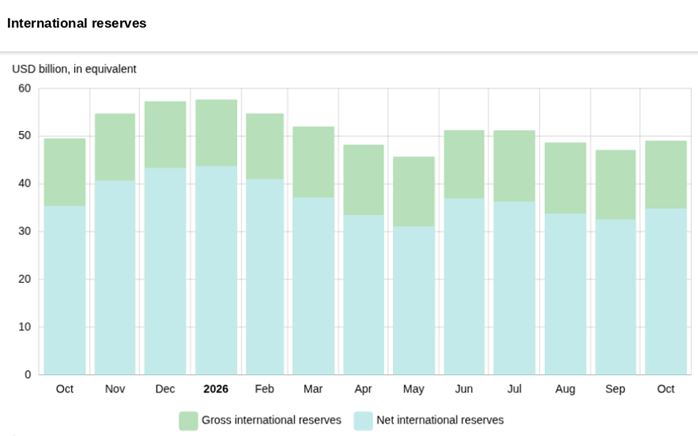
Change in international reserves over the last 12 months. Source: NBU.
10 December. UIF. New forecast of macroeconomic, budget and balance of payments indicators for 2026.
Verkhovna Rada of Ukraine. Adoption of the 2027 budget.
This publication was created by the Ukrainian Institute of the Future with the support of the Askold and Dir Foundation, administered by ISAR Unity as part of the project “Strong Civil Society in Ukraine – a Driver of Reforms and Democracy” funded by Norway and Sweden. The content of the publication is the responsibility of the Ukrainian Institute of the Future and does not reflect the views of the governments of Norway, Sweden, or ISAR Unity.



Together we can change the future! Your support allows us to continue our research and provide objective analysis of key social issues. Join us today to build the future of our generations together.
Support