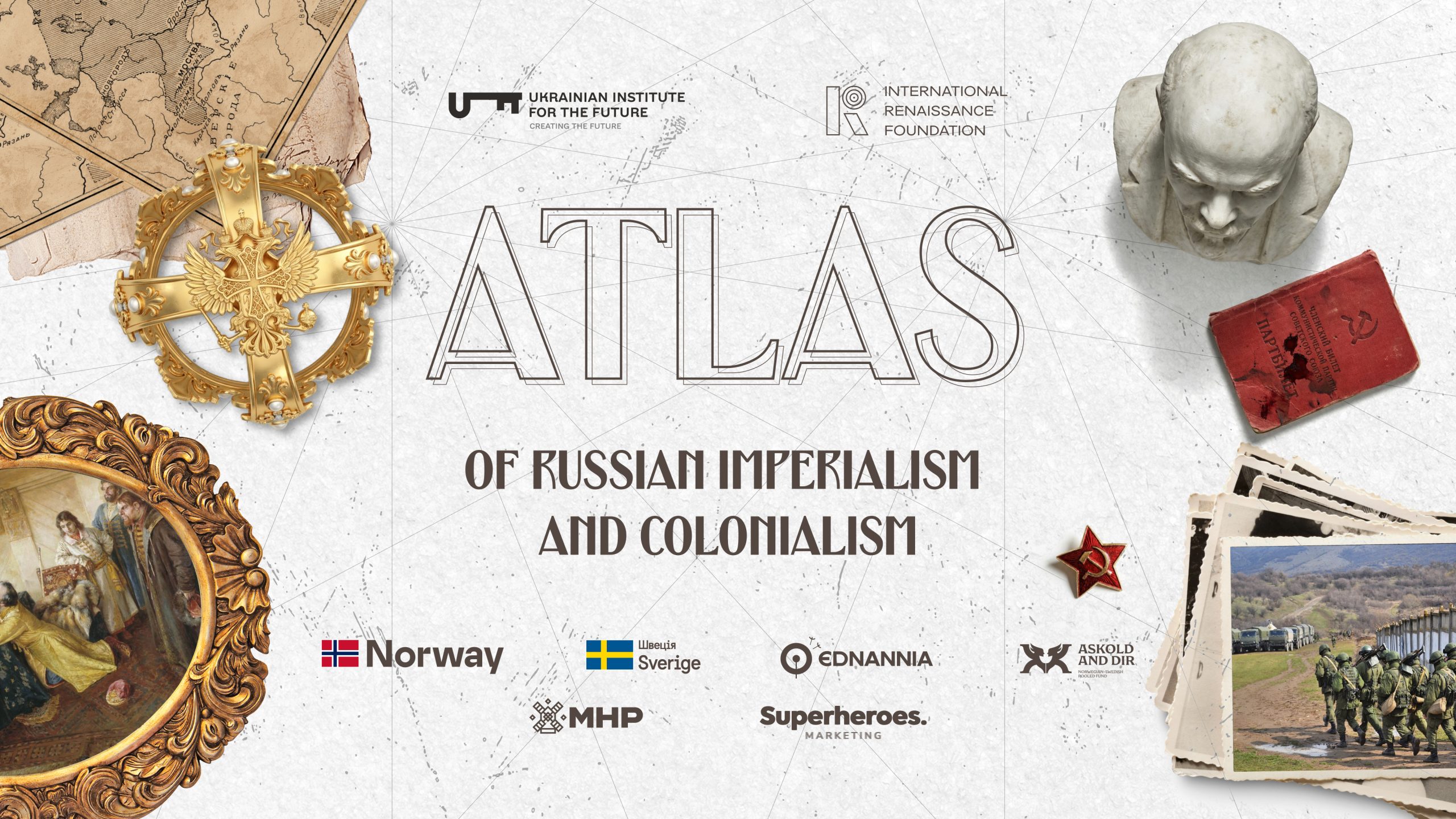
The Ukrainian Institute of the Future has published the Atlas of Russian Imperialism and Colonialism — the first cartographic study of five hundred years of Russian colonial and imperial expansion.
The Atlas was compiled by Serhii Hromenko, PhD in History, Head of the Historical and Cultural Policy Programme at the Ukrainian Institute of the Future and Junior Sergeant of the 14th National Guard Brigade “Chervona Kalyna.”
“Simply closing your eyes will not make Russia disappear. Those who believe a deep moat or a high wall will protect them are mistaken. So are those who refuse to look at Russia at all — who think that any engagement with this country weakens Ukraine. History has determined that we were, are, and will for some time remain neighbours of this state. No moat and no wall will shield us from Russian missiles, saboteurs, or — least of all — information warfare. That is precisely why studying Russia here and now matters,” said Serhii Hromenko at the Atlas launch.
Anton Hulidin, Chief Operating Officer of the Ukrainian Institute of the Future and project lead, outlined the publication’s distribution strategy:
“The Atlas is already available on the Ukrainian Institute of the Future’s website — free to view and download. A full English-language edition is forthcoming. Printed copies will be distributed to university libraries, history and political science departments, and secondary schools with specialist history programmes. The English edition will go to think tanks, diplomatic academies, and parliamentary committees in partner countries — the institutions where understanding of Russia is formed and where that understanding carries consequences.”
Hromenko expressed confidence that the Atlas would contribute to broader intellectual and policy discourse: “I hope this work will generate new analytical coverage in the media and inform new university courses on Russian imperialism. Russian studies programmes have already launched at a minimum of two Ukrainian higher education institutions — but that is clearly insufficient. Our diplomats abroad will also gain another instrument: one that helps them explain more precisely to senior officials in other countries what our struggle means and what Russian success would cost.”
About the publication
Spanning 55 chapters, the Atlas covers more than five centuries of history across over 200 pages of original maps and analytical texts. All maps are rendered at a uniform scale, allowing readers to trace the spread of Russian imperial influence across Eurasia as they move through the volume.
The publication is structured around four stages in the development of Russia as a colonial system: the Muscovite state, the Russian Tsardom, the Russian Empire, the Soviet Union, and the contemporary Russian Federation. Each stage is examined through three lenses: external expansion, internal colonialism, and the anti-imperial resistance of subjugated peoples — the last of which is presented with a degree of geographic granularity unprecedented in world historiography.
Key themes include: deportations as an instrument of state policy, with the earliest documented case dated to 1486 — long before Stalin; linguicide, meaning the destruction of languages without the physical elimination of their speakers; demographic engineering from sixteenth-century Kazan to the annexed Crimea and occupied Mariupol; and mechanisms of coercive control from the Oprichnina to the contemporary Rosgvardia.
Editorial team
Compiler: Serhii Hromenko, PhD in History, Head of the Historical and Cultural Policy Programme, Ukrainian Institute of the Future
Contributing authors:
- Yevhen Bulavka, publicist (chapters 52–54);
- Bohdan Korolenko, PhD in History (chapter 35);
- Iryna Vyshnia, PhD in History (chapters 26–30);
- Hryhorii Rii, PhD in Humanities (chapters 32–34, 38–40, 43–51, 55)
Peer reviewers:
- Yevhen Magda, PhD in Political Science, Director of the Institute of World Policy;
- Larysa Yakubova, Doctor of Historical Sciences, Head of the Department of Ukrainian History of the 1920s–1930s, Institute of History of Ukraine, National Academy of Sciences of Ukraine
Project lead: Anton Hulidin, Chief Operating Officer, Ukrainian Institute of the Future
The Atlas is available to view and download in PDF format on the Ukrainian Institute of the Future’s website.
The project is supported by the International Renaissance Foundation.
This publication was created by the Ukrainian Institute of the Future with the support of the Askold and Dir Foundation, administered by ISAR Unity as part of the project “Strong Civil Society in Ukraine – a Driver of Reforms and Democracy” funded by Norway and Sweden. The content of the publication is the responsibility of the Ukrainian Institute of the Future and does not reflect the views of the governments of Norway, Sweden, or ISAR Unity.