

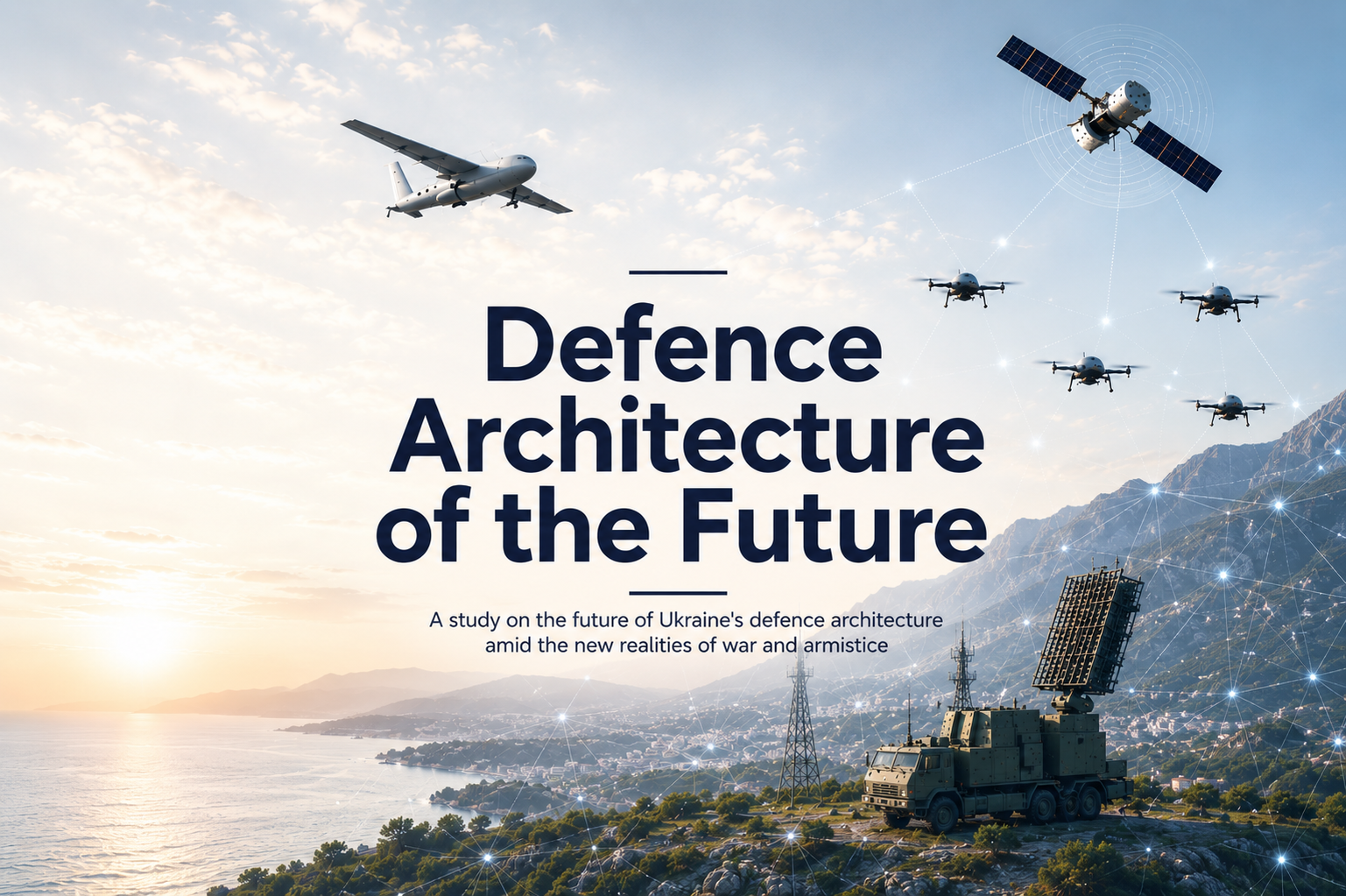
On 20 April 2026, at a briefing, President Zelensky reported: for the first time in the history of this war, an enemy position was taken exclusively by unmanned platforms — ground robots and drones. Not a single Ukrainian soldier was present on site. Two Russian servicemen surrendered to a machine.
The event illustrates large-scale change. Classic infantry warfare is giving way to autonomous systems, networked command, and the constant adaptation of tactics to the front. The Carnegie Endowment calls this a revolution in military affairs. But the state’s defence architecture — how it plans the budget, forms strategic documents, manages the defence-industrial complex — remains a model from the mid-2010s.
The Military Doctrine was adopted in 2004 and last updated in 2015 — to reflect the realities of Crimea and Donbas, before the full-scale invasion. The National Security Strategy was adopted in September 2020. The Military Security Strategy — in March 2021. The Defence Industry Strategy — in August 2021, still written for Ukroboronprom and the state core of the defence industry. None of these documents mentions drone warfare, cyber-kinetic attacks, hypersonic weapons in Russia’s arsenal, or armistice scenarios.
The Ukrainian Institute for the Future’s report “If we want peace, we must prepare for the war of the future” (Anatoliy Amelin, Executive Director and Co-founder of UIF, and Andriy Myroshnychenko, Co-founder of the DREAM Hub analytical centre) shows the scale of this gap and proposes how to close it before it becomes critical.
The window is narrowing to 12–18 months
Since August 2025, Ukraine has been in active ceasefire negotiations. Over nine months there have been six rounds, none of which ended with a signed agreement. August 2025 — the Trump–Putin summit in Anchorage, no result. October — the announced summit in Budapest was cancelled days before it was due to take place. November — Geneva worked on Witkoff’s 28-point plan, against the backdrop of a corruption scandal Andriy Yermak resigned. On 22 January 2026, Witkoff and Kushner met Putin in Moscow — no result on territory. In February, the second day of talks in Geneva was cut short after just two hours. In March, in Abu Dhabi, 157 Ukrainian prisoners were exchanged, but the main issues again went unanswered.
In parallel, in January 2026 in Paris, 35 participants of the European coalition of the willing, including 27 heads of state and government, agreed on five of their own post-war priorities: ceasefire monitoring, support for the Armed Forces of Ukraine, deployment of multinational forces, commitments in the event of renewed aggression, and long-term defence cooperation. Britain and France are already preparing military hubs in Ukraine.
Each round of negotiations reduces the amount of time Ukraine has for structural reform before an armistice becomes a fact.
Five armistice options — and not a single ready plan
The report’s authors model five armistice scenarios. Each requires a separate defence architecture:
- Korean-style, with a demilitarised zone — a stable front line, an army of 200–300 thousand, USD 40–50 billion in annual spending.
- A frozen conflict on the Transnistrian model — dependency, decline, instability.
- An armistice without recognition — 2–5 years of legal vacuum.
- Low-intensity hybrid war — modelled on the 150+ sabotage incidents in Europe since 2022.
- A new full-scale offensive — possible in 2028–2030 if Russia completes its army’s reconstitution.
Today, Ukraine is preparing mainly for the fifth scenario — active war. For the first four, there are neither strategic documents, nor resource allocation, nor institutional structures.
What happens if an armistice is signed before the architecture is updated
The report describes a transition that will happen automatically, without any additional decisions. The temporary martial law provisions — including CMU Resolutions No. 1097 and No. 1275, which underpin accelerated defence procurement — will lose effect together with the martial law regime. The codification time for a new weapons model will increase from 1–4 weeks to 6–18 months: in 2025 the Ministry of Defence admitted more than 1,300 new items into service (550+ UAVs, 270+ types of ammunition, 11+ armoured vehicles); without wartime provisions, such a number of admissions will become physically impossible — 30–50 per year.
The defence budget item, which stands at 27.2% of GDP in 2026, will shrink under the inertial scenario to 12–15% as early as 2027, and the domestic defence order will be halved. 80% of the Brave1 ecosystem’s companies will not pass the classic procurement procedure and will either close or relocate — Poland, Estonia, Lithuania and Czechia are already ready to take them in. This amounts to a loss of approximately USD 1.5 billion in private investment in defence tech. A separate risk of the inertial scenario is the outflow of 20–30 thousand engineering and research personnel by 2030.
Without a sustainable regulatory base, procurement will revert to the practices of 2014–2018: in 2028–2029 the authors expect 5–7 major corruption cases per year. Exports remain a monopoly of Ukrspetsexport — a lost USD 7–10 billion in potential annual revenue.
What UIF proposes
The document builds a transformation framework in three blocks:
- Strategic planning — move from the 2020–2021 documents to a flexible system with an annual review and a full cycle every four years, synchronised with NATO’s planning cycle.
- Defence-industrial policy — remove it from the procuring authority’s function, provide a unified architecture, and protect Ukrainian agency in global defence-tech chains.
- Transitional regime — legally define how Ukraine moves from martial law to a sustainable post-peace model.
Among the specific steps are a Strategic Defence Review modelled on the British approach, a separate Defence-Industrial Policy Agency modelled on South Korea’s DAPA, and a package of laws on a transitional defence regime.
Two scenarios through to 2030
Today, in 2026, Ukraine’s defence industry production capacity is estimated at USD 35 billion, drone production stands at 4 million per year, and defence industry exports are only just beginning. The report’s authors calculate where these indicators will lead by 2030 — depending on whether the framework described above is implemented or not.
If nothing changes:
- Defence sector GDP will fall to USD 15–20 billion
- Exports will remain at USD 1–2 billion per year — old Ukrspetsexport contracts, with no new ones
- Drone production will fall to 1.5–2 million per year
If the report’s recommendations are implemented:
- Defence sector GDP will grow to USD 60–80 billion
- Exports will reach USD 7–10 billion per year
- Drone production will grow to 8–12 million per year
The difference between the scenarios is USD 50–60 billion of GDP per year by 2030. The package of changes itself, according to the authors’ estimate, costs UAH 7–10 billion as a one-off amount and UAH 3–4 billion annually — 0.1–0.15% of the 2026 defence budget.
Who this document is for
The document is addressed to the Office of the President, the National Security and Defence Council, the Cabinet of Ministers, the Ministry of Defence, and the Verkhovna Rada Committee on National Security and Defence, as well as to partner audiences — NATO, the European Council, and Ukraine’s key bilateral partners.
Anatoliy Amelin, Andriy Myroshnychenko — Ukrainian Institute for the Future (https://uifuture.org). May 2026.
This publication was produced by the NGO “Ukrainian Institute for the Future” with the support of the Askold and Dir Fund, administered by ISAR Ednannia within the project “A Strong Civil Society of Ukraine — a Driver of Reforms and Democracy,” funded by Norway and Sweden. The content of the publication is the responsibility of the NGO “Ukrainian Institute for the Future” and does not reflect the views of the governments of Norway, Sweden, or ISAR Ednannia.