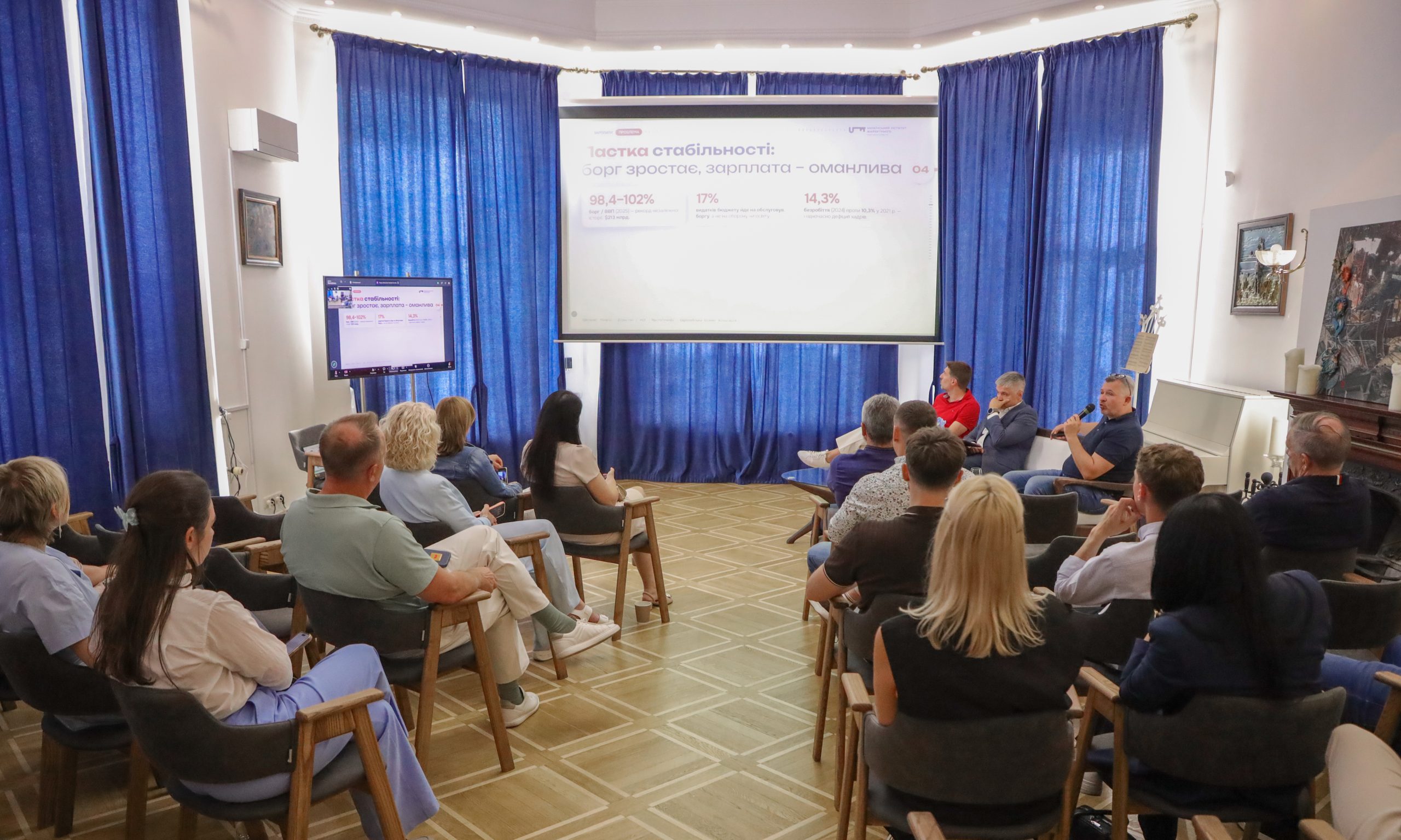
Last week, at a closed meeting of the Ukrainian Reform Club, the Ukrainian Institute for the Future unveiled its new study “35 Years of Ukraine’s Independence: Economic Results 1991–2026”. The meeting was held under the Chatham House Rule, so UIF is publishing only a summary of the discussion without attributing individual remarks.
Speakers: Anatoliy Amelin, Executive Director and Co-Founder of the Ukrainian Institute for the Future; Ihor Koliushko, Chairman of the Board of the Centre of Policy and Legal Reform; Vadym Prystaiko, diplomat and Minister of Foreign Affairs of Ukraine in 2019–2020. The discussion was moderated by Vladyslav Antypov, founder and CEO of the Center for Ecology and Development of New Technologies.
The conversation covered the economy, state institutions and security. The theme running through the meeting: those who do not understand the past cannot shape the future.
Economy. Ukraine remains the only country in Europe where real GDP per capita is still below its 1991 level. At the start of independence the gap with Poland stood at roughly 6%; today Poland’s GDP per capita is 2.4 times higher than Ukraine’s. Five interconnected systemic traps continue to constrain Ukraine’s development, and the authors estimate the cumulative cost of postponed reforms and forgone opportunities at $480–950 billion.
Politics and institutions. Over 35 years Ukraine has seen 21 governments, and none maintained a long-term development strategy beyond a single electoral cycle. Participants named the absence of public consensus on the country’s direction, poorly prepared reforms, and limited capacity to design policy for the long run.
Security. External aggression explains only part of Ukraine’s current predicament; much of it has followed from decisions made at home. Participants pointed to several historical episodes when Ukraine accepted weaker arrangements instead of firm security guarantees.
The shared conclusion of the discussion: Ukraine has learned to unite in the face of existential threats, but not yet to consolidate around a long-term development goal. This is where participants see the task ahead for the state and the expert community.
The Ukrainian Institute for the Future will present the study publicly on 13 August 2026.
This publication was produced by the NGO “Ukrainian Institute of the Future” with the support of the Askold and Dir Foundation, administered by ISAR Ednannia within the project “A Strong Ukrainian Civil Society — A Driver of Reform and Democracy,” funded by Norway and Sweden. The content of this publication is the sole responsibility of the NGO “Ukrainian Institute of the Future” and does not represent the views of the governments of Norway or Sweden, or of ISAR Ednannia.