Over 35 years of independence Ukraine has accumulated $54.6 billion in foreign direct investment. Poland, which started from a comparable position in the early 1990s, has 345.2 billion. Per head of population: $1,516 against 9,100.
https://unctad.org/system/files/non-official-document/wir_fs_pl_en.pdf · https://data.worldbank.org/indicator/BX.KLT.DINV.CD.WD?locations=UA
The state responds in the only way available to it: it creates new instruments. Free economic zones in the 1990s, industrial parks in 2012, UkraineInvest in 2016, investment nannies in 2021, Diia.City in 2022, Brave1 in 2023, Defence City in 2026. More than fifteen regimes, agencies and funds in three and a half decades. The capital has not followed.
We assessed each of these designs against a single framework: mandate, stated KPIs, verified result, reason for failure. Two of them work systematically: Diia.City and Brave1. Both operate where the investor needs no land, no grid connection and no physical security. What we are dealing with is no longer the failure of an individual programme but a defect in the design, one that reproduces itself regardless of who holds power and whether the country is at war.
The gap opened before the first shots
Between 2005 and 2013, in peacetime, Ukraine attracted around $7.3 billion a year, 49% of the Polish rate. And even that money was foreign mainly by passport: the share of round tripping, Ukrainian capital returning through Cyprus, reached 68.5% of inflows in 2021. The war of 2022 did not create this defect. It exposed it.
https://data.worldbank.org/indicator/BX.KLT.DINV.CD.WD?locations=UA · https://bank.gov.ua/admin_uploads/article/FDI_round_tripping_ICL-DFS_pr.pdf
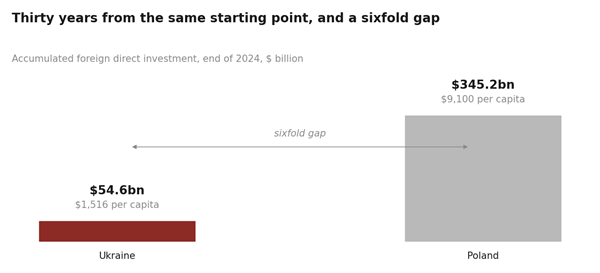
Figure 1. Accumulated FDI, end of 2024. UNCTAD WIR 2025 (unctad.org), World Bank (data.worldbank.org).
The root cause is institutions.
The World Bank’s Rule of Law index put Ukraine at 44.6 out of 100 in 2024, exactly where it stood in 2013.
Two Maidans, two waves of reform, an anti-corruption architecture built from nothing, and a range of 41 to 47 that the index has never once left since measurement began in 1996. No benchmark country has achieved comparable results with a score below 65. The gap with Poland is 22 points, and an investment committee sees that figure before it sees any Ukrainian presentation.
https://www.worldbank.org/en/publication/worldwide-governance-indicators · https://databank.worldbank.org
What has been built and what works
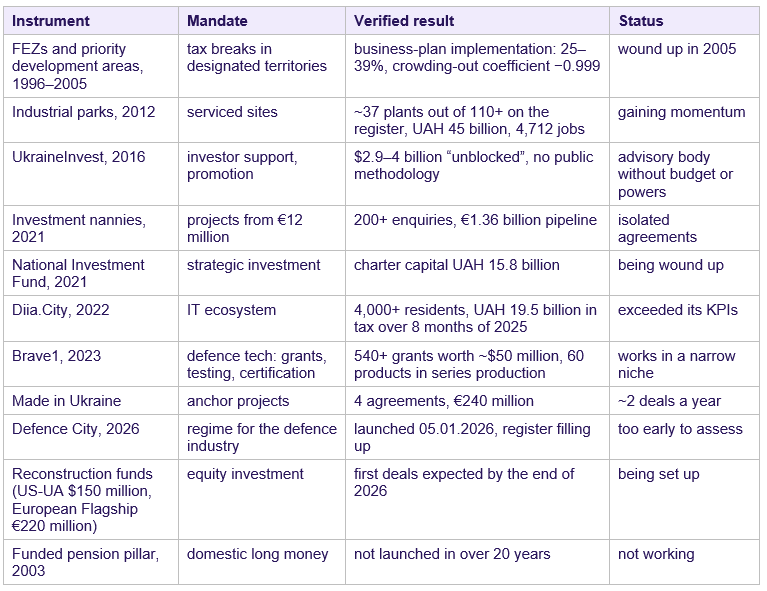
Table 1. The table sets out eleven key positions; with sectoral sub-regimes and territorial constructions that did not survive to 2026, the list exceeds fifteen. Texts of the laws (rada.gov.ua), me.gov.ua, kmu.gov.ua, tax.gov.ua, nif.gov.ua.
Of the eight instruments whose results can be measured at all, one has cleared the 60% KPI delivery mark.
The reasons differ every time. The design does not.
UkraineInvest has neither a budget for incentives nor the right to take decisions: it announces billions in unblocked investment while withholding its methodology, so the figure cannot be checked. By comparison, Poland’s PAIH supported projects worth €7.4 billion in 2023 and publishes how it calculates them.
The investment nannies have investor interest and no conversion: the first special investment agreement, Astarta at €76.6 million, was signed as late as October 2024; the bottleneck was the limited capacity of the procedure itself. The free economic zones of the 1990s produced a crowding-out coefficient of minus 0.999: every hryvnia brought into a zone knocked a hryvnia out of the rest of the region.
https://ukraineinvest.gov.ua · https://www.paih.gov.pl · Cabinet of Ministers Order No. 945-r of 04.10.2024 · Kachur, KMA, 2002
Defence City came into operation on 5 January 2026 with defects built in at the design stage: a criminal-record requirement that almost no large Ukrainian manufacturer satisfies cleanly, a turnover threshold that cuts out SMEs, VAT asymmetry working against domestic subcontracting, and a ban on dividends. The risk is obvious: a regime for a few dozen large players instead of hundreds of drone start-ups, precisely the opposite of the intent.
The two exceptions look like this. Diia.City: more than 4,000 residents as of April 2026, their number doubling over 2025, around 148,000 specialists, UAH 19.5 billion in taxes over eight months of 2025.
In two years Brave1 has issued more than 540 grants worth around $50 million and taken 60 products into series production; according to the cluster, Ukrainian defence tech start-ups raised $105 million of private capital in 2025.
https://city.diia.gov.ua/registry/resident · https://tax.gov.ua · https://ukrainesarmsmonitor.substack.com/p/brave1-the-engine-behind-ukraines
The obvious objection is that both regimes work simply because they hand out a tax break. They do not. Industrial parks have tax breaks, so does Defence City, so did the former free economic zones, and it produced no result.
Diia.City and Brave1 win on something else: a guarantee that the terms will not change, and a fast process, in a segment where the investor needs no land, no grid connection and no physical security. IT is mobile and asset-light, defence tech is quick to move and largely grant-funded. A factory needs something different, and neither of these two regimes provides it or was ever meant to.
The quiet killers
Rankings measure the de jure. Deals are killed by the de facto. These constraints have consistently fallen out of earlier diagnostics, although they are what decides the fate of every individual transaction.
Money is artificially expensive. The policy rate has stood unchanged at 15% since January 2026 against inflation of 8.2%, giving a real rate of roughly plus 7 percentage points. I understand the NBU’s logic, inflation has to be contained; the economy pays the price.
Credit to the private sector stands at 18% of GDP against more than 60% in Slovakia, while Ukrainian banks park liquidity in certificates of deposit and government bonds, earning rent instead of lending.
https://bank.gov.ua · https://www.epravda.com.ua
The currency regime is a trap. The ceiling on dividend repatriation is €1 million per month per investor; above that, only what has just been paid into charter capital can be taken out.
For an investor with $50 million and a 15% ROI this stretches repatriation over six to seven years, and the loss of NPV at a 12% discount rate reaches 33–38%.
In four years only one year of dividends has been unblocked, 2022 dividends remain frozen, and there is no public timetable for lifting the restrictions. What has no date cannot be built into a financial model.
NBU Resolutions No. 18, No. 56, No. 95 · https://bank.gov.ua
There is neither a capital market nor long money. Capitalisation fell from around 30% of GDP in 2010 to around 1% by 2024; across the whole of 2024 the National Securities and Stock Market Commission registered 60 share issues and 38 bond issues worth UAH 5.08 billion, and banks hold around 76% of financial assets.
An IPO is out of the question, exit is blocked, and any large deal escapes to the Netherlands, Cyprus or London. The funded pension pillar was written into law back in 2003 and has still not been launched; there are 57 private pension funds with negligible assets. Ukraine simply has no class of local institutional co-investors of the kind that creates demand for long-dated debt in Poland and Estonia, and without it there is no non-recourse project finance, which is what reconstruction is made of.
https://www.nssmc.gov.ua · https://www.oecd.org · https://zakon.rada.gov.ua/laws/show/1058-15
A court ruling can be won but not enforced.
Over 2024 the enforcement service processed documents worth UAH 2.5 trillion and actually recovered UAH 25.5 billion, 1.15% of what was awarded. Raiding, meanwhile, has changed method rather than disappeared: fewer criminal proceedings (323 against 597 in 2021), but 1,722 complaints to the Anti-Raider Office, 42% more than before, 86% of them concerning real estate.
The raider has traded the assault rifle of the 1990s and 2000s for a forged power of attorney and access to the state register through a registrar. Add pressure from law enforcement: of roughly 1,200 complaints to the Business Ombudsman Council over 2024–2025, tax matters account for 61%, while complaints about the Bureau of Economic Security have tripled. When the national court does not work, the dispute goes to arbitration: 31 investment disputes against Ukraine, tenth place in the world, claims of $23.5 billion.
https://ae.org.ua · https://opendatabot.ua · https://boi.org.ua · https://investmentpolicy.unctad.org/investment-dispute-settlement
None of these barriers is fatal on its own. Together they lock into one another and create a perfect storm: currency restrictions impede the movement of capital, the absence of a market blocks fundraising and exit, pressure from law enforcement creates a risk that cannot be hedged, and tax volatility destroys predictability over a five to ten year horizon. Structuring through foreign jurisdictions governed by English law is a rational response to all four at once.
Debt against equity: more than 50 to 1
In 2025 Ukraine raised $52.4 billion in external financing, a record. More than 70% of it (37.9 billion) was ERA Loans, debt secured against income from frozen Russian assets. Within total external financing the grant component amounts to 1.3%, debt obligations to 98.7%.
https://mof.gov.ua · https://www.kmu.gov.ua
The headline direct investment figure rests on two illusions. The first is reinvested earnings, 64.7% of the 2024 inflow: not new money but profit stuck in the country because it cannot be taken out as dividends. The second is round tripping: $603 million, or 38.3% of the net inflow in 2025.
These two adjustments have different bases and the shares cannot be added together; but once both are stripped out in sequence, real new foreign capital comes to $0.4–0.9 billion a year, the level of a small Balkan country rather than an economy of 37 million people.
https://bank.gov.ua/admin_uploads/article/FDI_round_tripping_ICL-DFS_pr.pdf
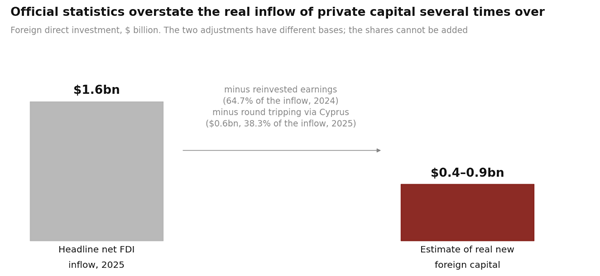
Figure 2. From headline inflow to real new capital, 2025. NBU (bank.gov.ua); estimate of real new capital, authors’ calculation.
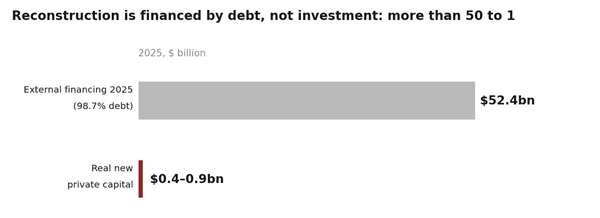
Figure 3. Structure of external financing in 2025 against fresh private FDI. mof.gov.ua, kmu.gov.ua, bank.gov.ua.
Debt is serviced at the expense of future generations, and it brings no technology, no markets and no management.
Direct investment brings all of that, since the investor’s return depends on how the asset performs rather than on a payment schedule.
The World Bank puts reconstruction needs at $524 billion (RDNA4) and 588 billion (RDNA5). Debt secures survival; growth is secured by investment.
https://www.worldbank.org/en/country/ukraine
The cost of inaction can be measured
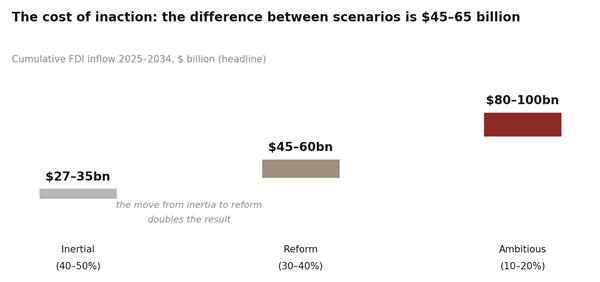
Four independent sources across 2024–2026 converge on the same point: legal insecurity and tax instability are the dominant barriers.
1. The EBA Investment Attractiveness Index stands at 2.70 out of 5 in 2025, and over 17 years of measurement it has never once risen above 3.0.
2. At AmCham, the rule of law has become priority number one: from 53% to 86% in a year.
3. UNDP, on a sample of 628 enterprises: 80% of SMEs do not consider foreign capital at all.
4. The Business Ombudsman Council records the same themes in the structure of complaints.
https://eba.com.ua · https://chamber.ua · https://boi.org.ua
No survey captures what matters most. Every sample consists of those who survived: companies already in the market. Nobody asks the investors who looked at Ukraine and decided not to come.
| Parameter | Ukraine | Poland | Romania | Estonia |
| WGI Rule of Law (0–100) | 44.6 | 66.9 | 63.4 | 82.5 |
| Corporate profit tax | 18% / 9% special regimes | 19% / 9% for SMEs | 16% | 0% on undistributed profit |
| Currency convertibility | ceiling of €1 million a month | free | free | free |
| Capital market | ~1% of GDP, absent | developed (GPW) | functioning (BVB) | Nasdaq Baltic |
| CPI 2025 (rank) | 36 (104th) | 53 (52nd) | 45 (70th) | in the top 15 |
| Investment promotion agency | UkraineInvest (advisory) | PAIH (+ grants) | InvestRomania | digital public services |
Table 2. Systematic comparison with countries competing for capital. World Bank WGI, ti-ukraine.org, paih.gov.pl, national tax codes.
The central shift we propose is from incentives to guarantees. An investor will not enter a country with courts that do not work and credit that is out of reach, even at a zero tax rate, and none of the recommendations below works in isolation: every unresolved layer cancels out progress on the rest.
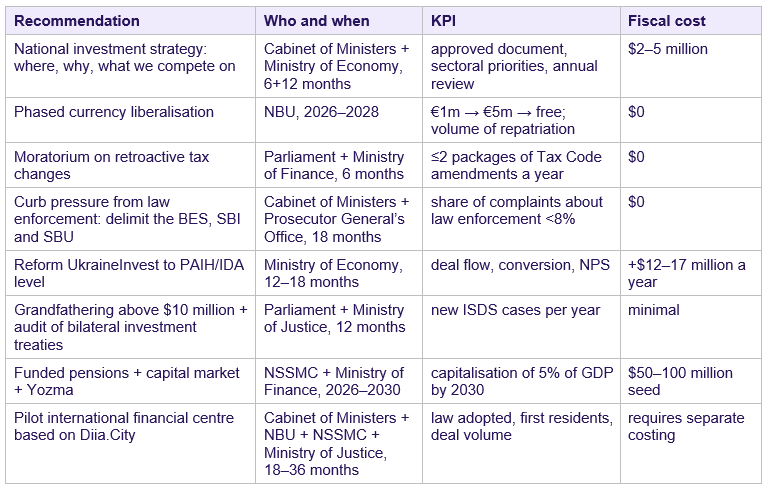
Table 3. Roadmap. Sequenced on the principle of maximum signalling effect at minimum wartime risk.
The first three items after the strategy cost the budget nothing: currency liberalisation, a moratorium on retroactive tax changes, and delimiting the powers of the law enforcement bodies. The strategy itself costs $2–5 million, a rounding error against 52 billion of external financing. We have also set review thresholds: if real new FDI fails to exceed $2 billion for two years running, a more radical model is needed; if WGI does not break past 50 and the EBA index does not break past 3.0, the reforms have not worked.
A jurisdiction within a jurisdiction
Institutional reform is the work of decades. The rule of law index has not moved in eleven years, and there is no basis for expecting the next five to deliver a leap from 44.6 to 65+. Countries that faced the same problem did not rely on nationwide institutional reform alone: Dubai, Abu Dhabi, Astana and Casablanca created international financial centres, zones bounded by a perimeter with their own legal regime based on common law, their own courts and arbitration, a separate financial regulator and a special currency regime. The investor gets familiar law and a predictable court without waiting for the country to rebuild its institutions in full.
This is not a replacement for reform but a fast lane while reform runs its course.
The difference from our free economic zones is fundamental. The zones sold a tax break within a territory and delivered pure redistribution instead of new capital.
A financial centre sells a jurisdiction: law, courts, a regulator, convertibility. The tax regime there is secondary.
The closest Ukrainian prototype already exists. Diia.City is the only regime that guarantees terms will not change for 25 years, works through the legal status of a resident rather than through territory, and has exceeded its own KPIs.
It has proved the main point: the “jurisdiction, not real estate” design works in Ukraine, and works in wartime. The next step suggests itself: not multiplying sectoral “cities” to suit every lobbying request, but building into Diia.City what it lacks, namely its own court and arbitration, a separate financial regulator, a currency regime without a repatriation ceiling, and access to capital market instruments.
https://zakon.rada.gov.ua/laws/show/1667-20 · https://city.diia.gov.ua/registry/resident
What such a centre costs, how many years it takes to pay for itself and what measurable effect it has on capital inflows are questions we are taking into a separate study. Also outside the scope of this diagnostic are sectoral strategies, a mechanism for guaranteeing war risks (BlackRock halted a $2.5 billion fund precisely because there was none), and the institutional design of a new-generation agency.
We are not waiting for peace: there is no investment architecture during the war and there was none before it. Peace by itself will change nothing. It will only take away the last excuse.
The opinions, assessments, and conclusions presented in this article are the author’s personal views and do not necessarily reflect the official position of the Ukrainian Institute of the Future, its partners, or its donors.