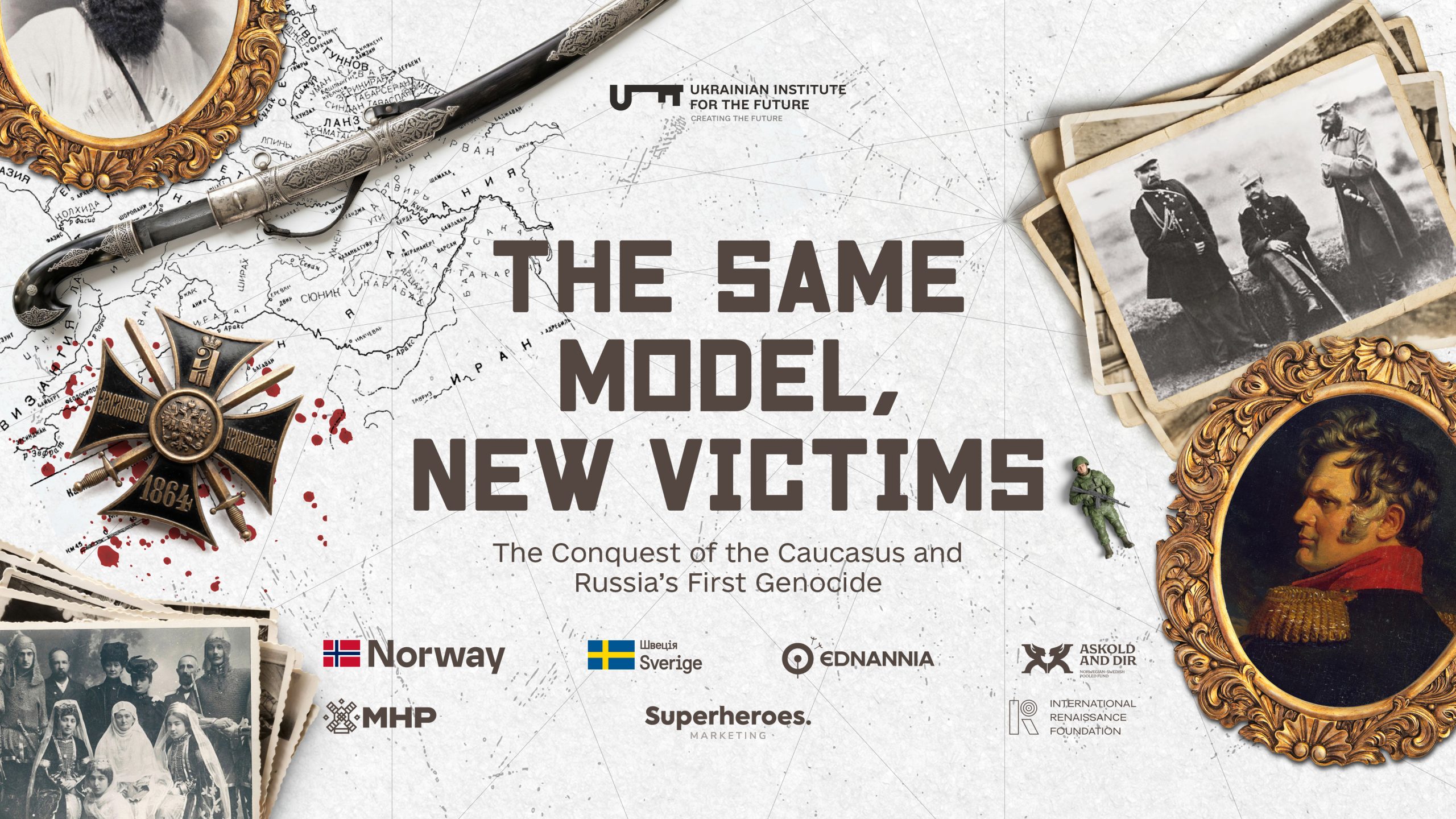
Series “Anatomy of an Empire” │ Ukrainian Institute of the Future
This material was prepared as part of work on the “Atlas of Russian Imperialism and Colonialism” — a UIF publication forthcoming this year.
This piece addresses the following questions:
→ How long the Caucasian War lasted — and why it remains so little known internationally
→ What the Imamate of Shamil was — a state Russia took thirty years to destroy
→ What happened to the Circassians after 1864 — and why researchers call it genocide
→ Of 300,000 Kabardians, 35,000 remained — where did the rest go
→ How this logic recurs in Chechnya, Syria, and Ukraine
A War That Seems Not to Have Happened
1864. The Caucasian War officially ended. In St. Petersburg — celebrations, decorations, triumph. Russia had finally subdued the Caucasus after more than half a century of fighting.
What followed left almost no trace in official Russian historiography. Expulsions. Mass killings. The flight of hundreds of thousands across mountains and sea — to Turkey, Syria, Jordan.
The Circassians, Adyghe, Ubykh, and Abkhaz — the peoples who had inhabited the Northwest Caucasus — were almost entirely displaced from their lands. Within a matter of years.
The international Circassian diaspora today numbers over five million people. Fewer than 700,000 live in the homeland.
This is the consequence of what happened in 1864 and after. Researchers increasingly describe it as genocide.
The Caucasian War: Forty-Seven Years of Resistance
The Caucasian War officially lasted from 1817 to 1864. Nearly five decades.
Longer than any other colonial war Russia fought. Longer than the conquest of Siberia. Longer than the subjugation of Central Asia.
The Caucasus did not yield.
The primary reason was terrain. Conventional military tactics did not function in these conditions. Columns stalled in gorges. Fortresses in the foothills provided no control over the passes. Local fighters knew every slope.
General Yermolov, appointed to command the Caucasian Corps in 1816, understood that conventional methods could not prevail. He proposed a different approach: the systematic destruction of villages, the clearing of forests where fighters sheltered, and the mass resettlement of entire communities from the mountains to the plains — under garrison control.
“I desire that the terror of my name should guard our frontiers more powerfully than chains or fortresses,” he wrote. This was not rhetoric. It was strategy.
The Imamate: A State That Took Thirty Years to Destroy
In 1828, a Murid movement emerged among the Chechens and Dagestanis — a Sufi order that combined religious practice with organized armed resistance. The followers of Ghazi Muhammad, and then of Shamil, were not merely fighting; they were building a state.
The Imamate of Shamil (1840–1859) was a functioning state with its own administration, a justice system based on sharia, an army, and a diplomatic presence. Shamil sought contact with Britain and the Ottoman Empire and appealed to the international community.
Throughout the 1840s and early 1850s, the Imamate held its own against the regular Russian army. Russia deployed additional corps to the Caucasus, rotated commanders, and built new lines of fortifications.
Only in 1859, after a prolonged siege, did Shamil surrender. He was taken prisoner, transported to St. Petersburg, presented to Alexander II — and released to live in Kaluga. He died in 1871 during the hajj, in Medina.
But the subjugation of Chechnya and Dagestan was not the end of the Caucasian War. It was the first half.
1864: What Came After Victory
After the Imamate’s defeat, the Northwest Caucasus remained: the Circassians, Adyghe, Ubykh, and Abkhaz. They fought differently — without centralized command, through an extended network of clans. This made them a more difficult target for conventional forces, but also precluded unified diplomacy.
In 1864, organized armed resistance in the Northwest Caucasus was suppressed.
Then the expulsions began.
This was not spontaneous brutality. It was a deliberate decision: the mountain peoples, who would never accept Petersburg’s authority, were to vacate their lands. Or — relocate to the plains under garrison control and gradually dissolve among the settlers.
Most chose emigration. Not because they wanted to — because no other path remained.
Hundreds of thousands set out for the Ottoman Empire. Along the way — through the mountains in winter, then by sea — thousands died. The Ottoman government, unprepared for the scale of the influx, could provide neither adequate food nor shelter. Mortality in the receiving camps reached tens of percent.
The Ubykh — a people whose language is considered among the world’s most complex in terms of consonant inventory — disappeared almost entirely. The last fluent speaker of Ubykh, Tevfik Esenç, died in Turkey in 1992.
Figures That Are Difficult to Absorb
The Kabardians. Before Russia’s conquest of the Caucasus: 300,000 people. By the second quarter of the nineteenth century: 35,000 remained. The rest had perished or fled.
The Abkhaz. Estimates indicate that from the early to the late nineteenth century, the population fell by more than two-thirds — from several hundred thousand to under 70,000.
The Adyghe and Circassians overall. Different researchers cite figures ranging from 400,000 to over a million killed or expelled in the 1860s–1870s.
The vacated lands were settled by Cossacks, then by migrants from Russia’s interior provinces. Place names were changed. Mountain and river names — in part as well.
In 2011, Georgia officially recognized the events of 1864 as genocide of the Circassian people. Russia has no official position.
Chechnya: The Same Logic a Century Later
In 1944, Stalin deported the Chechens and Ingush — 490,000 people in a matter of weeks. The official pretext: collaboration with the Nazis. The real reason: a people that had never accepted central authority was a threat.
This is the same logic as 1864. If a people cannot be subdued, it must be removed or destroyed as a community.
When the Chechens returned in 1957, they found their homes destroyed, their cemeteries razed, the names of their villages replaced.
The First and Second Chechen Wars of 1994–2009 are a continuation of the same unending Caucasian War. The same geography, the same tenacity of the mountains, the same Moscow tactic: mass bombardment in place of Yermolov’s deforestation, but the same objective — destroy resistance by destroying the environment and the population. The UN declared Grozny in 2000 the most destroyed city on earth.
What Remains Constant
There is a model that recurs in the Caucasus across two centuries: a people that resists is not merely defeated in battle — it is targeted for elimination as a subject. Through deportation, expulsion, demographic displacement, and the destruction of cultural markers: place names, languages, cemeteries.
This logic is not exclusive to the Caucasus. The Mari after the Cheremis Wars. The Nogais after 1783. The Crimean Tatars in 1944. Mariupol in 2022.
Total destruction as a strategy of control is not an anomaly in Russian colonial practice. It is one of its consistent elements.
The difference between Yermolov and Putin is not in methods. It is in scale — and in the cameras recording everything.
A piece from the “Anatomy of an Empire” series. The series is based on the “Atlas of Russian Imperialism and Colonialism” — a major UIF research project forthcoming in print and digital format.
This text was prepared with the assistance of artificial intelligence on the basis of the “Atlas of Russian Imperialism and Colonialism.” This project is implemented with the financial support of the International Renaissance Foundation.
This publication was produced by the NGO “Ukrainian Institute of the Future” with the support of the Askold and Dir Foundation, administered by ISAR Ednannia within the project “A Strong Ukrainian Civil Society — A Driver of Reform and Democracy,” funded by Norway and Sweden. The content of this publication is the sole responsibility of the NGO “Ukrainian Institute of the Future” and does not represent the views of the governments of Norway or Sweden, or of ISAR Ednannia.