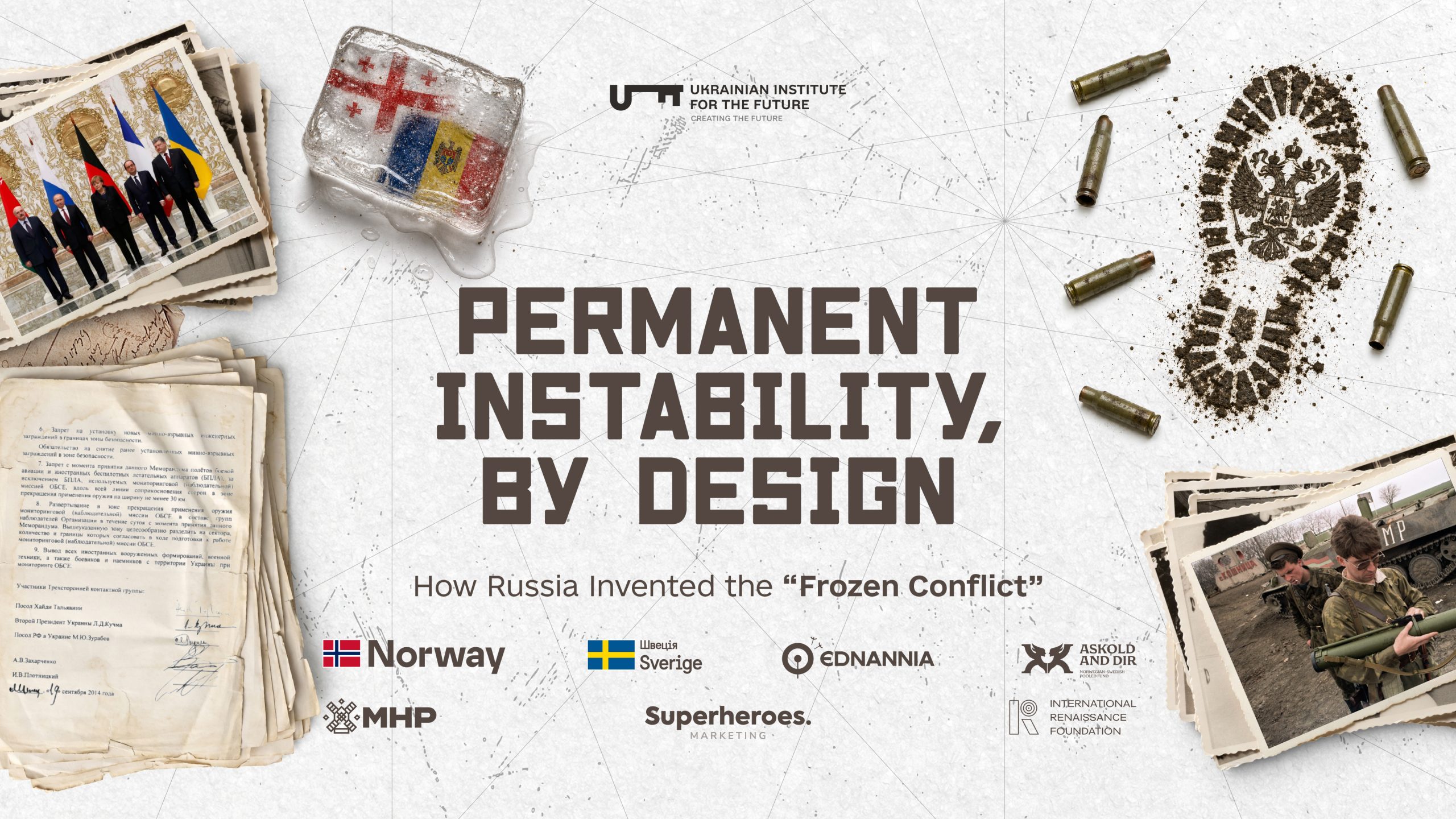
Series “Anatomy of an Empire” │ Ukrainian Institute of the Future
This material was prepared as part of work on the “Atlas of Russian Imperialism and Colonialism” — a UIF publication forthcoming this year.
This piece addresses the following questions:
→ What a “frozen conflict” is — and who does the freezing
→ How Russia converted Transnistria, Abkhazia, and Karabakh into levers of pressure
→ Why “peacekeepers” are an instrument of occupation, not peace
→ Why the Minsk agreements of 2014–2015 applied the same method to Ukraine
→ What happens when a “frozen” conflict ceases to be useful to Moscow
Conflict as an Instrument, Not a Tragedy
Most people understand armed conflicts as tragedies that occur: the product of accumulated grievances, miscalculations, and circumstance.
“Frozen conflicts” in the post-Soviet space are a different phenomenon. They were not merely left unresolved. They were initiated, sustained, and maintained in a state of controlled instability — as a management instrument.
From the early 1990s, Russia applied the same model in Moldova, Georgia, Azerbaijan, and Tajikistan. Then in Ukraine.
The sequence is consistent: back the separatists, help them halt the “kinetic phase,” insert “peacekeepers,” freeze the status quo. Then manage the situation — and through it, control the country.
A frozen conflict is not a problem Russia has failed to resolve. It is a solution Russia has deliberately engineered.
Transnistria: The First Template
Moldova became independent in 1991. Before the USSR had even dissolved, separatists in Tiraspol, on the left bank of the Dniester, declared the “Pridnestrovian Moldavian Republic” — on 25 August 1991.
Transnistria’s population was mixed: Moldovans, Russians, Ukrainians. The PMR’s pro-Soviet leadership rejected Chisinau’s course toward independence and closer ties with Romania.
Active hostilities began in the spring of 1992. Russia’s 14th Army played a central role — initially supplying separatists with weapons and personnel “unofficially,” then intervening openly under the pretext of “protecting its own.”
A ceasefire agreement was signed on 21 July 1992. Russia obtained the status of “guarantor” and deployed “peacekeepers.” The conflict was frozen.
The consequences: Moldova remained divided. Russia financed the PMR, maintained a military base there, but formally withheld recognition of its independence. This is the essence of the method — keep the situation unresolved. Not to settle it, but to exploit it.
For decades, Moldova could not advance toward the EU at the pace it sought — because it had an “active conflict on its territory.” That is precisely what Moscow required.
Georgia: Two Conflicts, One Outcome
Abkhazia (1992–1993) and South Ossetia (1991–1992) were two Georgian regions where armed conflicts broke out during the dissolution of the USSR.
In both cases, Russia supplied arms and volunteers to the separatists. In both, it froze the conflict with its own “peacekeepers.”
From that point, Abkhazia and South Ossetia existed de facto as “self-proclaimed republics” under full Moscow control — but without formal Russian recognition. The same model as Transnistria.
In 2003, Georgia’s Rose Revolution brought pro-European forces to power. Russia responded with escalating pressure: an economic embargo, the expulsion of Georgians from Russia, and provocations in the frozen conflict zones.
In August 2008, Moscow moved to open armed aggression. Within five days of fighting, it occupied part of Georgia and “recognized the independence” of Abkhazia and South Ossetia.
The timing is significant: this followed Georgia’s clear movement toward NATO membership. The frozen conflict was thawed the moment it became advantageous to do so.
This refutes the narrative that Russia “seeks peace.” It seeks control.
Nagorno-Karabakh
The Karabakh war (1988–1994) between Armenia and Azerbaijan is a more complex case, but one that follows the same logic.
Russia supplied arms to Armenia. Simultaneously, it positioned itself as a mediator in negotiations. It maintained a military base in Gyumri. It became the “guarantor” of the frozen conflict that followed the 1994 ceasefire.
The outcome: both Armenia and Azerbaijan depended on Moscow. One through the base and arms. The other through “mediation” over the return of occupied territories.
The conflict was thawed in 2020, when Azerbaijan conducted a successful 44-day operation with Turkish support. Karabakh returned to Baku’s control. Russia deployed “peacekeepers” for a time — but without meaningful influence over the outcome.
When Armenia began moving toward the EU and the West in 2023, Moscow found itself unable to retain even this lever.
The Minsk Agreements: A Frozen Conflict Applied to Ukraine
In 2014, Russia seized Crimea and activated “people’s republics” in the Donbas. In the summer of 2014, as Ukrainian forces began successfully restoring control, Russia deployed regular units.
The Minsk agreements of 2014 and 2015 were the frozen conflict instrument applied to Ukraine.
The structure was the same: a ceasefire, a “status quo,” Russia simultaneously acting as “guarantor” and “mediator.” The occupied “republics” formally remained part of Ukraine — but were in practice controlled by Moscow. Minsk required Ukraine to grant them special status — in effect, to embed pro-Kremlin enclaves into its own constitution.
Four features distinguished this from previous frozen conflicts:
- Scale: 7 percent of Ukrainian territory, not a small region.
- Strategic objective: not merely a lever of pressure, but a mechanism to block NATO and EU accession.
- Force size: Russia maintained not “peacekeepers” but a full military contingent.
- Terminal objective: Minsk was designed to render Ukraine dysfunctional from within.
When it became clear that Minsk would not hold and Ukraine was moving West regardless, the frozen conflict was thawed in February 2022.
The Lesson
Frozen conflicts are not a failure of the peace process. They are a management instrument.
The defining feature: Russia is never a neutral guarantor. It is always one of the parties — even when formally positioned as a “mediator.”
The core finding: as long as a frozen conflict remains useful, it is maintained. When a country escapes Russian influence despite it, the conflict is thawed.
This means that no agreement granting “special status” to occupied territories can be durable as long as Russia remains a participant rather than a withdrawing party.
The only scenario in which a frozen conflict does not become the next hot war is one in which Russia loses its leverage — through defeat, or through internal changes that erode its capacity to sustain separatist enclaves.
This is the tenth piece in the “Anatomy of an Empire” series. The series is based on the “Atlas of Russian Imperialism and Colonialism” — a major UIF research project forthcoming in print and digital format. To be continued.This project is implemented with the financial support of the International Renaissance Foundation.
This project is implemented with the support of the International Renaissance Foundation.
The views, assessments, and conclusions expressed in this authored publication represent the personal position of the author and do not necessarily reflect the official position of the Ukrainian Institute of the Future, its partners, or its donors.
This publication was produced by the NGO “Ukrainian Institute of the Future” with the support of the Askold and Dir Foundation, administered by ISAR Ednannia within the project “A Strong Ukrainian Civil Society — A Driver of Reform and Democracy,” funded by Norway and Sweden. The content of this publication is the sole responsibility of the NGO “Ukrainian Institute of the Future” and does not represent the views of the governments of Norway or Sweden, or of ISAR Ednannia.