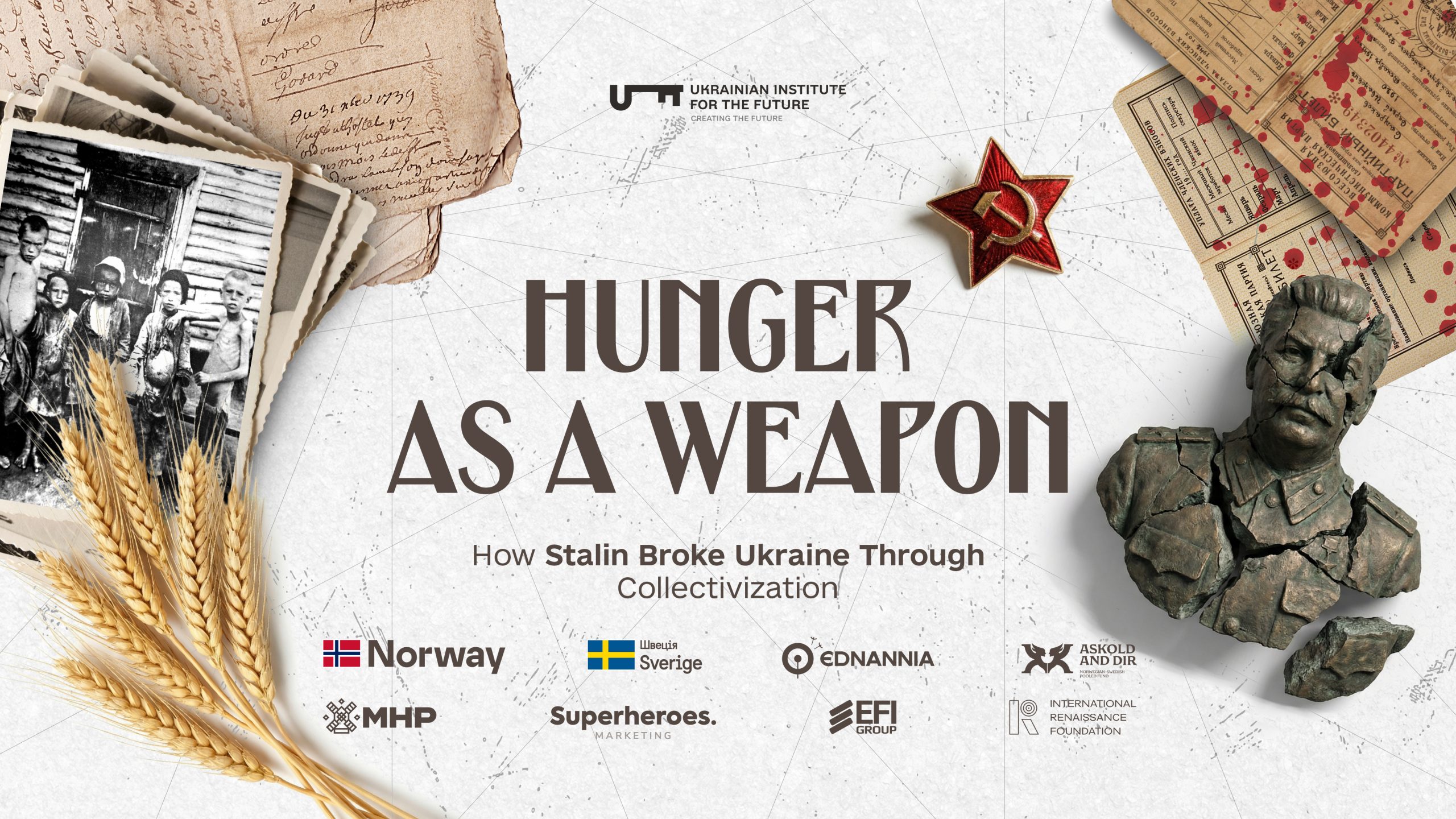
Series “Anatomy of an Empire” │ Ukrainian Institute of the Future
This material was prepared as part of work on the “Atlas of Russian Imperialism and Colonialism” — a UIF publication forthcoming this year.
This piece addresses the following questions:
→ What collectivization was — and why it struck Ukraine harder than Russia
→ How the “five stalks law” converted famine from catastrophe into instrument
→ Why Stalin denied the famine — and refused international aid
→ What happened in Kazakhstan — and why it too constitutes genocide
→ Where the logic of collectivization is being reproduced today
Why This Is Not Simply a Tragedy
There is a tendency to describe the Holodomor in the language of catastrophe — as a calamity that descended on Ukraine like drought or flood. Poor harvests, an inefficient system, administrative errors. Tragic, but impersonal.
This interpretation is not merely imprecise; it conceals the essential point. The famine of 1932–1933 in Ukraine was the outcome of a sequence of decisions, each of which compounded the next: confiscate the grain; place the village on the “blacklist”; prohibit departure; refuse international aid; deny the fact itself.
This was not a convergence of poor decisions. It was a mechanism.
Understanding the Holodomor requires understanding collectivization. And understanding collectivization requires examining why Moscow feared the Ukrainian peasantry.
What Stalin Feared
Before the revolution, Russia and Ukraine had fundamentally different agrarian traditions. Russia had a strong culture of communal land tenure — the mir, a collective village unit that redistributed land among households. Ukraine was characterized predominantly by individual farming.
That tradition was incompatible with the collective farm model. Forced collectivization in Ukraine met with systematic resistance: in 1930, 4,098 mass peasant uprisings were recorded in the Ukrainian SSR. In the same year, the Moscow region recorded 676.
The problem, however, extended beyond resistance. An independent Ukrainian peasantry — with its own landholdings and its own language — constituted a potential base for any national movement. Eliminating the peasantry as a class meant eliminating that base.
Moscow was pursuing two objectives simultaneously.
The Mechanics of Famine: From Policy to Outcome
In December 1927, the Fifteenth Congress of the All-Union Communist Party resolved to begin collectivization. The intended pace was gradual. By 1930, however, more than half of all Soviet peasants had been forcibly driven into collective farms.
In the Ukrainian SSR, the rate was higher still: by March 1930, 64 percent of households had been incorporated into the collective system.
On 2 March 1930, Stalin published his article “Dizziness from Success,” transferring responsibility for “excesses” onto local officials. Peasants began leaving collective farms en masse. By June 1930, only 24 percent of households remained in the system.
In the autumn, the drive resumed — this time with greater severity.
In autumn 1932, the measures that converted famine into a policy instrument were set in motion. On 22 October, emergency commissions were dispatched to the main grain-producing regions: Molotov to Ukraine, Kaganovich to the Kuban. Their mandate was to fulfill the grain procurement plan at any cost.
On 7 August 1932, the so-called “five stalks law” came into force, criminalizing the gleaning of grain remnants from collective farm fields — the remnants that peasants had gathered after the harvest to survive. The penalty was imprisonment or execution.
A system of “blacklists” followed. Villages that failed to meet their quotas were entered into a special register, after which all supply deliveries ceased, a military blockade was imposed, and mass searches were conducted to confiscate all food stocks.
Including food that had already been cooked.
Spring 1933: The Peak
In June 1933, approximately 28,000 people were dying in Ukraine every day.
That single figure conveys the scale: twenty-eight thousand deaths per day exceeds the population of an average district town.
Throughout this period, grain exports continued. The Soviet authorities not only declined to halt exports; they refused to acknowledge the famine and rejected offers of international assistance. Foreign journalists who sought access to the affected regions were either denied entry or conducted on organized tours featuring model collective farms.
Walter Duranty of the New York Times reported that there was no famine. He received the Pulitzer Prize.
By the most rigorous estimates, the Holodomor claimed approximately four million Ukrainian lives.
The total Ukrainian population recorded in the Soviet Union fell from 31.1 million in the 1926 census to 28.1 million in 1939 — during a period when the overall Soviet population was growing.
Kazakhstan: The Same Logic, a Different People
The Holodomor in Ukraine is comparatively well documented. Less widely recognized is the catastrophe that unfolded simultaneously in Kazakhstan, which was comparable in scale.
The Kazakhs were a nomadic people whose economy was built on livestock. In 1930, forced collectivization and the compulsory sedentarization of nomadic households began. Livestock was confiscated.
Of 40 million head of livestock in 1930, 10 million remained by 1933. For a nomadic people, the confiscation of livestock was the elimination of any viable means of subsistence.
The famine killed at least 1.5 million Kazakhs — approximately one quarter of the entire population. More than a million fled to China, Iran, and Afghanistan.
Kazakhstan lost a third of its population between the 1926 and 1939 censuses. The number of Kazakhs recorded in 1939 was lower than in 1926.
A demographic collapse of this magnitude is not the consequence of poor administration. It is the consequence of a system that assigned no value to human life beyond its contribution to production targets.
Russification as a Parallel Process
Famine and collectivization were not the only instruments deployed. Concurrent demographic and cultural measures reinforced them.
During the 1930s, thousands of settlers arrived in Ukrainian SSR cities from Russia: 26 percent of all arrivals to major cities in 1933 were from the Russian SFSR.
From 1938, the Russian language became compulsory in all schools across all republics. In 1939–1940, the Latinized alphabets of non-Russian languages were replaced with Cyrillic — a measure designed to make linguistic dependence on Moscow structurally permanent.
Limitations in Standard Interpretations
The most common error in assessments of the Holodomor is treating it exclusively as a Soviet crime, detached from the broader logic of Russia as an imperial power.
Collectivization in Kazakhstan and in Ukraine was a variation of the same method: destroy the economic and demographic base of a population that does not conform to the model of centralized control; replace it with a different population, or render it so dependent on the center that any capacity for self-determination becomes structurally impossible.
The blockade of Mariupol in 2022. The prohibition on exporting grain from occupied Ukrainian territories. The forced transfer of Ukrainians to Russia.
Different instruments. The same underlying logic: control the resource and the population, or remove what cannot be controlled.
This is the fifth piece in the “Anatomy of an Empire” series. The series is based on the “Atlas of Russian Imperialism and Colonialism” — a major UIF research project forthcoming in print and digital format. To be continued.
The text has been adapted with the assistance of AI tools. The original text of the Atlas may differ in style.
This project is implemented with the support of the International Renaissance Foundation.
The views, assessments, and conclusions expressed in this authored publication represent the personal position of the author and do not necessarily reflect the official position of the Ukrainian Institute of the Future, its partners, or its donors.
This publication was produced by the NGO “Ukrainian Institute of the Future” with the support of the Askold and Dir Foundation, administered by ISAR Ednannia within the project “A Strong Ukrainian Civil Society — A Driver of Reform and Democracy,” funded by Norway and Sweden. The content of this publication is the sole responsibility of the NGO “Ukrainian Institute of the Future” and does not represent the views of the governments of Norway or Sweden, or of ISAR Ednannia.