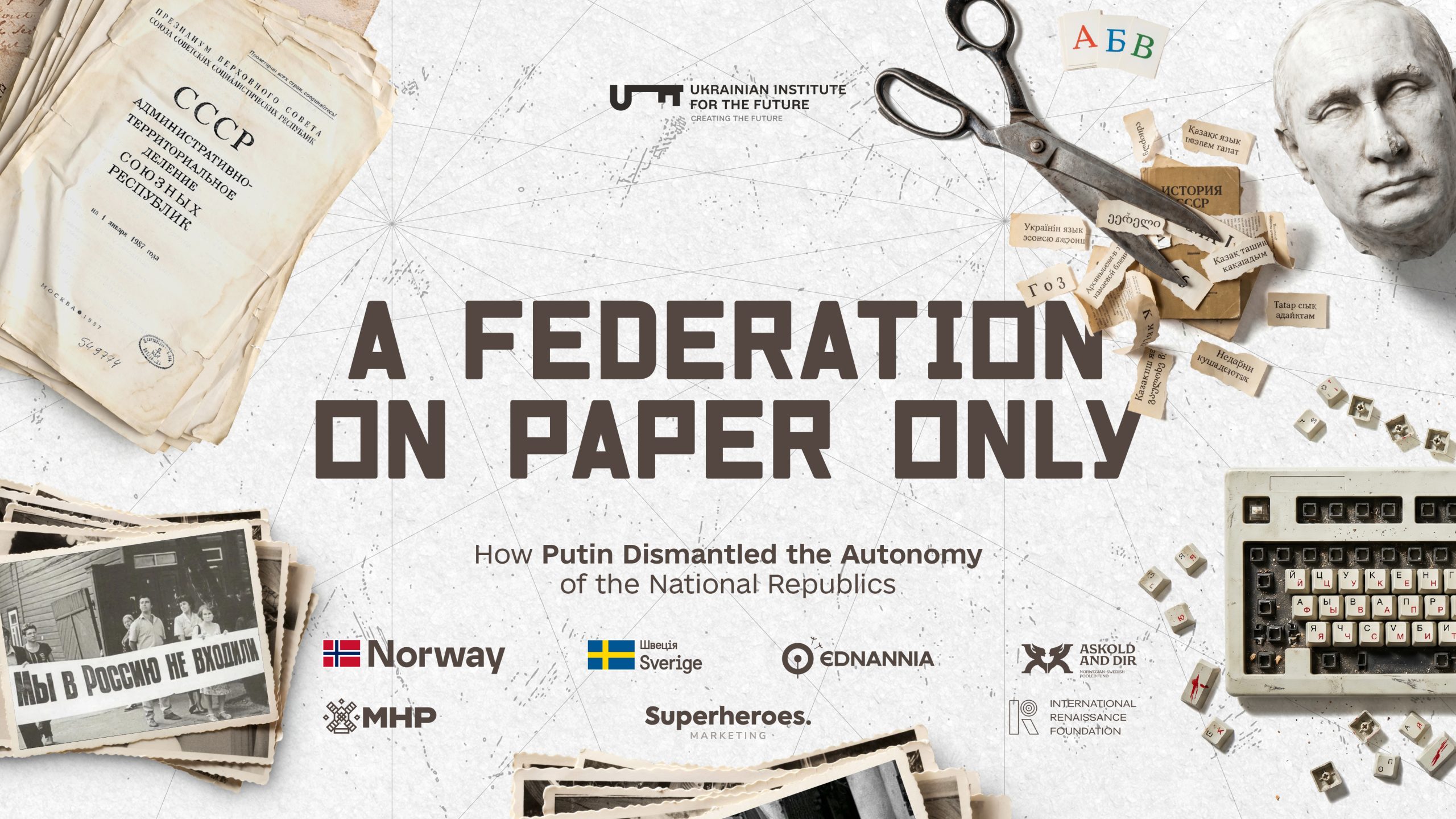
Series “Anatomy of an Empire” │ Ukrainian Institute of the Future
This material was prepared as part of work on the “Atlas of Russian Imperialism and Colonialism” — a UIF publication forthcoming this year.
This piece addresses the following questions:
→ What real autonomy Tatarstan and Bashkortostan held in the 1990s — and why they were stripped of it
→ How Putin converted a federation into a unitary state with a facade of self-governance over twenty-five years
→ What happened to the languages of Russia’s peoples — and why the number of speakers is falling even as populations grow
→ Why the 2022 mobilization fell disproportionately on ethnic minorities
→ What “federalization” means in the negotiating context of Ukraine
The 1990s: When the Federation Was Real
In 1990, against the backdrop of the USSR’s dissolution, sovereignty declarations came not only from the union republics but from the autonomous republics within the RSFSR itself.
On 8 October 1990, the Buryat ASSR adopted a Declaration of State Sovereignty. On 11 October, Bashkiria followed. Chechnya declared independence in 1991.
Tatarstan went further. On 30 August 1990, its Supreme Council declared sovereignty and stated that the republic was subject to neither the USSR nor the RSFSR. In 1992, a referendum produced a majority in favor of sovereign state status. In 1994, a treaty was concluded between the Russian Federation and Tatarstan that effectively granted the republic the standing of a confederate subject: its own constitution, its own powers over the economy, language, education, and foreign economic relations.
Bashkortostan and Yakutia signed similar agreements. By 1994–1995, approximately fifty such bilateral treaties existed between Moscow and various regions of the Russian Federation.
This was a genuine asymmetric federation. Unwieldy, unstable — but real.
What Yeltsin Gave the Peoples — and Why
Why did Moscow agree to such broad concessions in the 1990s?
One factor was the weakness of the center. Yeltsin was balancing competing power groups, the country was in economic crisis, and the coercive resources needed to maintain a rigid vertical were simply unavailable.
A second was the lesson of 1991. The USSR had dissolved not only under external pressure but from within, when the republics refused to sustain the center. Yeltsin understood that holding Russia together required giving the regions enough that they would not want to leave.
A third factor was Chechnya, which defined the boundary. The First Chechen War (1994–1996) ended with the Khasavyurt Accords — in effect, a recognition of de facto independence. For Moscow, this became an argument in its dealings with other republics: it was better to make concessions on autonomy than to face full-scale separatism.
Russia lived this way for ten years — in permanent tension between the center and regions that held real, if limited, rights.
Putin: Systematic Dismantling
When Putin came to power in 2000, restructuring federal relations was among his first moves.
13 May 2000: a decree established “plenipotentiary representatives of the President in federal districts.” Seven districts, seven presidential envoys — in effect, a new layer of administration between Moscow and the regions, with oversight functions over both.
2001–2004: constitutional reforms in the republics. All provisions of regional constitutions that conflicted with the federal constitution were subject to annulment. Tatarstan adopted a revised constitution in 2002 — without the provisions on state sovereignty.
2004: following the Beslan terrorist attack, Putin abolished the direct election of governors. They would henceforth be appointed by the president. The phenomenon of “parachute governors” — Moscow appointees with no connection to their region — gradually became the norm. By 2025, more than 50 of the federation’s 89 regions were headed by graduates of the “governors’ school” at the presidential administration.
2003–2008: several autonomous districts were dissolved as independent federal subjects. The Komi-Permyak, Taymyr, Evenki, and Koryak districts were merged with other units.
2007–2008: the abolition of the “national-regional component” in education. Regions lost the right to include the mandatory study of local languages and cultures in school curricula.
2015: a law prohibited the senior officials of federal subjects from holding the title of “president.” Tatarstan was granted a transition period until 2017. In 2017, the special-status agreement was not renewed.
The Federal Treaty as a functioning document died quietly, without announcement.
Languages: Linguicide in Detail
The dismantling of political autonomy was accompanied by a linguistic catastrophe.
2002: all official languages of Russian federal subjects were required to use exclusively the Cyrillic alphabet. Tatarstan, which had shifted to Latin script several years earlier, was compelled to reverse course.
2008/2009 academic year: the Unified State Examination was conducted exclusively in Russian. Regional languages were excluded from the examination — and therefore from the pathway to social mobility.
2018: the state languages of the national republics were reclassified as electives — available even to native speakers only on parental application. In the first six months following the law’s passage, the number of students studying Nogai fell by half.
2020: constitutional amendments enshrined Russian as “the language of the state-forming people.”
2025: the number of hours allocated to native language instruction in schools was halved.
The outcome: of more than one million Chuvash, approximately 700,000 are fluent in their native language. Of 386,000 Udmurts — 255,000. Of 424,000 Mari — 259,000.
The populations are not shrinking. The number of speakers is.
Mobilization 2022: Who Pays the Price
On 21 September 2022, Putin announced “partial mobilization.”
Officially: uniform. In practice: disproportionate. Ethnic minorities and peripheral regions received more draft notices per capita than Moscow and St. Petersburg.
Dagestan, Buryatia, and Tuva led in battlefield fatality rates relative to population in the first months of the war. Bashkortostan and Yakutia were the regions where public protests against mobilization were most visible.
One slogan in the squares of Ufa: “Why always the Bashkirs? We always fight Moscow’s wars.”
This is not a new problem. It is the structural logic of empire: the periphery pays for the ambitions of the center. The blood of ethnic minorities — in the Caucasian War, in the First and Second World Wars, in Chechnya, now in Ukraine.
“Federalization” as a Rhetorical Trap
In negotiations over a ceasefire in Ukraine, Russia has periodically advanced the demand for “federalization” — the granting of “special status” to Donetsk and Luhansk within Ukraine.
This demand must be understood through the lens of what actually happened to federalism inside Russia itself.
“Special status” is not a guarantee of autonomy. It is the opening move before that status is systematically removed. Tatarstan held its broadest powers in 1994 — and had lost all of them by 2017.
Federalization of Ukraine as Moscow envisions it would mean embedding pro-Kremlin enclaves in the Ukrainian constitution — with a right of veto over the Euro-Atlantic course and a permanent lever of internal influence.
This is not a proposal for decentralization. It is a proposal for slow annexation through legal mechanisms.
A piece from the “Anatomy of an Empire” series. The series is based on the “Atlas of Russian Imperialism and Colonialism” — a major UIF research project forthcoming in print and digital format.
This text was prepared with the assistance of artificial intelligence on the basis of the “Atlas of Russian Imperialism and Colonialism.” This project is implemented with the financial support of the International Renaissance Foundation.
This project is implemented with the support of the International Renaissance Foundation.
The views, assessments, and conclusions expressed in this authored publication represent the personal position of the author and do not necessarily reflect the official position of the Ukrainian Institute of the Future, its partners, or its donors.
This publication was produced by the NGO “Ukrainian Institute of the Future” with the support of the Askold and Dir Foundation, administered by ISAR Ednannia within the project “A Strong Ukrainian Civil Society — A Driver of Reform and Democracy,” funded by Norway and Sweden. The content of this publication is the sole responsibility of the NGO “Ukrainian Institute of the Future” and does not represent the views of the governments of Norway or Sweden, or of ISAR Ednannia.