

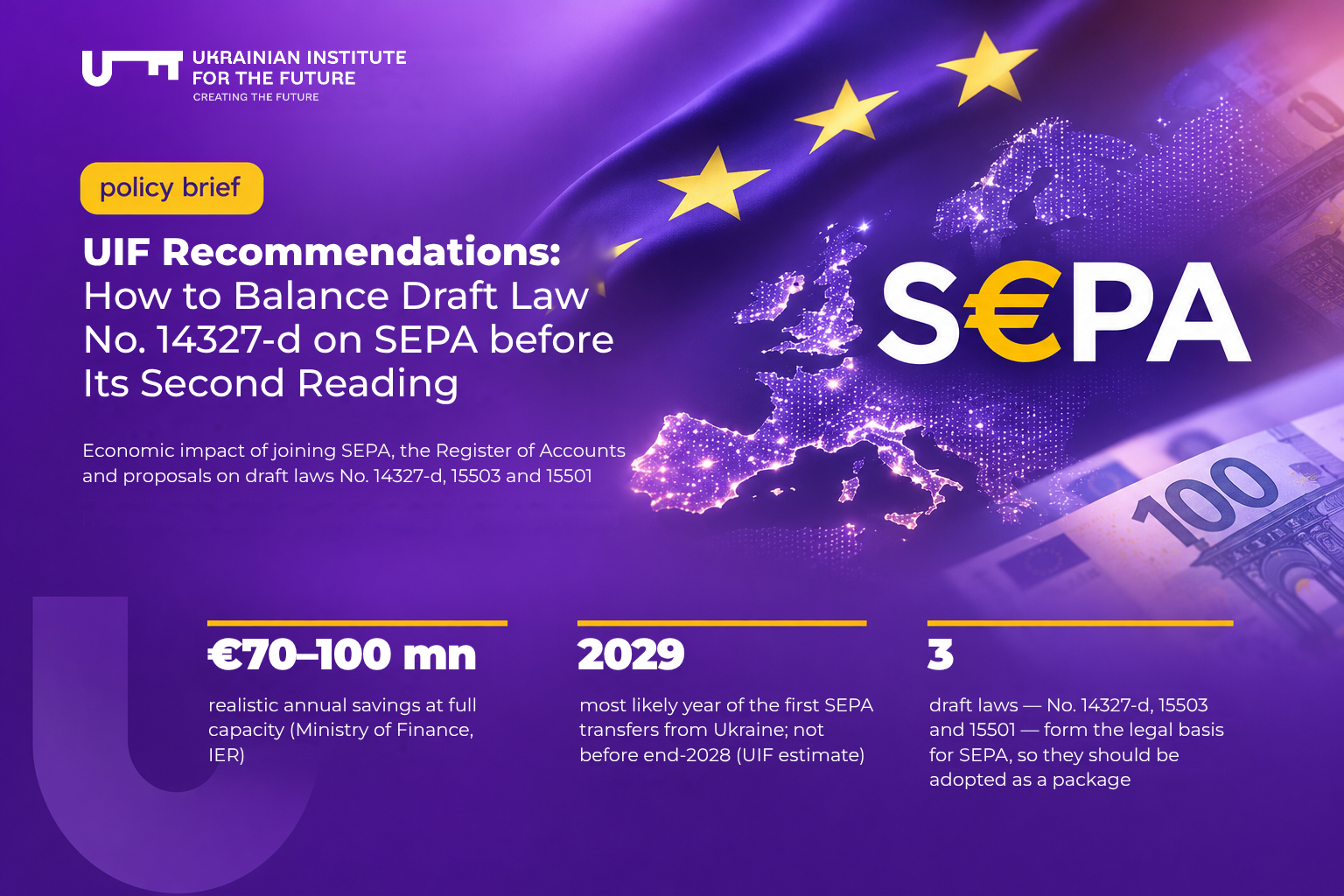
The economic effect of joining SEPA, the Register of Accounts, and proposals on Draft Laws No. 14327-d, No. 15503 and No. 15501

This analysis is based on the texts of Draft Laws No. 14327-d and No. 15503 as adopted at first reading on 10 November 2026, and of No. 15501 as submitted by the Government on 10 August 2026, as of 23 November 2026.
Intended for: members of the Verkhovna Rada (Parliament of Ukraine) Committee on Finance, Taxation and Customs Policy and other relevant committees; the Ministry of Finance; the National Bank of Ukraine (NBU); representatives of the European Union (EU) and international financial institutions.
Key points
- The savings are real, but the official figures are inconsistent. A realistic estimate is EUR 70–100 million a year once SEPA reaches full capacity, with an upper bound of around EUR 150 million. Another Ministry of Finance figure — EUR 4,000 for each of 120,000 exporting SMEs — implies ≈EUR 480 million and contradicts the first.
- The Register of Accounts is a requirement of EU law, which Ukraine must implement in order to join the EU. The debate should be about the rules of access to it, not about the Register itself.
- The draft law can be strengthened without delaying SEPA. The amendments to No. 14327-d concern access control, transparency and the security of the Register. One of them — direct access for the State Financial Monitoring Service — is also required for compliance with EU law. In our view, the most serious risk comes from the provision under which the grounds for refusing to register a new account are set by a Ministry of Finance order.
- Beyond legislative changes, the decisive role belongs to the NBU. Without simpler currency controls for euro payments and without transparent fees, much of the savings will not reach customers.
Context
Three draft laws form the legal basis for SEPA, and they should be adopted as a package. If No. 15501 falls behind, the new rules on reporting violations will take effect without sanctions for pressure on whistleblowers.
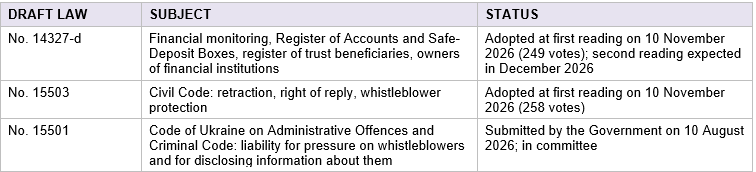
The committee replaced the Government’s No. 14327 (23 December 2025) and the alternative No. 14327-1 (9 January 2026) with the revised No. 14327-d (6 April 2026). According to the explanatory note, the law is one of the indicators of the Ukraine Plan under the Ukraine Facility. The media have also reported that it is a condition for World Bank budget support; we found no official confirmation.
Once the law enters into force, Ukraine will need to apply to the European Payments Council (EPC), the EPC will need to take a decision on Ukraine, and each bank will need to connect to the SEPA Credit Transfer (SCT), SEPA Instant Credit Transfer (SCT Inst) and SEPA Direct Debit (SDD) schemes. Moldova took about 21 months to go from application to its first payments; Albania took 16. The EPC will assess applications submitted after November 2026 against new, stricter criteria, and the Ministry of Finance allows for accession slipping to around 2029. The first SEPA transfers from Ukraine should therefore be expected no earlier than the end of 2028, and most likely in 2029. This forecast assumes that an adopted law is sufficient for the application; if the EPC requires the Register to be already operational, the timeline will slip further.
Economic effect
FIGURE 1. Estimates of annual savings from SEPA for Ukraine, EUR million

Sources: Ministry of Finance, 17 December 2025; IER, May 2025 (via Interfax-Ukraine); National Bank of Moldova; Ekonomichna Pravda. UIF calculations.
Where EUR 70–150 million comes from. The Ministry of Finance and the Institute for Economic Research and Policy Consulting (IER) estimate the savings at EUR 70–100 million a year. The IER arrived at this figure by scaling Moldova’s forecast (EUR 12 million) by the ratio of trade volumes (×9) and transfer volumes (×6). Moldova’s actual savings in the first year were EUR 16.4 million; multiplied by 6–9, this gives EUR 100–150 million. This is an upper bound, since the National Bank of Moldova’s methodology counts all SEPA transfers as if, without SEPA, they would have gone through SWIFT. In Ukraine, some transfers from the EU already go through cards, fintech services and virtual IBANs (including monobank via Clear Junction), so the actual effect is likely to be closer to the lower bound.
Forecasts diverge from outcomes in both directions. Moldova expected EUR 12 million in the first year and received EUR 16.4 million. Montenegro saved EUR 3.8 million in its first six months — around 27% of the estimated annual savings from capping fees (EUR 13.9 million a year) and about half of the six-month forecast.
Who benefits. In Moldova, around 75% of SEPA transfers were incoming, mostly to individuals’ accounts, while businesses used SEPA mainly to pay for imports (EU4Moldova). In Ukraine, the beneficiaries are families who receive money from the EU and small and medium-sized enterprises (SMEs) — above all importers and exporters of services. For importers, currency controls matter more than fees. Customers’ savings also mean lost fee income for banks, so it is the all-in cost of a payment that needs to be measured, including the FX conversion markup.
The Ministry of Finance’s estimate of ‘up to 0.3% of GDP at PPP in the first year’ and the explanatory note’s ‘hundreds of millions of euros annually’ are not supported by published calculations, so we do not rely on them.
Register of Accounts and Safe-Deposit Boxes
What it will contain. In public, the Ministry of Finance has described only the IBAN, full name and bank. The text of the draft law (Article 37 of the new Section IX¹ of the Law on Financial Monitoring, hereinafter the AML/CFT Law) is broader: tax number or passport, entry in the demographic register, ultimate beneficial owners and authorised persons, account type, currency, opening and closing dates, and, for safe-deposit boxes, the contract, terms and persons with access. The Register covers not only bank accounts but also payment accounts with non-bank providers, e-wallets and securities accounts. Transactions, balances and the contents of safe-deposit boxes are not recorded. Data are kept for five years after an account is closed, with a possible extension of another five. The register holder is the Ministry of Finance.
Why it is needed. Article 32a of Directive (EU) 2015/849, as amended by Directive (EU) 2018/843, requires Member States to have a centralised mechanism that identifies the holders of accounts and safe-deposit boxes. The EU’s new 2024 AML package (Regulation (EU) 2024/1624 and Directive (EU) 2024/1640) retains this obligation; the Regulation applies from 10 July 2027.
Who will get access. The Asset Recovery and Management Agency (ARMA), the National Agency on Corruption Prevention (NACP) and the Economic Security Bureau of Ukraine (ESBU) will have direct access, but only from the date falling six months before the EU Accession Treaty enters into force. Until then, the NBU and the National Securities and Stock Market Commission (NSSMC) will receive data for supervisory purposes, and all others only by court order. Balances and account movements remain protected by banking secrecy (Article 62 of the Law on Banks and Banking), and funds can be seized only in the manner prescribed by law. According to Interfax-Ukraine, the European Commission considers the list of authorities too narrow, and the parties are discussing access for other authorities via the prosecutor’s office.
Human rights. The Register is an interference with the right to private life guaranteed by Article 32 of the Constitution and Article 8 of the European Convention on Human Rights. Such interference is permissible if it is prescribed by law, pursues a legitimate aim and is proportionate. In practice, this means a clear list of authorities and grounds for access, independent oversight of requests and an effective remedy for the individual. Recommendations 2–8 strengthen precisely these safeguards.
Gaps in the draft. In the text adopted at first reading, we did not find the State Financial Monitoring Service (SFMS) — Ukraine’s financial intelligence unit — among the users of the Register (Part 9 of Article 37), even though Article 32a of Directive 2015/849 (as amended by Directive 2018/843) requires such units to have direct, immediate and unfiltered access. The division of roles between the SFMS, the ESBU, the NACP and ARMA should also be set out, so that the same person is not subject to parallel requests from different authorities. There is a request log (Part 4 of Article 37), but the draft does not specify who audits it independently. Individuals can obtain a free extract on their own accounts, but they are not expressly notified of requests about them by ARMA, the NACP and the ESBU; the text is silent on requests by other users. Use of data for purposes other than those intended is deemed unauthorised, but there is no specific sanction. The draft law requires an authorised security system or a certificate of conformity but does not provide for regular independent audits. Funds can be debited from a new account only after registration or confirmation that the notification has been received (penalty for breach: 10% of the amount, minimum UAH 1,700). The response time is one hour, or up to four hours during the first nine months of the Register’s operation. The grounds for refusing registration are set by a Ministry of Finance order (Part 4 of Article 38); individuals have no right to appeal a refusal, and there is no fallback procedure in case of failure. At each registration, the Ministry of Finance checks the data against state information resources, but the draft law does not specify which ones. The financial monitoring threshold (UAH 550,000) is not indexed. No. 15501 protects only employees and sets a fine of UAH 510 upwards for pressure on a whistleblower (see Annex). At the same time, No. 14327-d itself shifts the burden of proof to the employer in disputes over pressure on a whistleblower, extends protection to the whistleblower’s family members and colleagues, and grants the right to free legal aid. No. 15503 exempts whistleblowers from compensating damage caused by an unintentional error, but not from retraction, and does not abolish the presumption that negative information is untrue (Article 277 of the Civil Code).
Limits on access. The new Part 10 of Article 61 of the Law on Banks and Banking allows the Ministry of Finance to transfer Register data constituting banking secrecy to ARMA, the ESBU, the NACP and the NBU. Under the final provisions, it enters into force without the delay set for these authorities’ direct access. Unless it is aligned with Part 9 of Article 37 and the safeguards of Article 62, this provision could be used as a workaround. The limits of access should also be regulated separately: each request must have a lawful basis, a recorded purpose and a link to specific proceedings or a function of the authority, and the scope of data must be limited to what is necessary. The right of access should not replace judicial oversight where the law requires it.
Safeguards for business. Paragraphs 7 and 8 of Section I exempt regulations and supervision in the field of financial monitoring from the laws on regulatory policy and on state supervision: no regulatory impact assessment, no mandatory consultation, no general safeguards during inspections. Amendments to Article 68 of the Law on the National Bank of Ukraine require the NBU to publish enforcement measures within five working days of the decision, and information on appeals against them and on court rulings within five working days of receiving it; this safeguard should be retained in the final text. The new Part 1 of Article 17 of the AML/CFT Law allows customer data to be shared within financial groups, including with third countries, without any requirement for an adequate level of personal data protection.
Recommendations
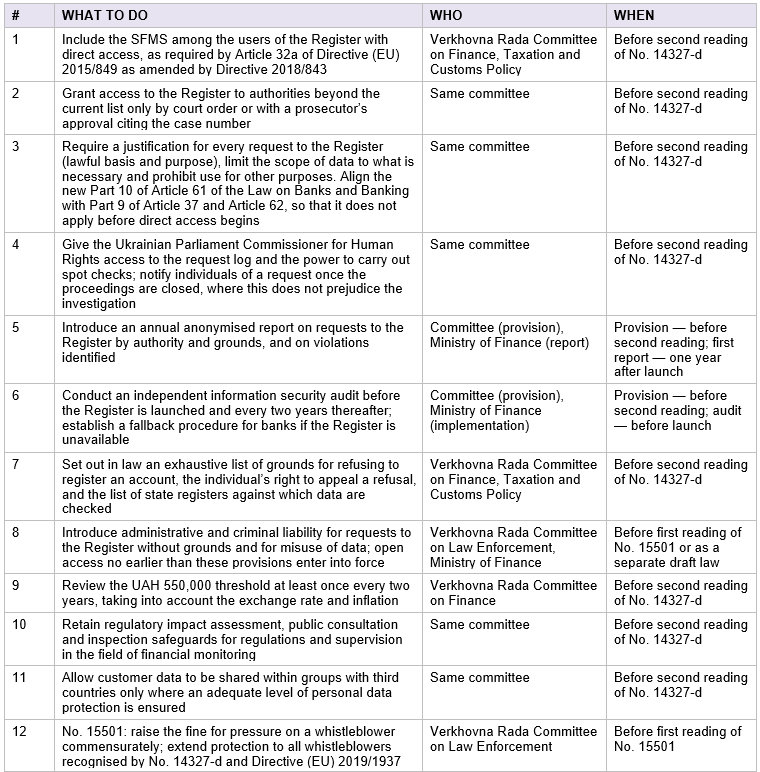
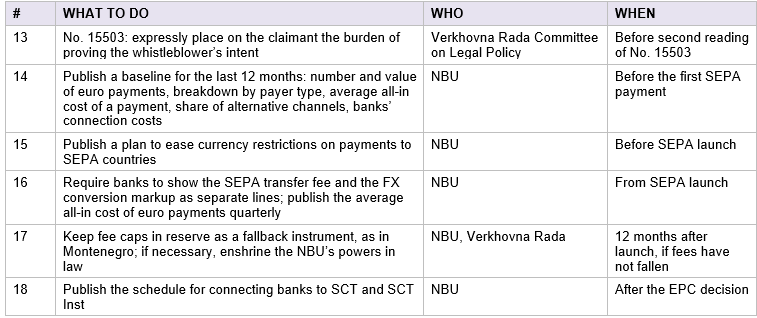
Recommendations 1–13 concern access rules, transparency and the protection of rights. In our view, they do not conflict with the EPC criteria, and Recommendation 1 brings the text closer to EU requirements. Recommendation 2 should be coordinated with the European Commission, which, according to media reports, is pressing for a broader list of authorities with access.
How to measure results
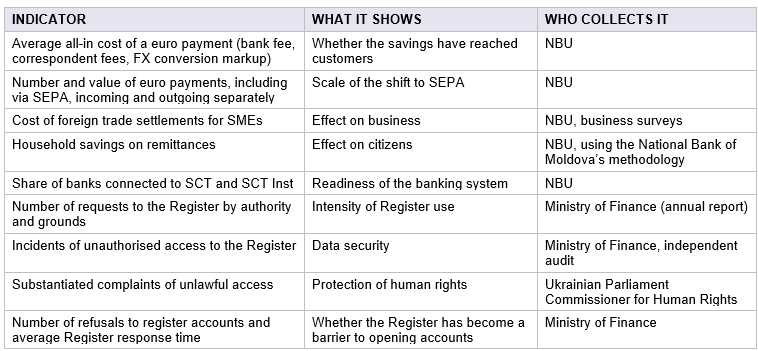
Before SEPA is launched, the NBU should establish a baseline (Recommendation 14): the average all-in cost of a euro payment, and the number and value of euro payments and their breakdown by payer type. The remaining indicators should be tracked from the first year of operation of the Register and SEPA.
Methodology and limitations
The legal conclusions are based on the texts of Draft Laws No. 14327-d, No. 15503 and No. 15501, the comparative tables and the opinion of the lead committee of 10 November 2026. The economic estimates draw on published data from the Ministry of Finance, the central banks of Moldova and Montenegro, and the Bank of Albania. The upper bound of the effect was obtained by scaling Moldova’s actual savings by the ratio of Ukraine’s and Moldova’s trade and transfer volumes (×6–9). A full assessment requires the model E = Σ Nᵢ × (C₀ᵢ − C₁ᵢ), where Nᵢ is the number of payments in category i that will switch to SEPA, and C₀ᵢ and C₁ᵢ are the average all-in cost of a single payment before and after connection; the categories are individuals, sole proprietors (FOPs), SMEs and large enterprises. The data for the model should come from the NBU baseline.
Limitations: the NBU does not publish the structure of fees for euro transfers, the share of transfers via alternative channels or the share of fees retained by foreign correspondent banks. The estimates therefore show gross savings for customers rather than the net effect on the economy. We did not estimate banks’ costs of connecting to SEPA or the costs of creating and maintaining the Register. Media data were used only where no primary sources are available, and this is indicated in the text. The text of No. 14327-d may change before second reading.
Annex. Sanctions in Draft Law No. 15501
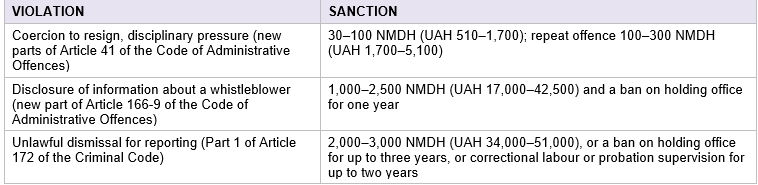
NMDH (tax-free minimum income) is a statutory unit used to calculate fines and equals UAH 17.
Sources
All links were checked on 23 November 2026.
Official documents and primary sources
- Verkhovna Rada of Ukraine. Draft Law No. 14327-d: text, explanatory note, committee opinion of 10 November 2026 (in Ukrainian). https://itd.rada.gov.ua/billinfo/Bills/Card/69818
- Verkhovna Rada of Ukraine. Draft Law No. 15503 (in Ukrainian). https://itd.rada.gov.ua/billinfo/Bills/Card/70498
- Verkhovna Rada of Ukraine. Draft Law No. 15501 (in Ukrainian). https://itd.rada.gov.ua/billinfo/Bills/Card/70496
- Verkhovna Rada of Ukraine. Draft Law No. 14327-d adopted at first reading (in Ukrainian). https://www.rada.gov.ua/news/razom/276669.html
- Verkhovna Rada Committee on Finance, Taxation and Customs Policy. Opinion on No. 14327 and No. 14327-1 (in Ukrainian). https://komfinbank.rada.gov.ua/uploads/documents/34494.pdf
- Verkhovna Rada Committee on Law Enforcement. Draft laws for which the Committee is the lead committee (No. 15501) (in Ukrainian). https://komzakonpr.rada.gov.ua/news/zp_na_roz/ZP_golovni/page/7
- Directive (EU) 2018/843 inserting Article 32a into Directive (EU) 2015/849. https://eur-lex.europa.eu/eli/dir/2018/843/oj
- Ministry of Finance of Ukraine. Ukraine on the way to the Single Euro Payments Area (SEPA). 17 December 2025 (in Ukrainian). https://www.kmu.gov.ua/news/ukraina-na-shliakhu-do-iedynoi-zony-platezhiv-v-ievro-sepa-finansovyi-bezviz-prozorist-i-novi-mozhlyvosti
- Ministry of Finance of Ukraine. Parliament supports draft law on Ukraine joining SEPA at first reading (in Ukrainian). https://www.kmu.gov.ua/news/minfin-parlament-pidtrymav-zakonoproiekt-shchodo-pryiednannia-ukrainy-do-iedynoi-zony-ievroplatezhiv-u-i-chytanni
- Ministry of Finance of Ukraine. Serhii Marchenko: Timely accession to euro payments (SEPA) opens up new opportunities. 17 November 2026 (in Ukrainian). https://www.kmu.gov.ua/news/serhii-marchenko-svoiechasne-pryiednannia-do-ievroplatezhiv-sepa-vidkryvaie-novi-mozhlyvosti-dlia-hromadian-i-biznesu
- Ministry of Finance of Ukraine. Methodological AML Bulletin, special issue on SEPA (in Ukrainian). https://www.mof.gov.ua/storage/files/%D0%9C%D0%B5%D1%82%D0%BE%D0%B4%D0%BE%D0%BB%D0%BE%D0%B3%D1%96%D1%87%D0%BD%D0%B8%D0%B9%20%D0%B1%D1%8E%D0%BB%D0%B5%D1%82%D0%B5%D0%BD%D1%8C_%20%D0%A1%D0%B5%D1%80%D1%96%D0%B9%D0%BD%D0%B8%D0%B9%20%D0%BD%D0%BE%D0%BC%D0%B5%D1%80%20%D0%9C%D1%96%D0%BD%D1%84%D1%96%D0%BD-AML-2026-SE-01.pdf
- National Bank of Moldova. One year of operational connection to SEPA: citizens and businesses save more than EUR 16 million. https://www.bnm.md/en/print/content/one-year-operational-connection-sepa-citizens-and-businesses-save-more-eur-16-million
- Central Bank of Montenegro. Six months of Montenegro in SEPA. https://cbcg.me/en/public-relations/news/press-releases/six-months-of-montenegro-in-sepa-over-16-billion-euros-in-transactions-and-38-million-euros-in-savings-for-citizens-and-businesses
- Central Bank of Montenegro. CBCG limits fees for SEPA payments. https://cbcg.me/en/public-relations/news/press-releases/cbcg-limits-fees-for-sepa-payments-citizens-and-the-economy-to-save-millions
Analysis and media
- EU4Moldova. How SEPA has transformed payments in the Republic of Moldova during its first nine months. https://eu4moldova.eu/en/how-sepa-has-transformed-payments-in-the-republic-of-moldova-during-its-first-nine-months
- Interfax-Ukraine. IER estimate of the effect of SEPA. 21 May 2025 (in Ukrainian). https://interfax.com.ua/news/economic/1073703-amp.html
- Interfax-Ukraine. Compromise with the EU on access to the register of accounts. https://en.interfax.com.ua/news/economic/1234756.html
- Kyiv Post. The SEPA law and the World Bank’s Development Policy Loan (DPL) programme (in Ukrainian). https://www.kyivpost.com/uk/post/74900
- Ekonomichna Pravda. How joining SEPA will change transfers between Ukraine and the EU. https://epravda.com.ua/rus/finances/kak-prisoedinenie-k-sepa-izmenit-denezhnye-perevody-mezhdu-ukrainoy-i-es-822727/
- Clear Junction. monobank case study. https://clearjunction.com/?p=2194
- Bank of Albania (BIS). Application to the EPC in June 2024. https://bis.org/review/r240718b.htm
This publication was produced by the NGO “Ukrainian Institute for the Future” with the support of the Askold and Dir Fund, administered by ISAR Ednannia within the project “Strong Civil Society of Ukraine as a Driver of Reform and Democracy”, funded by Norway and Sweden. The content of this publication is the responsibility of the NGO “Ukrainian Institute for the Future” and does not reflect the views of the governments of Norway or Sweden, or of ISAR Ednannia.
About UIF. The Ukrainian Institute for the Future (UIF) is an independent think tank founded in 2016. We model Ukraine’s development scenarios and the economic cost of decisions before they are made: from an annual economic forecast to sector studies and proposals for government decisions.
The views expressed in this document are those of the authors and UIF and do not necessarily reflect those of the Institute’s partners or donors.
Artificial intelligence tools were used in preparing this document: to search for and analyse sources, compare the texts of the draft laws and edit. Facts, figures and legal conclusions have been verified against the primary sources cited in the document. The authors and UIF are responsible for the content.
If you notice an inaccuracy, please write to info@uifuture.org. We mark corrections in the text, indicating the date.
You may also like