
Summary
Business inviolability and the presumption of innocence for businesses are basic conditions for a favourable business climate. In Ukraine, these principles are undermined by existing legislation and by the way it is applied: the burden of proof is shifted onto the entrepreneur, and restrictions that bring business operations to a halt are imposed before any court decision.
According to the Accounting Chamber of Ukraine, from 2021 to the first half of 2024 alone, the registration of 7.7 million tax invoices and adjustment calculations, carrying UAH 144.1 billion in VAT, was suspended. In 75% of court disputes, the courts ruled in favour of taxpayers.
The paper identifies five areas in which these principles are violated: criminal procedure, taxation, banking regulation, seized asset management, and regulation and licensing. For each, it proposes legislative changes.
Key proposals
- only a court may establish a taxpayer’s intent and guilt;
- while an administrative or judicial appeal is pending, it is prohibited to open criminal proceedings under Article 212 of the Criminal Code, conduct searches, arrest assets or block accounts;
- abolish the tax invoice blocking system and the White Business Register;
- in financial monitoring, interpret doubts in the client’s favour, limit a bank’s internal review to 48 hours, and take blocking decisions only manually;
- prohibit recognising real estate as material evidence and transferring corporate rights to the management of ARMA before a court verdict;
- abolish on-site inspections triggered by complaints and abolish licence fees, and in the longer term shift the retail excise tax to producers and importers, as is the practice in Europe;
- introduce liability for officials who violate the guarantees of business inviolability.
Adopting these changes will reduce pressure on business, preserve working capital and jobs, and increase investor confidence, which is particularly important as Ukraine moves towards EU accession and prepares for reconstruction.
Approach and sources
This paper is based on an analysis of current legislation and its application. The main sources are the Accounting Chamber’s audit of VAT administration (2021 to the first half of 2024), Ministry of Finance data, the IMF report on the first review of Ukraine’s programme, international indices of the rule of law and property rights protection, and publicly available materials on individual cases.
Violations of the principles of business inviolability and innocence are grouped under five channels through which the state affects economic activity. For each channel, the paper sets out the legal provisions that create risks and illustrative cases. The cases illustrate how the violations work; they do not describe how widespread they are.
The proposals are formulated as amendments to legislation.
Section I. Conceptual foundations of business inviolability and innocence
Business inviolability is not immunity from oversight but a guarantee that lawful activity can continue without interruption.
This principle protects companies’ property, data and freedom of operation from arbitrary action by the supervisory authorities. It guarantees that a business can operate undisturbed unless there are lawful grounds for an inspection or search. It is a state in which a company’s property, offices, accounts and trade secrets are inviolable by default. The tax authority or law enforcement authorities cannot simply carry out a search, block accounts or seize servers. This requires substantial lawful grounds – for example, a court decision. A prosecutor has no right to place a company’s warehouses under arrest merely because he believes they hold illegal goods. Official evidence and court authorisation are required.
Business inviolability should be considered in three key dimensions: protection of private property, limits on interference in operations, and transparency of tax and law enforcement oversight.
Protection of private property includes:
- Inviolability of rights to assets.
- Protection against unlawful expropriation of property.
- Equal rules for all forms of ownership.
- Swift and fair court proceedings in the event of disputes.
Limits on interference in operations
- Freedom to take decisions within the company.
- A ban on officials dictating how business should be run.
- Minimum requirements for operating in the market.
- Clear and infrequent inspections by government agencies.
Transparency of tax and law enforcement oversight
- Open rules for tax and law enforcement authorities.
- Clear reasons for inspections and visits.
- A ban on pressure through force and the courts.
- Liability of officials for harm caused to a company.
The presumption of innocence for businesses is a basic principle of interaction between the state and business. It governs the process of accusing a business of offences (tax, administrative or criminal). It protects a company from being automatically deemed guilty by the state. A business is considered law-abiding until the state authorities prove otherwise by legal means. All doubts concerning the interpretation of laws or the evidence collected must be resolved in favour of the entrepreneur or the business. It is the tax service that must prove that a company has evaded taxes, rather than the business having to prove that it is clean. If the tax inspectorate finds an inaccuracy in a company’s reports because the law is confusing, the court should side with the business, since any ambiguity in legislation is interpreted in favour of the taxpayer.
The presumption of innocence for businesses extends a fundamental legal principle, enshrined in Article 62 of the Constitution of Ukraine, to the sphere of economic and commercial relations. It means that the state and the supervisory authorities must prove that a company has broken the law, rather than the entrepreneur being obliged to justify himself.
Article 62. A person is presumed innocent of committing a crime and shall not be subjected to criminal punishment until his guilt is proved through legal procedure and established by a court verdict of guilty.
No one is obliged to prove his or her innocence of committing a crime.
An accusation shall not be based on illegally obtained evidence as well as on assumptions. All doubts in regard to the proof of guilt of a person are interpreted in his or her favour.
{Official interpretation of the provisions of part three of Article 62, according to which an accusation may not be based on illegally obtained evidence: see Decision of the Constitutional Court of Ukraine No. 12-rp/2011 of 20 October 2011}
In the event that a court verdict is revoked as unjust, the State compensates the material and moral damages inflicted by the groundless conviction.
Source: Constitution of Ukraine.
Key differences between the presumption of inviolability and the presumption of innocence
| Criterion | Presumption of inviolability | Presumption of innocence |
| What does it protect? | Property, funds in accounts, offices, the right to operate | Reputation, funds exposed to fines, management’s freedom. |
| When does it apply? | Continuously, in the course of day-to-day operations. | Only when charges have been brought against the business. |
| What does it protect against? | Unlawful searches, blocking and corporate raiding. | Fines and sanctions imposed without solid evidence. |
The presumption of inviolability can be considered in the following key contexts:
- Relations with the tax authorities. Tax disputes are the classic example. By law, the tax authorities are obliged to prove that a transaction was sham and that its purpose was to evade taxes. In practice, the burden of proof often falls on the taxpayer, who is forced to collect documents confirming that its business transactions were genuine. Where the law is ambiguous, any doubts and contradictions must be resolved in favour of the business.
- Criminal and administrative prosecution. Liability may be imposed only in accordance with the procedure established by law, and all unproven doubts must be resolved in favour of the suspect. The state cannot bring charges on the basis of the ‘internal assumptions’ of its systems; every fact of an offence requires convincing evidence.
- Protection of business reputation (the information dimension). Accusations made against a company by civil servants or regulators before a court decision violate its right to be presumed innocent and cause significant harm.
- Competition and regulatory law. The Antimonopoly Committee of Ukraine and other regulators impose large fines. The authority must prove that the business’s actions restrict competition.
International indices
Two key specialised international rankings are used to assess business inviolability and the protection of property rights.
1. WJP Rule of Law Index
This ranking by the World Justice Project assesses the effectiveness of the justice system, the fairness of criminal justice and respect for the presumption of innocence.
In 2025:
- Ukraine’s current rank: 90th out of 143 countries worldwide.
- Overall score: 0.48 (on a scale of 0 to 1).
- Regional position: 10th out of 15 countries in Eastern Europe and Central Asia. Ukraine ranks above Belarus (105) and Russia (119) but below Georgia (52) and Moldova (68).
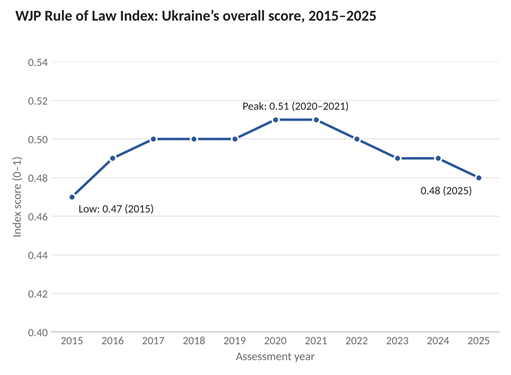
Source: https://worldjusticeproject.org/rule-of-law-index/country/Ukraine
2. International Property Rights Index (IPRI)
This specialised index by the Property Rights Alliance assesses how well physical property rights (real estate, business assets) and intellectual property rights are protected in a country.
In 2025:
- Ukraine’s current rank: 104th out of 126 countries.
- Regional position: 24th out of 25 countries (Central and Eastern Europe and Central Asia)
- Overall score:3.50 (on a scale of 0 to 10).
Ukraine’s component scores:
- Legal and Political Environment (3.12): judicial independence and control of corruption.
- Physical Property Rights (2.91): ease of registering property and protection of business against corporate raiding.
- Intellectual Property Rights (4.48): protection of copyright, patents and trademarks.
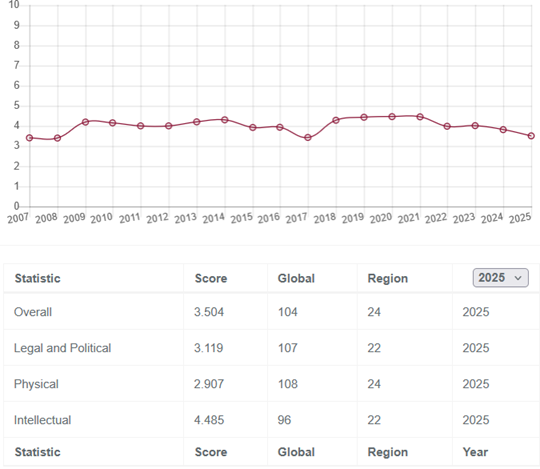
IPRI scores for Ukraine, 2007–2025.
Source: https://internationalpropertyrightsindex.org/country/ukraine
Section II. A record of violations: Major cases and legal provisions that violate the principles of inviolability and innocence
We have grouped violations of the principles of business inviolability and innocence by the state into five channels:
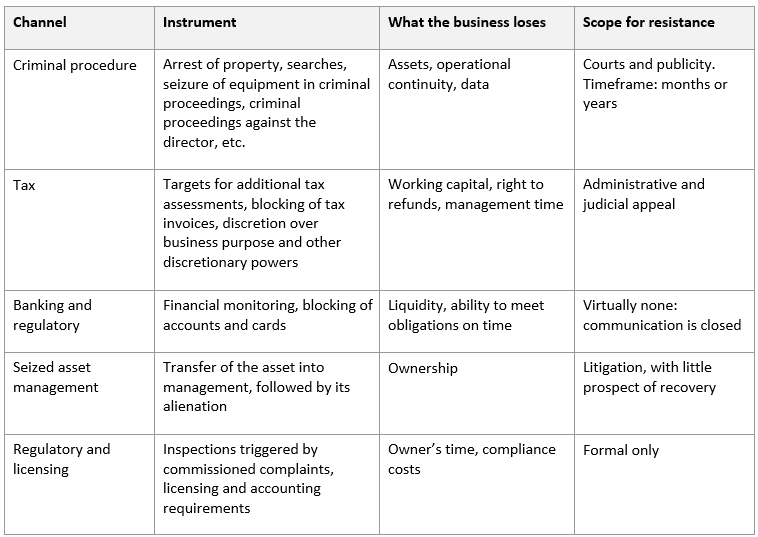
Criminal procedure channel
Arrest of property, searches, seizure of equipment in criminal proceedings, criminal proceedings against a company’s director and similar practices are cases and statutory provisions governing the actions of law enforcement authorities that violate the principles of business inviolability and innocence.
The Criminal Code of Ukraine contains a fairly long list of articles relating to economic activity, collected in Section VII, ‘Criminal Offences in the Sphere of Economic Activity’ (Articles 199–233).
Particular attention should be paid to Article 209 (Legalisation (Laundering) of Property Obtained by Criminal Means), Article 209-1 (Wilful Violation of Legislation on the Prevention and Counteraction of Legalisation (Laundering) of the Proceeds of Crime) and Article 212 (Evasion of Taxes and Duties (Mandatory Payments)).
Article 209 has become a universal ‘add-on’ charge in virtually any tax or customs dispute. If investigators regard income as ‘unlawfully saved’ (for example, through tax optimisation), all subsequent financial transactions of the company are classified as laundering. This entirely negates the inviolability of assets before any court verdict.
A criminal case under Article 212 on tax evasion is opened in parallel with a tax dispute in the administrative court, creating instruments for out-of-court pressure and for coercing payment of the disputed amounts.
Law enforcement authorities often resort to pre-emptive criminal prosecution: they enter information into the Unified Register of Pre-Trial Investigations (URPI) – which formally opens a criminal investigation – and apply the instruments of the Criminal Procedure Code (CPC), such as detaining executives under Article 208 of the CPC and arresting operating accounts and property under Article 170 of the CPC, before the company has had a chance to exercise its constitutional right to appeal tax decisions administratively or in court. A business may cease operating while still at the investigation stage, long before a court verdict.
Typical cases include:
- Detention without a court ruling (Article 208 of the CPC): Although it is difficult to detain a person without a court ruling on ‘economic’ charges (this is permitted mainly during or immediately after the commission of an offence), law enforcement officers resort to psychological pressure – for example, by staging an artificial ‘urgent search’ or by intimidating executives with notices of suspicion and motions for pre-trial detention with bail set in the billions.
- Arrest of assets (Article 170 of the CPC): Under Article 170 of the CPC, an investigating judge, on a prosecutor’s motion, may arrest a company’s accounts, goods, equipment and real estate merely because they ‘may constitute material evidence’ or ‘to secure the state’s civil claim’. Arrest here means a court-ordered restraint on the use and disposal of property.
- Violation of principles: A business is blocked at the investigation stage, when guilt has not yet been proven at all. The company may not survive until the court verdict (which may come several years later or end in acquittal), since its assets are frozen and its counterparties stop working with it. This is a direct violation of the principles of business inviolability and innocence in the absence of a court verdict of guilt.
In addition, following amendments to the Tax Code (Law No. 466-IX of 16 January 2020), provisions appeared under which guilt and intent may be established not by a court but by a supervisory authority (the tax authority). As a result, any tax authority act finding that a taxpayer acted with intent is already a potential criminal case against the company’s management, even though it has not yet been through administrative or judicial appeal.
Tax channel
Blocking of tax invoices
One of the most significant cases violating both the principle of business inviolability and the principle of innocence for businesses is the tax invoice blocking system created by the Ministry of Finance. Under Ukraine’s VAT system, a seller must register each tax invoice in the Unified Register of Tax Invoices for the buyer to be able to claim input VAT; ‘blocking’ means that the tax authority suspends this registration.
The automatic blocking of tax invoices by the system creates a situation in which the entrepreneur is forced to justify himself, rather than the state or the tax authorities having to prove the company’s guilt.
Auditors of the Accounting Chamber of Ukraine, the country’s supreme audit institution, found that, although the State Tax Service (STS) had taken certain measures in 2021–2023 and the first half of 2024 to improve the administrative and judicial appeal procedures, the suspension of registration of 7.7 million tax invoices and adjustment calculations (TIs/ACs) during this period, and the subsequent process of appealing the tax authorities’ decisions, had a significant impact on taxpayers’ economic activity. At the same time, the courts ruled in favour of taxpayers in 75% of cases, and over three and a half years the STS had to pay UAH 800 million in court fees.
Tax revenues to the state budget from court decisions and court fees paid by the STS
UAH million
| Indicator | 2021 | 2022 | 2023 | H1 2024 |
| Actual tax revenues from court decisions in favour of STS bodies | 1,290.5 | 826.3 | 470.3 | 315.1 |
| Court fees paid by STS bodies for filing statements of claim, appeals and cassation appeals in property and non-property disputes | 291.2 | 215.8 | 221.6 | 77.2 |
Source: https://rp.gov.ua/upload-files/Activity/Collegium/2024/49-1_2024/Zvit_49-1_2024.pdf
In total, during the audit period, taxpayers appealed more than 44,000 tax decisions through the administrative procedure, and the courts considered almost 73,000 such cases. The auditors also found that the outcomes of appeals against STS decisions differ significantly between the administrative and judicial procedures. Whereas only 27% of decisions (worth UAH 34.5 billion) were resolved in taxpayers’ favour through the administrative procedure, in court the figure was 75% (UAH 127.5 billion). Together, this amounts to UAH 162 billion over three and a half years, or UAH 46.3 billion a year on average.
During the audit period, an average of around 16,000 taxpayers were on the list of high-risk taxpayers (a direct violation of the principle of innocence), and they paid UAH 42.7 billion in taxes and levies to the state budget. During the audit period, the registration of TIs/ACs carrying UAH 144.1 billion in VAT was suspended. Of this, TIs/ACs carrying UAH 42 billion in VAT were suspended on the basis of the taxpayer riskiness criterion (24.7% of the total number of suspended TIs/ACs).
But this is not only working capital withdrawn from business. It also means significant administrative costs for businesses in proving their innocence (a direct violation of the principle of innocence) and, often, the suspension of business operations as a result of such actions by the State Tax Service (a direct violation of the principle of inviolability). Moreover, the Accounting Chamber reports that even when a taxpayer wins in court, the tax service may take three months, and sometimes more than a year, to enforce the court decision.
A direct consequence of this situation is corruption: payments to unblock tax invoices or to be removed from the list of high-risk taxpayers. An illustrative example is the search conducted by the State Bureau of Investigation (SBI) at the premises of a head of one of the tax service’s regional offices.
Privileged categories of taxpayers
Law No. 3813-IX, known as the ‘White Business Club’ law and adopted on 18 June 2024, effectively creates a privileged category of taxpayers – those granted benefits for meeting compliance criteria set by the tax authority – and calls into question the principle of innocence for all other businesses. If 1% of businesses are ‘white’, what does that make the other 99%? In effect, the law establishes:
- A presumption of guilt: The tax service effectively divides business into ‘white’ and ‘grey’, automatically casting all other companies as potential offenders who must now prove their integrity.
- Inequality and discrimination: Unequal competitive conditions are created, in which selected companies receive protection from the state, while all other businesses face increased pressure and inspections by the tax authorities.
- Reputational losses: Businesses not included in the list lose the trust of counterparties and banks, which may regard absence from the ‘club’ as a sign of risk.
Banking and regulatory channel
Financial monitoring and the blocking of accounts and cards
Ukraine’s financial monitoring system is built as a vertical hierarchy, from international standards down to the internal instructions of each individual bank. The rules that businesses and citizens encounter are clearly governed by three levels of regulation and are overseen by specific state bodies.
Level 1. Who makes and regulates the rules (public authorities)
1. International institutions (FATF, EU): The Financial Action Task Force (FATF) sets global standards (the 40 Recommendations), which Ukraine is obliged to implement as an EU candidate country and an IMF partner.
2. Verkhovna Rada of Ukraine (the national parliament): Adopts the core laws, aligned with FATF requirements and EU directives.
3. National Bank of Ukraine (NBU): The main regulator of the banking sector. It is the NBU that writes detailed compliance instructions, fines banks for violations and sets the criteria for what is ‘suspicious’.
4. State Financial Monitoring Service of Ukraine (SFMS): A specialised body (Ukraine’s financial intelligence unit) that collects information from banks on large-scale suspicious transactions, analyses it and passes it on to the National Anti-Corruption Bureau of Ukraine (NABU), the Security Service of Ukraine (SSU) or the National Police of Ukraine.
Level 2. What governs the rules (key documents)
1) The Law of Ukraine ‘On Prevention and Counteraction to Legalization (Laundering) of the Proceeds from Crime…’ is the foundation of the entire financial monitoring system. It establishes:
- The threshold for automatic review: from UAH 400,000.
- Banks’ obligation to block transactions if a client cannot confirm the source of funds.
- The concept of PEPs (politically exposed persons / senior officials): rules on enhanced scrutiny of politicians.
2) NBU Board Resolution No. 65 ‘On Approval of the Regulation on Financial Monitoring by Banks’. It is this document that requires banks to build strict algorithms:
- It requires a risk-based approach (classifying clients into ‘green’, ‘amber’ and ‘red’ risk zones).
- It contains more than 70 indicators of suspicious transactions (for example, atypical volumes, circular transfers, sudden receipt of funds by an unemployed person, etc.).
Level 3. A bank’s internal financial monitoring (why transactions of UAH 5,000 get blocked)
The law sets a general control threshold (UAH 400,000), but a bank has the right to block any amount. This is governed by the bank’s internal rules (within the framework of NBU Resolution No. 65):
Why is financial monitoring perceived as a punitive body?
1) Automation errors (AI): Banks configure their IT systems to block automatically at the slightest deviation from a client’s typical behaviour. Volunteers, individual entrepreneurs (FOPs – a simplified tax and legal status for self-employed persons) and ordinary card-to-card transfers are hit.
2) Presumption of the client’s guilt: Unlike criminal law (where Article 62 of the Constitution applies), banking compliance operates on the opposite principle: the client must prove the legality of every hryvnia by providing numerous supporting documents, or the account will be blocked. This is a direct violation of the principles of client inviolability and innocence.
3) Excessive fines for banks: The National Bank of Ukraine (NBU) severely penalises financial institutions themselves for ‘missing’ suspicious transactions. As a result, it is easier for compliance officers to block an ordinary client’s transaction ‘just in case’ than to risk their licence or fines running into millions.
In this way, the state has built an analogue of tax invoice blocking, only in the banking sector, which in practice leads to:
- Business payments not being processed for weeks, including payments under military contracts, with lengthy correspondence and the need to provide additional confirmation for the payment to go through,
- Individuals’ cards being blocked even for a transaction of UAH 5,000,
- Accounts being closed by the bank, which in effect amounts to total interference in operations.
Because of the risk of blocking, even collections for school class needs are sometimes made in cash, since a card may be blocked. According to Member of Parliament Yaroslav Zhelezniak, in 2025 alone banks closed the accounts of 606,000 individuals and 30,000 FOPs.
Meanwhile, NABU recordings from Operation ‘Forrest Gump’ make it clear how financial monitoring actually works and how easily it can be bypassed to make corrupt payments – precisely the payments the system was introduced to counter.
Seized asset management channel
The case of the Gulliver business and shopping centre in Kyiv is one of the most high-profile cases of violation of property inviolability and of the presumption of innocence before a court verdict. The centre was built in 2013, financed with foreign-currency loans from two state-owned banks, Oschadbank and Ukreximbank. The original loan principal: the banks lent USD 441 million to Tri O LLC. However, after the hryvnia devalued from UAH 8 to UAH 25 per US dollar, the debt grew from UAH 3.5 billion to UAH 11 billion. At the same time, Gulliver earned its rental income mainly in hryvnia, which had lost value. The company’s business model lost the ability to repay the principal of the dollar-denominated debt.
In 2017, the Gulliver shopping centre was first arrested and transferred to the management of the Asset Recovery and Management Agency (ARMA), the state body that manages assets seized in criminal proceedings, as part of a large-scale investigation by the Prosecutor General’s Office, as compensation following the collapse of Bank Mykhailivskyi. However, the property was not actually taken from its owners. ARMA legally received the asset, but by court decision Tri O LLC (the previous owner) was appointed manager of the Gulliver shopping centre from April 2018.
In 2020, the debt was restructured until 2044. All capitalised (accrued and unpaid) interest, fines and penalties for previous years of non-payment were added to the total debt, which rose to USD 675 million.
On 3 June 2024, the Shevchenkivskyi District Court of Kyiv, on a motion by the Office of the Prosecutor General, transferred the Gulliver shopping and business centre to ARMA’s management. Grounds for the charge: a pre-trial investigation by the Economic Security Bureau of Ukraine (ESBU), the law enforcement authority responsible for economic crimes, into tax evasion of UAH 145.8 million (the tax authority had not even issued a tax assessment notice).
In this case, we see four violations of the basic rights of a private investor:
- Violation of the presumption of innocence. The state applied the most radical sanction to the investor – physically depriving it of the right to manage its property – at a stage when the management’s guilt existed only as a suspicion and in analytical memos by ESBU detectives (the alleged tax debt of UAH 146 million was calculated by ESBU detectives; the tax service did not issue a tax assessment notice). The indictment was sent to court only two months after the asset had been transferred to ARMA. The owner was deprived of control over the business before the trial had even begun.
- Extended interpretation of the status of ‘material evidence’ (a scheme using Article 100 of the CPC). To gain access to the property, the prosecution relied on the article on the legalisation of proceeds of crime. This allowed it to designate a multi-storey complex in central Kyiv as ‘material evidence’ that supposedly had to be urgently seized and transferred to ARMA for ‘safekeeping’. From a legal standpoint, this decision is questionable, since the building is real estate: it cannot be sold without the knowledge of the state registers, nor hidden or destroyed. The practical effect of the decision was the takeover of the property’s management.
- Disproportionality (violation of the right to peaceful enjoyment of possessions). This is a violation of Article 1 of Protocol No. 1 to the European Convention on Human Rights (ECHR). The investigators claimed hypothetical losses to the state of UAH 146 million from unpaid taxes. Instead of freezing that specific amount in the accounts or arresting an equivalent part of the property, the court and ARMA blocked and seized the entire complex. The state blocked an asset worth more than 50 times the amount of the claims themselves.
- Creating the conditions for default. The state, acting through the ESBU and ARMA, knew that Gulliver was encumbered with a large loan owed to another arm of the state – Oschadbank and Ukreximbank. By blocking the operations of Tri O LLC and attempting to appoint a private manager (through a tender in which Limex Express took part), ARMA created the conditions for the company’s default. The owner was deprived of the ability to meet its obligations, which opened the way to the alienation of the property.
Subsequently, the state banks (Oschadbank and Ukreximbank) took a radical step: they invoked a commercial mortgage clause and took full ownership of the shopping centre in settlement of the debt, which automatically cancelled the court-ordered arrest and ARMA’s powers in October 2025.
The presumption of innocence and business inviolability are often violated during unscheduled inspections triggered by complaints, as well as through stringent licensing and accounting requirements. Supervisory authorities sometimes use complaints as a formal pretext for pressure, shifting onto the entrepreneur the burden of proving innocence even before a final decision has been taken.
Regulatory and licensing channel
Problems with complaint-based inspections:
- Formal grounds: Complaints are often filed without proper evidence, yet they become a lawful pretext for launching an inspection.
- Reversed burden of proof: The business is forced to justify itself and compile large sets of documents, instead of the state authority proving that a violation took place.
- Subjectivity: Inspectors interpret the rules in favour of the budget rather than of the bona fide taxpayer or entrepreneur.
A typical case of pressure is the so-called ‘commissioned’ inspection scheme. This is when inspectors ask an acquaintance or relative to write a complaint against a business, or the inspectors themselves fabricate a complaint from a fictitious person, or two state bodies arrange a ‘commissioned’ inspection between them.
In Ukraine, licensing and accounting still perform a fiscal and punitive function (filling the budget through fines and financial control), whereas in the European Union they are purely an administrative and safety instrument (control over product safety and compliance with trading rules).
Licensing and accounting cases and risks:
- Treating an error as a crime: Any technical or formal error in a receipt issued by a payment transaction recorder (PTR, i.e. a cash register) or in a primary document is automatically treated by the supervisory authorities as deliberate concealment of profits or trade in counterfeit goods. The business immediately faces fines running into millions.
- Shifting the burden of proof: Instead of the tax authority proving that a real offence took place, the company is forced to justify itself in court, bringing piles of paperwork and proving that the transaction was genuine.
- Fiscal duplication: The simultaneous existence of the retail excise tax (an excise tax levied on retail sales of excisable goods) and a licence creates a situation in which the state suspects business of bad faith a priori, forcing it to pay ‘in advance’ for the right to operate and to account for every kopiyka in several different forms.
- Linkage to PTRs: The requirement to buy a separate licence for each cash register, rather than for the retail outlet as a whole, puts direct financial pressure on business expansion. A large, transparent supermarket with many tills bears a heavier burden than a small kiosk operating in the shadow economy.
- Artificial pretexts for blocking: Retail licences and complex inventory accounting rules become an ideal hook for unscheduled inspections triggered by competitors’ ‘commissioned complaints’. Tax officials exploit vague legislation to block a company’s operations (through seizure of goods or revocation of a licence) before a final court decision.
- No right to make a mistake: Unlike EU countries, where the principle of warning and compliance applies, the Ukrainian system is geared towards immediate financial punishment or revocation of the right to operate for the slightest formal inconsistency.
Section III. Changes in state policy to secure the presumption of business inviolability and innocence
In the previous section, we sought to identify the causes of the current situation and the major cases and legal provisions that violate the principles of inviolability and innocence. This section is devoted to policy changes which, in our view, will help secure the presumption of business inviolability and innocence.
Policy selection priorities
1. Legislative change. We believe that securing the presumption of business inviolability and innocence requires, above all, legislative change rather than decisions that set out algorithms for action in particular cases and explain how to act within the current legal framework. Our proposals therefore seek first and foremost to make pressure on business by law enforcement authorities impossible or to reduce it to a minimum, which far better serves the goal of resolving the issue of business inviolability and innocence systemically.
2. Balancing the powers of supervisory authorities with their liability. We believe that the current situation creates an asymmetry of rights and responsibilities. The powers of supervisory and law enforcement authorities are so extensive that their liability for using them comes nowhere close. For business, the opposite is true: a great deal of responsibility and minimal rights. The state builds oversight in one direction only. It oversees itself through anti-corruption bodies, but these have different tasks. We therefore believe that criminal and administrative liability of officials for state racketeering against business should also be introduced, as an instrument for balancing rights and responsibilities.
3. Privileged categories of taxpayers. We believe that creating privileged categories of taxpayers violates the fundamental right of inviolability of all other businesses, or shifts the emphasis for other businesses towards having to prove their good faith, which fundamentally violates the principle of innocence for businesses. All such categories should therefore be abolished.
4. Eliminating or minimising conflict rather than reaching yet another compromise. We believe it is necessary to focus on policy changes that eliminate or minimise conflict and that the business community will perceive as a step forward rather than as yet another compromise.
Policy changes
In line with these policy priorities for securing the presumption of business inviolability and innocence, and with the problems and cases identified, we have formulated recommendations for changes in state policy that will help secure the presumption of business inviolability and innocence.
Area 1. Criminal procedure
- Removing quasi-judicial functions from the tax authority.
Current law enforcement and fiscal practice in Ukraine reflects a deep crisis of trust between the state and business. One of the main problems is the artificial criminalisation of ordinary administrative and commercial disputes. Provisions introduced earlier allowing the tax authorities themselves to determine a taxpayer’s ‘intent’ and ‘guilt’ (Law No. 466-IX of 16 January 2020) have turned tax audits into an instrument for generating initial materials for criminal prosecution. We propose:
- Only a court may establish intent and guilt; the tax authority records indications of an offence
- Eliminating discretion in setting fines. Removing fines for acts committed ‘with intent’.
Key benefits:
- A taxpayer’s guilt may be established only by a court.
- An end to ‘bargaining over intent’ by the tax authority, used as blackmail through the threat of opening criminal proceedings.
- Penalties are fixed and cannot include aggravating circumstances based on an inspector’s subjective opinion.
Implementation requires amendments to Section II of the Tax Code.
- Ending pre-emptive criminal prosecution.
In many developed countries, tax violations are treated as civil or administrative offences. Criminal liability arises only for large-scale systemic fraud, not for ordinary disputes over the interpretation of tax legislation. Moreover, evasion of the unified social contribution (USC) – Ukraine’s single payroll-based contribution to compulsory state social insurance – cannot be a ‘scheme’ at all, given that banks control the payment of salaries to employees and process payments only after mandatory taxes and the USC have been paid.
On the other hand, halting a company’s operations through searches, arrest of assets and blocking of current accounts causes the state greater losses – in forgone future taxes and lost jobs – than the amount of the disputed tax debt.
We therefore propose the following changes:
- Removing Article 212-1 (evasion of the USC) from the Criminal Code.
- Prohibiting law enforcement authorities from taking over the functions of the tax authority and producing their own calculations of debt under Article 212. A charge under Article 212 of the Criminal Code of Ukraine presupposes the existence of a tax debt that has been agreed and calculated solely on the basis of a tax audit.
- Immunity during appeal. A ban on opening cases under Article 212 of the Criminal Code (tax evasion). While an administrative appeal is under way or a case is before the administrative court, law enforcement authorities have no right to open a criminal case, conduct searches, arrest assets or block accounts. Only if a court has finally established the company’s guilt, and the amount of the loss is critically large and involved deliberate deception, may the materials be referred to law enforcement authorities.
- Narrowing the application of Article 212 of the Criminal Code. Introducing a mandatory ‘deception’ criterion (tax fraud): criminal liability should arise not because ‘the tax authority does not recognise your transaction’ but only if the tax authority has proven direct deception, such as the use of forged documents, fictitious foreign companies or concealed accounts.
- Balancing powers. Amending Article 365 of the Criminal Code to cover violations of the immunity of business entities, introducing the offence of ‘Wilful violation of statutory guarantees of the inviolability and immunity of business entities’: entering information into the URPI, conducting a search or temporary seizure of property, detaining an official under Article 208 of the CPC, or filing a motion to arrest property while immunity is in force (an administrative or judicial appeal is under way, or the time limit for filing one has not yet expired).
Key benefits:
- Minimising racketeering against business through criminal proceedings, blocking of accounts and arrest of property
- Ensuring uninterrupted economic activity: company accounts cannot be frozen while a dispute with the state is under way, which preserves jobs and tax revenues.
- Reducing the burden on the ESBU and the courts: law enforcement authorities will stop spending public funds on investigating minor and medium-sized commercial disputes and will concentrate on genuine criminal cases.
- Increasing Ukraine’s investment attractiveness: introducing European standards on tax fraud and genuine procedural protection for business will restore the confidence of domestic and international investors.
Implementation requires amendments to the Criminal Code, the Criminal Procedure Code and the Tax Code (above all to paragraph 56.22 of Article 56 of the Tax Code).
Area 2. Taxation
- Abolishing the tax invoice blocking system.
The electronic VAT administration system, followed by the system of VAT prepayment before goods are even sold, had already put the Ukrainian jurisdiction at a competitive disadvantage. The first version of tax invoice blocking was introduced in 2018 by Cabinet of Ministers of Ukraine Resolution No. 117 of 21 February 2018. Later, criteria-based blocking of tax invoices took shape in Cabinet of Ministers Resolution No. 1165 of 11 December 2019, which came into effect in 2020. The Ministry of Finance has been changing the criteria for many years, but this has not solved the problem.
| Indicator | 2017 | 2018 | 2019 | 2020 | 2021 | 2022 | 2023 | 2024 | 2025 |
| VAT, % of GDP | 10.5% | 10.5% | 9.5% | 9.6% | 9.8% | 8.9% | 8.8% | 9.6% | 9.5% |
Source: Ministry of Finance of Ukraine.
Indeed, VAT revenues to the budget actually fell by one percentage point of GDP after the tax invoice blocking system was introduced. We also believe that part of these losses is linked to corruption in the unblocking of tax invoices.
The statistics on STS court disputes are also telling. According to the Accounting Chamber, actual tax revenues from court decisions in 2023 amounted to around 0.007% of GDP, and net of court fees paid, to 0.0037% of GDP.
Tax revenues to the state budget from court decisions and court fees paid by the STS
UAH million
| Indicator | 2021 | 2022 | 2023 | H1 2024 |
| Actual tax revenues from court decisions in favour of STS bodies | 1,290.5 | 826.3 | 470.3 | 315.1 |
| Court fees paid by STS bodies for filing statements of claim, appeals and cassation appeals in property and non-property disputes | 291.2 | 215.8 | 221.6 | 77.2 |
On the other hand, even the IMF, in its first review of 21 July 2026, required the tax authority and the Ministry of Finance to simplify VAT administration, especially for small businesses, estimating the cost of VAT compliance in its current form at USD 3,300 a year (around UAH 150,000).
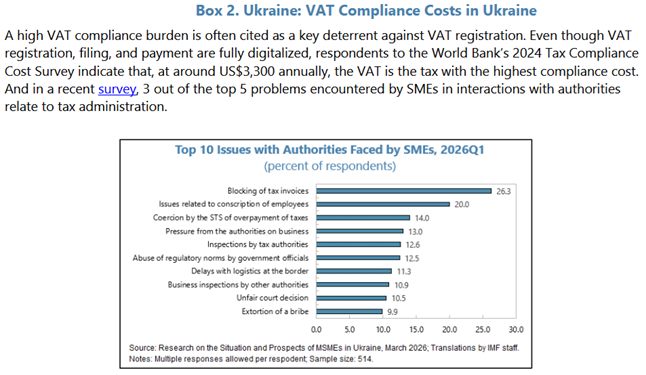
Source: IMF, report on the first review of 21 July 2026, p. 21
We therefore believe that the tax invoice blocking system should be abolished. VAT would be controlled through existing instruments: the VAT prepayment formula and monitoring of filed VAT returns.
Key benefits:
- Restoring the principles of inviolability and innocence to the business environment in VAT administration.
- Eliminating corruption in the unblocking of tax invoices.
- Reducing businesses’ administrative costs and increasing their working capital
Implementation requires amendments to the Tax Code and, once the law has been adopted, the repeal of Resolution No. 1165 and changes in the tax authority’s operational work.
- Abolishing privileged categories of taxpayers.
We believe that the tax authority should apply a risk-based approach at the operational level, as part of risk management. At the same time, we believe there must be a fundamental shift from the criterion of a ‘list of high-risk entities’ to the criterion of high-risk transactions by a specific business entity. This moves the administration system away from the principle of guilt ‘without trial’ towards the principle of innocence, which is important for restoring trust in the tax authority. Our position of principle is also that the Tax Code should not contain criteria for a public club or link tax benefits to membership of such a club.
We therefore propose:
- Removing the provisions on the White Business Club from the Tax Code
- Abolishing the White Business Register created by the tax authority
- Abolishing the benefits created for the club.
Implementation requires amendments to the Tax Code and, once the law has been adopted, the abolition of the White Business Register.
Area 3. Banking and regulatory
- Changes in financial monitoring policy.
We believe that the current stringency of financial monitoring in Ukraine is a direct result of the regulatory policy of the National Bank of Ukraine (NBU). It is the NBU that sets the rules under which commercial banks are forced to act as supervisory authorities over their own clients.
The current system allows Ukraine to report to the IMF and the EU on its efforts against money laundering, but in practice the pressure is unevenly distributed: the main burden falls on ordinary businesses and citizens, even though the system was designed primarily to counter large-scale schemes.
The FATF Recommendations require a ‘risk-based approach’. This means that controls should be targeted (at actual criminals), whereas total control over citizens’ small transactions violates the very spirit of the FATF standards, since it overloads the system and destroys the legitimate economy.
To genuinely restore the principles of the presumption of innocence and of inviolability to banking supervision, Resolution No. 65 and its Annex 20 (Indicators of Suspicious Financial Transactions) need radical reform. However, we believe the NBU is unable to do this on its own, since the current rules are the NBU’s own work. We therefore propose an alternative route through legislative change:
- Restoring the presumption of innocence. The law should establish that all doubts as to the lawfulness of a financial transaction and the sources of a client’s funds are to be interpreted in the client’s favour. It should also provide that a bank has no right to request documents (other than a short fixed list – for example, on the beneficial owner and the purpose of the transaction, if the client is new) where the transaction does not exceed the statutory threshold (currently UAH 400,000), except where there is an official request from law enforcement authorities.
- Enshrining the principle of FATF Recommendation 10 on not interrupting the normal conduct of business. The law should permit financial institutions to complete verification after the establishment of the business relationship, where this is appropriate for practical reasons, where money laundering and terrorist financing risks are effectively managed, and where this is essential not to interrupt the normal conduct of business
- Protecting property rights and living standards. Introduce the concept of a ‘minimum guaranteed (protected) balance’. Add a provision prohibiting restrictions on citizens’ debit transactions where the account balance or monthly transaction volume does not exceed five minimum wages. These funds are to be deemed inviolable for the purposes of financial monitoring.
- Limiting procedural arbitrariness. Add a provision setting a strict deadline: ‘A bank’s internal review of a transaction may not exceed 48 hours. If within this period the bank has not submitted a reasoned report to the SFMS, the funds must be unblocked immediately.’
- Ending automated repressive decisions. Add a provision prohibiting the automatic restriction of individuals’ rights by an IT system: ‘A decision to temporarily restrict a client’s right to dispose of funds shall be taken exclusively by an authorised bank employee, manually, and signed with a qualified electronic signature (QES)’ – that is, with personal accountability.
- Reviewing sanctions against financial institutions. Revise the penalties provided for in Article 32 of Law No. 361-IX towards softer rules and minimal penalties, in particular item 13: for failure to ensure the proper organisation and conduct of primary financial monitoring, the absence of a proper risk management system, or repeated failure to comply with the requirements of state financial monitoring bodies to remedy identified violations and/or to take measures to eliminate the causes that contributed to them – a fine of up to 10% of total annual turnover, but not more than 7,950 thousand tax-free minimum incomes of citizens (a statutory unit used to calculate fines)
Key benefits:
- Restoring the principles of inviolability and innocence to banking supervision
- Upholding the spirit of the FATF standards by concentrating on actual crimes
- Minimising NBU fines imposed on banks in the area of financial monitoring.
Implementation requires amendments to the Law of Ukraine ‘On Prevention and Counteraction to Legalization (Laundering) of the Proceeds from Crime, Terrorist Financing, and Financing of Proliferation of Weapons of Mass Destruction’, followed by amendments to NBU Resolution No. 65 once the law has been amended.
Area 4. Seized asset management
- Changing the approach to ARMA
ARMA’s current activity has turned from an instrument for preserving material evidence into an instrument for pre-trial expropriation of property and the artificial destruction of operating businesses before a court verdict. To restore the principles of inviolability and innocence, we propose the following changes:
1. Prohibiting ‘material evidence’ status for immovable property. Amend Article 100 of the CPC of Ukraine to explicitly prohibit recognising integral property complexes, buildings, plants and land plots as material evidence for the purpose of seizing them or transferring them to ARMA’s management at the pre-trial investigation stage.
2. Prohibiting the removal of the lawful owner from management (immunity of corporate rights). Amend Article 100 of the CPC of Ukraine to establish a mandatory prohibition on transferring a company’s corporate rights to ARMA and on changing its management until a final guilty verdict has been delivered.
Key benefits:
- Preserving jobs and tax revenues: the business continues to operate and pay into the budget, even while an investigation is under way.
- Protecting investment: foreign and domestic investors receive a guarantee that their plants or real estate will not be signed over to a third-party ‘manager’ on the strength of a single district court decision.
Implementation requires amendments to the Criminal Procedure Code.
Area 5. Regulatory and licensing
- Ending commissioned inspections
We believe that unscheduled inspections initiated in response to a complaint from a buyer or consumer – and all the more so on the basis of information from a local authority – are, in today’s world, instruments of pressure on business, of extortion of undue advantage and of unfair competition, with competitors commissioning inspections.
From the standpoint of the free market and common sense, if a buyer refuses a service or a purchase because something does not suit them, the loss of the customer and of profit is an immediate and fair penalty for the business.
Moreover, in today’s world, social media, Google Maps and customer reviews already act as controls on entrepreneurs’ behaviour, and the state is simply a superfluous actor here – especially when its bodies open a case on the premise of a ‘serious offence’.
On the other hand, amid power outages and unreliable internet connections, problems with card payments arise even in large retail chains. We therefore propose:
- Abolishing on-site compliance inspections of business entities triggered by a complaint from a buyer (consumer) (subparagraph 80.2.3 of the Tax Code)
- Abolishing on-site compliance inspections of business entities triggered by information received, in the manner prescribed by law, from state bodies or local self-government bodies (subparagraph 80.2.2)
- Supervising business entities through big data analysis (analysis of the reports they file, of PTR receipts and of the value of goods sold to them as recorded in the VAT system) and other criteria that may raise questions for the tax authority.
Key benefits:
- An end to ‘complaints from competitors’ and ‘commissioned complaints’.
- No more artificial pretexts for visits
- Big data analysis can be carried out through remote requests from the tax authority, without halting the business for an on-site inspection.
Implementation requires amendments to the Tax Code.
- Minimising accounting and licensing pressure.
To reduce pressure on business, protect its inviolability and restore the presumption of innocence, we propose considering two reform scenarios. Both aim to reorient the system from ‘punitive’ to ‘service- and safety-oriented’. Alignment with European directives should completely remove this regulatory pressure by separating taxation from the right to conduct business.
Option 1. Without abolishing the retail excise tax. In this scenario, the tax remains, but the rules, inspection procedures and administration change fundamentally.
- Eliminating licence duplication: Licence fees are abolished entirely. The licence becomes a free electronic extract confirming registration of the outlet. If a business pays excise tax, it should not have to buy an additional ‘right to trade’.
- Decoupling from the number of PTRs: Licensing and accounting requirements apply solely to the retail outlet (address). The number of cash registers on the premises no longer multiplies the financial or regulatory burden.
- Introducing the compliance principle (a warning instead of a fine): A mandatory first warning is introduced. If technical errors are found in excise accounting or PTR receipts, the business is given 30 days to correct the discrepancy, without fines and without suspension of operations.
Option 2. Full abolition of the retail excise tax (the European model). This option involves a far-reaching structural reform and full alignment of legislation with EU directives.
- Abolishing the retail excise tax: Retailers are removed entirely from the list of excise taxpayers. All excise duty is paid once – by the producer or importer when the goods are released for free circulation (as in the EU).
- Dismantling retail reporting: Shops and FOPs are released from the obligation to keep specific excise records and to file monthly excise tax returns. The tax authority loses 90% of its grounds for fining retailers.
- A purely declaratory principle: To start trading, an entrepreneur simply submits an electronic notification (declaration) of the opening of an outlet. State control shifts from ‘checking paperwork and receipts’ to laboratory testing of product quality and safety (combating counterfeit goods).
- Sanctions only by court order: Revocation of the right to trade (closure of a shop) or confiscation of property following any inspection becomes possible only on the basis of a court decision that has entered into force. The tax authority and other supervisory bodies lose the right to block a business unilaterally.
- The presumption of innocence in practice: Since retailers do not charge the tax, any discrepancies in stock records are treated as the business’s internal commercial losses rather than as ‘theft from the state budget’. The burden of proving that goods are illegal or counterfeit rests 100% with the state.
- Redistributing excise revenues: Local budgets’ losses from retail licences and the retail excise tax are to be offset by amendments to the Budget Code and by increasing the share of excise revenues from imports and production allocated to local budgets.
We consider Option 2 preferable, but implementing Option 1 would also significantly improve the situation.
Key benefits:
- A genuine presumption of innocence: compliance as an institution is introduced.
- Removal of licensing pressure: the link between the cost of a licence and the number of cash registers (PTRs) is abolished.
- Data-based audit (desk audits): supervision moves to remote, off-site checks.
- Radical simplification of accounting: retail businesses are fully released from the obligation to keep excise records (Option 2)
- A lower barrier to market entry: entrepreneurs do not have to pay large sums for licences in advance, before they start selling
Implementation requires amendments to the Tax Code; the Law ‘On State Regulation of the Production and Circulation of Ethyl Alcohol, Alcohol Distillates, Bioethanol, Alcoholic Beverages, Tobacco Products, Tobacco Raw Materials, Liquids Used in Electronic Cigarettes, and Fuel’; the Law ‘On the Use of Payment Transaction Recorders in Trade, Catering and Services’; and the Budget Code.
Conclusions
The problems described in this paper have a common source. The state has given supervisory and law enforcement authorities broad powers to interfere in business, but has not balanced them with liability for unjustified interference. As a result, the same pattern recurs across all five areas: the entrepreneur has to prove his innocence, and restrictions apply even before a court decision.
The cost of this model exceeds the amounts in dispute. When a business is halted by the arrest of its assets or the blocking of its accounts or tax invoices, the state forgoes future taxes, employees lose their jobs, and the company often does not survive until the court decision, even if it ultimately wins. Opaque mechanisms for unblocking and for removal from lists of high-risk taxpayers create fertile ground for corruption.
That is why we have focused on legislative change. Adjusting criteria and procedures within existing rules has not solved the problem, since the rules themselves allow business to be restricted before its guilt is proven. The proposed changes rest on four principles:
- guilt is established only by a court;
- while an appeal is pending, a business operates without restrictions that halt its activity;
- oversight targets high-risk transactions instead of dividing taxpayers into ‘white’ and ‘high-risk’;
- the powers of supervisory authorities are balanced by the liability of officials.
We believe that the proposed changes can improve the business climate in Ukraine, and we are open to discussing them with public authorities, business associations and the expert community.