KEY POINTS
On 15 September, the government of Ukraine presented the Budget for 2027. Having analysed the package of documents, we set out below the key points of this Budget:
- The 2027 Budget is a war budget for the whole of 2027.
- Consolidated government expenditure in 2027 will reach UAH 9.9 trillion, or 89.2% of GDP – a record.
- Consolidated government revenue in 2027 amounts to 74.1% of GDP. The budget deficit is 15.1% of GDP.
- The 2027 Budget requires USD 91.2 billion in external financing. Of this, USD 52.5 billion is grants and USD 38.7 billion is loans, at an average hryvnia/dollar exchange rate of 47.1 in 2027. Of this, more than UAH 1,537 billion, or USD 32.6 billion, has no source of financing.
- The government estimates GDP growth in 2027 at 1.3% and inflation at 8.0%. The increase in social standards is 10–11%.
- The government estimates the trade deficit for 2027 at USD 79.7 billion.
- Security expenditure, taking into account in-kind military assistance from international partners – missiles, weapons, equipment, shells and munitions – worth UAH 1 trillion, will amount to UAH 5.9 trillion, or USD 125 billion. This is USD 340 million per day and a new record for security spending.
- The Ministry of Finance estimates public debt at the end of 2027 at 113.9% of GDP, or, at the projected end-2027 exchange rate of UAH 48.3/USD, USD 262.7 billion.
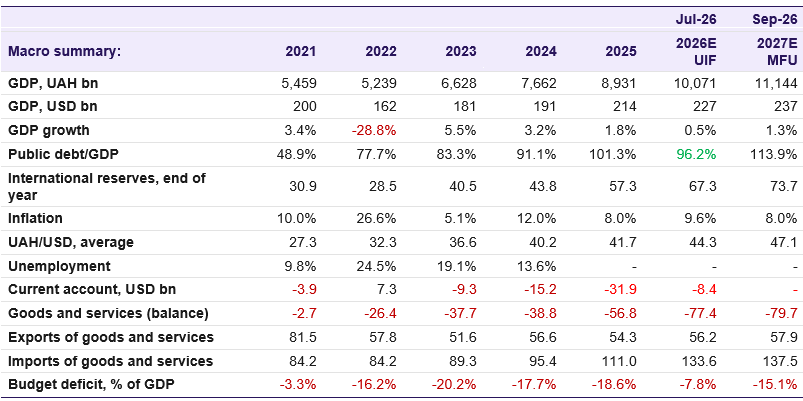
Source: Ministry of Finance of Ukraine, National Bank of Ukraine (NBU), calculations by the Ukrainian Institute for the Future (UIF).
Jul-26 2026E UIF – UIF calculations (July forecast for 2026)
Sep-26 2027E MFU – 2027 Budget of 15 September 2026 by the Ministry of Finance of Ukraine (MFU), with UIF calculations; international reserves – NBU forecast (Inflation Report, Q3 2026)
The 2027 Budget
Under the Budget Declaration for 2027–2029, the 2027 Budget was envisaged in two variants: the first, the baseline, assumed a cessation of hostilities in 2027; the second assumed war throughout 2027. The scenario of war throughout 2027 was chosen when the 2027 Budget was drafted. We can therefore say that the 2027 Budget is a war budget for the whole of 2027.
On the basis of this scenario, the government of Ukraine set economic indicators in which growth of the Ukrainian economy is reduced from 4.5% (baseline scenario) to 1.3% (Scenario 2)
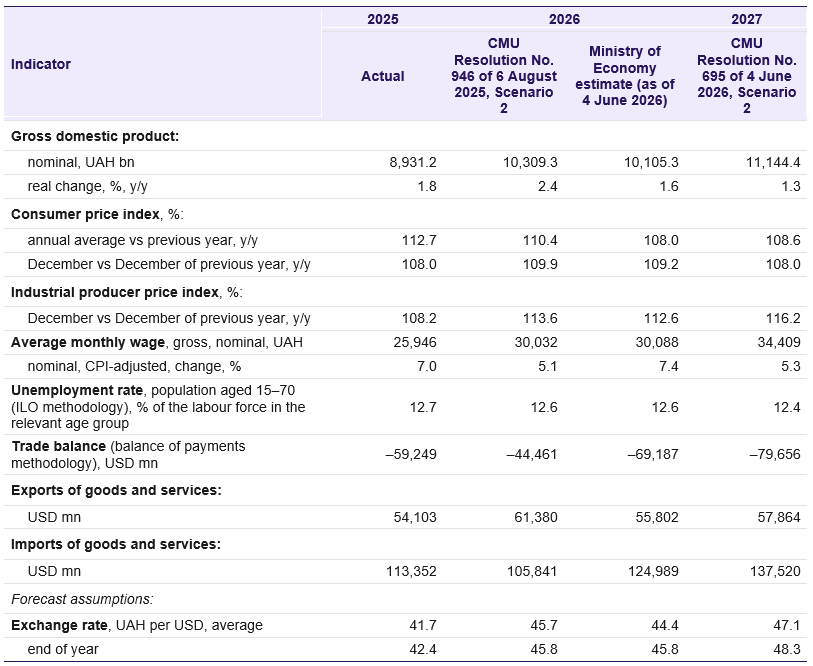
Source: Explanatory Note to the 2027 Budget.
We have analysed all the annexes to the State Budget, compiled the Consolidated Budget for 2027 and must note the following:
- The 2027 Budget is not based on the current tax base. It includes a tax on digital platforms (+UAH 14 billion), which has been voted through but not yet signed by the President. Corporate income tax: the 50% tax on banks for 2026 (+UAH 38.5 billion); taxation of goods in international parcels (UAH 11.8 billion); higher fuel taxes (+UAH 8.3 billion); and an increase in the VAT rate from 20% to 21% (UAH 58.7 billion).
- The 2027 Budget includes UAH 2,473 billion in EU grants as one of the components of grant financing. We believe this is EUR 45 billion of the 90 billion Ukraine Support Loan (USL), which is due to reach Ukraine in 2027.
- We added UAH 1,000 billion of military assistance, which is absent from the Ministry of Finance budget, to non-tax revenue, and UAH 1,000 billion to expenditure under the Defence line, as announced by the Prime Minister when presenting the Budget.
- Current Ministry of Finance calculations of consolidated government revenue in the 2027 Budget produce a figure of 40% of GDP for tax revenue and the single social contribution (SSC), whereas in 2025 it was 35.7% of GDP, and for 2026 our forecast is 37% of GDP. We believe this figure of 40% of GDP is unattainable. In 2026, tax revenue is rising primarily because wage growth is outpacing nominal economic growth and because of record import growth amid stagnating exports, which increases import VAT receipts, while VAT refunds are not growing. The 1% VAT increase and the launch of taxation of digital platforms and international parcels, which have not yet been voted through, will not yield even 1% of GDP in revenue. Wage growth in excess of nominal economic growth is now in serious doubt for businesses, which are suffering from drone and ballistic missile strikes on business premises. The State Budget raises the wage bill in 2027 by 18.3% compared with the amendments made by Draft Law No. 15224 (amendments to the 2026 State Budget). This exceeds nominal economic growth. However, we consider revenue of 38–38.5% of GDP a realistic estimate, which, incidentally, is already 2–3% of GDP more than in Poland and 10–13% of GDP more than in Romania and Bulgaria. Yet, in our assessment, the revenue side is exposed to a shortfall of UAH 150–200 billion, particularly in VAT. In every recent year, actual VAT revenue has come in 1% of GDP below Ministry of Finance targets.
- We must note a sharp reduction in revenue from the NBU in the 2027 Budget. The 2027 Budget includes UAH 48.7 billion, or 0.43% of GDP. In 2026, the budget received UAH 146.1 billion, or 1.45% of GDP. In effect, owing to NBU policy, which encourages the transfer of NBU profit to banks, the budget will lose 1% of GDP in revenue – comparable to the attempt to raise budget revenue by increasing taxes on the real sector of the economy.
- This budget requires a record amount of external financing: USD 52.5 billion in grants included in budget revenue, and UAH 1,822 billion to finance the budget deficit, which we estimate at UAH 1,682 billion, or 15.1% of GDP, and to repay debt principal, which the Ministry of Finance estimates at UAH 162 billion. This amounts to USD 38.7 billion in loans. The result is a record external financing requirement of USD 91.2 billion. By comparison, external financing amounted to USD 31.1 billion in 2022, USD 42.5 billion and USD 40.6 billion in 2023 and 2024 respectively, and USD 52.4 billion in 2025. As of 25 August 2026, Ukraine had received USD 30.5 billion in external financing. Our forecast, however, is that it will receive more than USD 35 billion in additional external financing, primarily through the USL from the EU. This clearly shows the upward trend in Ukraine’s spending. In addition, we must note that the government has only UAH 194 billion, or USD 4.11 billion, in confirmed loan resources out of the USD 38.7 billion for 2027. This creates major risks for financing the 2027 Budget.
- We see that the Ministry of Finance has cut debt servicing costs in the 2027 Budget from UAH 515 billion to UAH 477 billion. However, our forecast for debt servicing costs in 2026 currently remains at UAH 388 billion, and, together with large-scale grant financing in 2027, this item also has reserves, which we estimate at UAH 50–60 billion.
- We see a reserve of UAH 100 billion in administrative expenditure, with salaries raised by 18% in the 2027 Budget.
- Security expenditure in the 2027 Budget amounts to UAH 5.9 trillion, taking into account the statements by the Prime Minister on the 2027 Budget, in which he noted that Ukraine receives in-kind military assistance from international partners – missiles, weapons, equipment, shells and munitions – worth UAH 1 trillion. This is USD 125 billion at the average exchange rate of UAH 47.1/USD, or USD 340 million per day of war in Ukraine.
- We see a large increase in expenditure on economic activity (+60% against our forecast of expenditure on economic activity in 2026). We consider such use of resources highly inappropriate amid constant enemy strikes, except for spending on repairs to critical infrastructure facilities. That said, this past winter also saw a great many strikes on infrastructure and many problems with roads after a very harsh winter. We therefore believe that the limited resources here must be used more rationally. This could provide an additional reserve of UAH 100–150 billion.
- The 2027 Budget provides for an increase in social standards of approximately 10–11%. At the same time, growth in SSC receipts is expected to be higher, as wage growth outpaces economic growth. This makes it possible to minimise transfers from the State Budget to the Pension Fund of Ukraine. It is not yet known which pension indexation coefficients will be applied in March 2027. However, if the figure is around 11%, we believe social expenditure also has a reserve of UAH 100 billion.
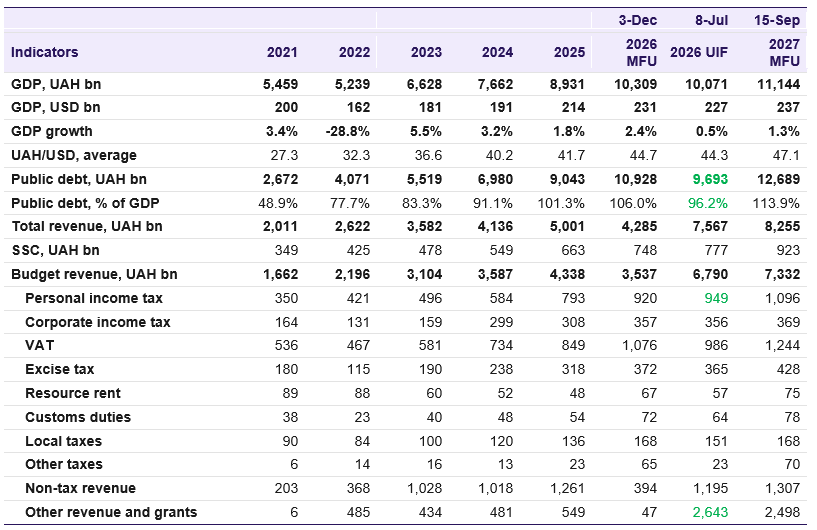
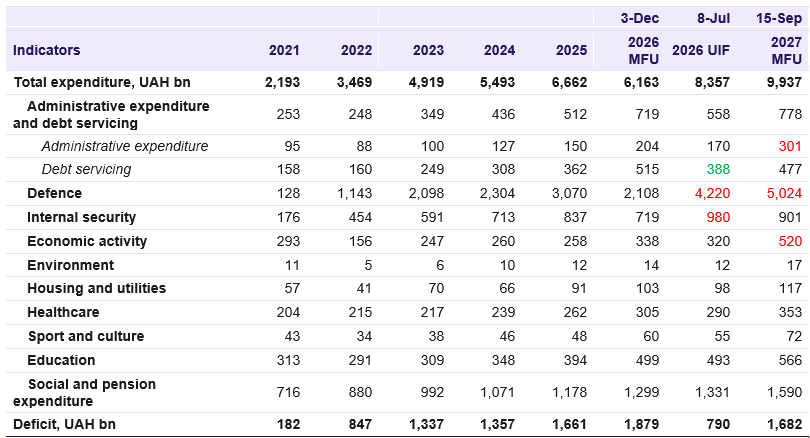
Consolidated Budget 2021–2027. Source: Ministry of Finance, UIF calculations.
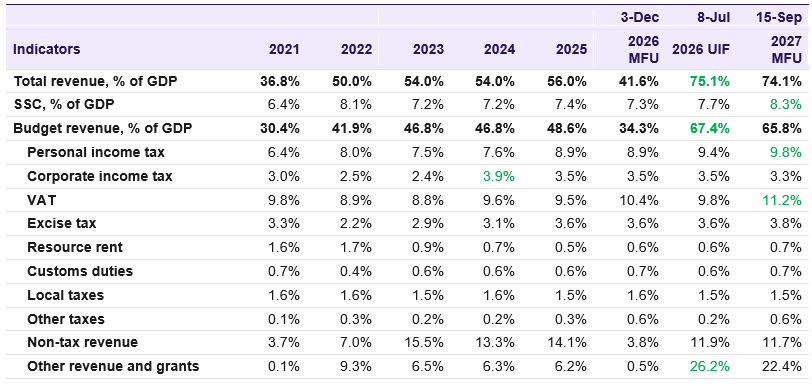
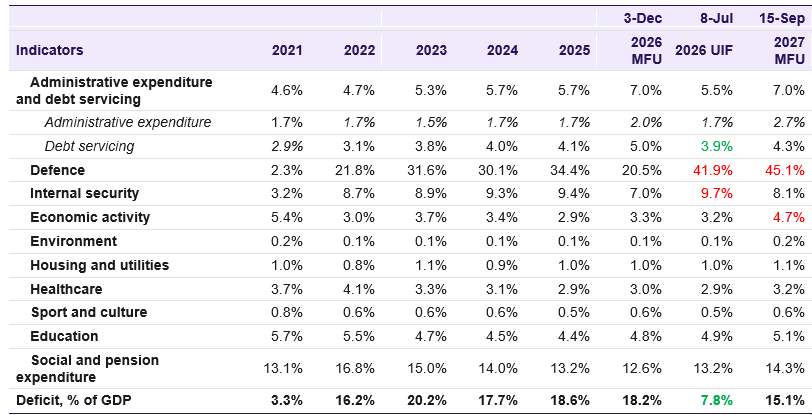
Consolidated Budget 2021–2027, % of GDP. Source: Ministry of Finance, UIF calculations.
This publication was produced by the NGO Ukrainian Institute for the Future with the support of the Askold and Dir Fund, administered by ISAR Ednannia under the project “Strong Civil Society of Ukraine — a Driver of Reforms and Democracy”, funded by Norway and Sweden. The content of this publication is the responsibility of the NGO Ukrainian Institute for the Future and does not reflect the views of the governments of Norway or Sweden or of ISAR Ednannia.