Digests • 12 August 2026
On July 20, the IMF Board approved the first review of the financing programme and authorised the disbursement of a USD 690 million tranche. This digest provides key information on the changes to the programme and the IMF’s new macroeconomic forecasts for Ukraine.
July 30. The Board of the National Bank of Ukraine raised the key policy rate from 15.0% to 15.5%.
On August 6, the NBU released its new Inflation Report for Q3 2026—the key parameters, provisions, and changes — in this digest.
International reserves decreased from USD 51.3 billion to USD 51.2 billion in July 2026.
On July 20, the IMF Executive Board completed the first review of Ukraine’s 48-month Extended Fund Facility (EFF) arrangement, allowing for the immediate disbursement of SDR 503 million (approximately USD 690 million).
The IMF noted the following:
Preserving macroeconomic stability remains an urgent priority. This requires prudent fiscal policy, sustained revenue mobilization efforts, vigilant monetary policy, exchange rate flexibility, and measures to safeguard financial sector stability.
Looking beyond the war, Ukraine’s economic success will depend on accelerating reforms that foster a more dynamic private sector, reduce the share of the informal economy, strengthen governance and the rule of law, improve the investment climate, deepen financial markets, and support EU accession.
The Fund remains committed to supporting Ukraine. Continued implementation of reforms, together with strong donor support, will remain vital to preserving stability, sustaining external financing, and laying the foundations for successful recovery and reconstruction. Readiness to take additional measures, if necessary, will continue to provide an important buffer against potential further shocks.
In this digest, we highlighted key changes to the programme conditions and changes in Ukraine’s macroeconomic forecasts.
The State Statistics Service of Ukraine published a preliminary estimate showing Ukraine’s economy grew by + 0.6% of GDP in the second quarter of 2026. After -0.6% in the first quarter, this brings first-half growth to 0%, indicating stagnation in the Ukrainian economy.
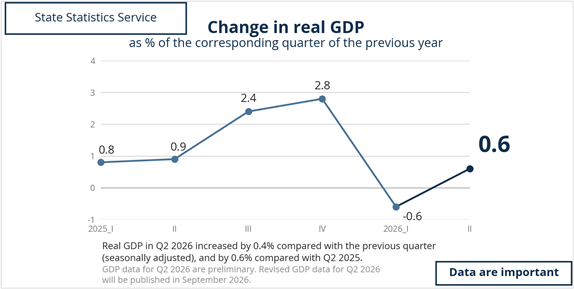
Source: State Statistics Service of Ukraine.
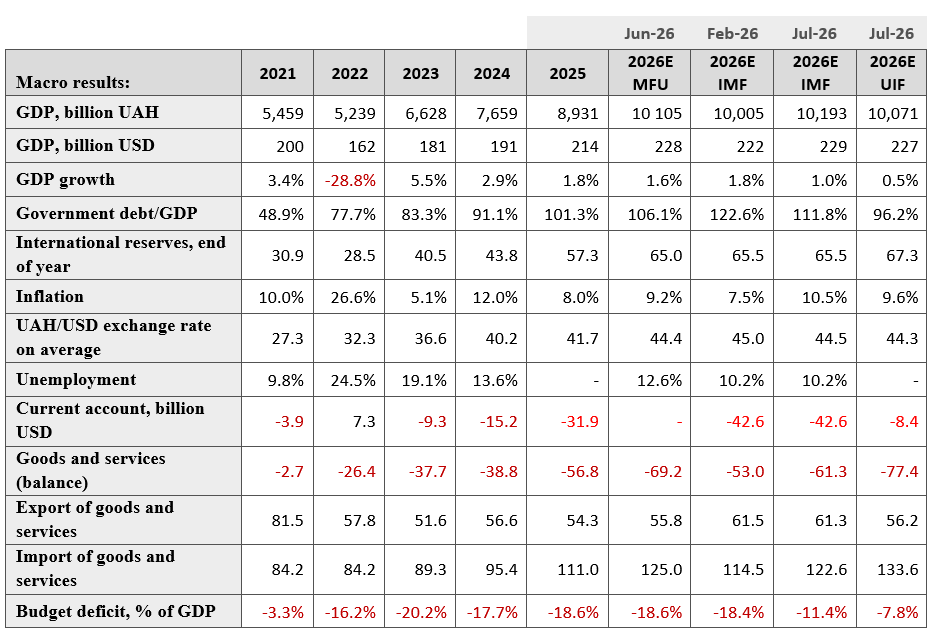
The IMF downgraded its forecast for Ukraine’s economic growth in 2026 from 1.8% to 1.0–1.6%. (1.0% is used in the calculations). The forecast for Ukraine’s nominal GDP in 2026 increased from UAH 10,005 billion to UAH 10,193 billion because the GDP deflator rose from 10.5% to 13%.
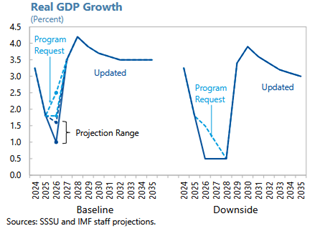
Source: IMF 20.07.2026
The NBU upgraded its GDP growth forecast for 2026 from 1.3% to 1.8%
Consumer prices in July 2026 rose 0.3% from June and 7.7% from July 2025.
Core inflation in July 2026 was 0.3% compared with June, and 8.1% compared with July 2025.
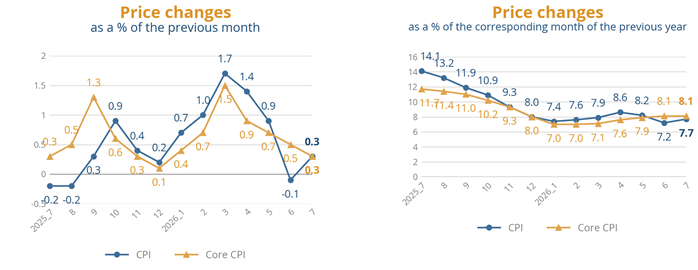
Price changes over the past 12 months. Source: Ukrstat.
In the consumer market in July, prices for food and non-alcoholic beverages decreased by 0.2%. Eggs and vegetables recorded the largest price declines (by 6.0% and 5.9%). Prices for pork, poultry, processed grain products, and lard decreased by 1.3–0.6%. At the same time, prices for fruit, fish and fish products, sunflower oil, non-alcoholic beverages, milk and dairy products, bread, pasta, and sugar increased by 1.5–0.6%.
Prices for alcoholic beverages and tobacco products increased by 1.5%, driven by a 1.8% increase in tobacco product prices.
Clothing and footwear became 4.8% cheaper, with clothing down 5.8% and footwear down 3.5%.
The 1.6% increase in prices (tariffs) for housing, water, electricity, gas and other fuels was mainly due to increases in water supply tariffs by 31.9% and sewerage by 29.8%.
Transport prices increased by 1.3% mainly due to increases in fares for road and rail passenger transport by 6.0% and 2.7%, respectively.
The IMF downgraded its 2026 inflation forecast for Ukraine. It revised inflation upward from 7.5% to 10.5%.
The NBU downgraded its 2026 inflation forecast for Ukraine. It revised inflation up from 9.4% to 10.0%. It expects inflation to peak at the end of 2026. Inflation will then begin to decline.
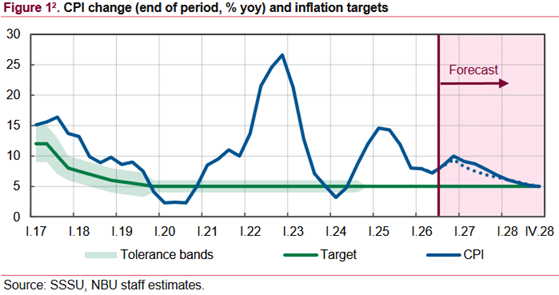
Source: NBU. Inflation Report, Q3 2026.
On July 30, the Board of the National Bank of Ukraine decided to raise the key policy rate to 15.5% in view of the sustained increase in underlying price pressures and a more significant acceleration in headline inflation towards the end of the year. The increase in the key policy rate aims to maintain the attractiveness of UAH-denominated assets, the stability of the foreign exchange market, and well-anchored inflation expectations, making it possible to return inflation to a downward trajectory towards the 5% target as early as 2027. The NBU remains ready to use its monetary policy instruments, including further interest rate tightening, to contain price pressures.
The National Bank’s current forecast allows for the possibility of a further increase in the key policy rate and a return to the monetary policy easing cycle in Q2 2027. At the same time, the NBU will respond flexibly both to inflation dynamics and to changes in the balance of risks.
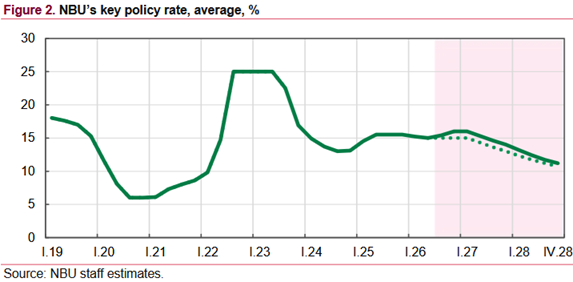
Source: NBU rate forecast. Inflation Report, Q3 2026
In the first 6 months of 2026, the consolidated budget deficit amounted to UAH 255.8 billion, compared with UAH 510.6 billion in 2025.
Tax revenues in the first 6 months of 2026 were UAH 230 billion higher than in the first 6 months of 2025. This was mainly due to higher personal income tax revenues (nominal wage growth), excise tax revenues (tax increases), and VAT revenues (nominal growth in the economy and imports).
In the first half of 2026, the budget received more grant funding than in all of 2025.
Expenditures in the first half of 2026 amounted to UAH 3,064 billion, which is UAH 447 billion more than in 2025. Spending on defense and internal security was UAH 295 billion higher than the previous year.
Spending also rose significantly on education (+UAH 47.9 billion) due to higher teacher salaries, and on social benefits (+UAH 39.3 billion) due to government payments to the population.
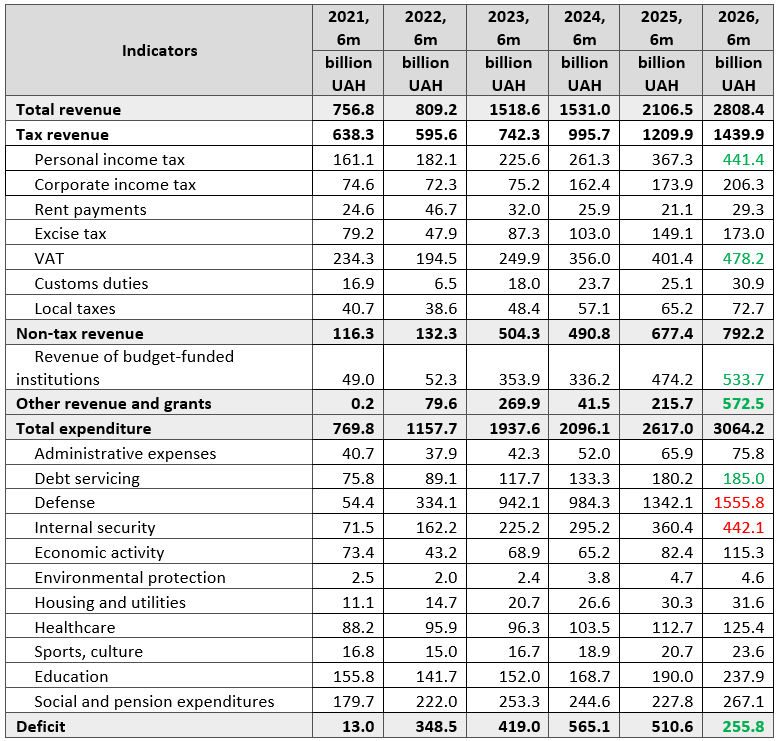
Source: Ministry of Finance.
In July 2026, financing was received from the following sources:
The EU provided USD 5.1 billion in financing. This is the 2nd tranche of military assistance under the EUR 90 billion Ukraine Support Loan (EUR 28.3 billion in total in 2026).
Ukraine received USD 683 million from the IMF. This is the second tranche under the new IMF programme. In the first 7 months of 2026, IMF financing amounted to approximately USD 2.2 billion out of the USD 3.8 billion expected under the new programme in 2026.
As of July 1, government cash balances amounted to UAH 453 billion. These funds are sufficient to finance budget expenditures until mid- or late September even without any additional inflows.
In June 2026, Ukraine’s public and publicly guaranteed debt rose from USD 210.5 billion to 211.6 billion (+USD 1.1 billion).
The debt rose because of the EU loan under the Ukraine Facility.
However, government debt effectively did not increase in the first half of 2026. It decreased from USD 213.3 billion to 211.6 billion. In nominal UAH terms, public and publicly guaranteed debt rose from UAH 9.042 trillion to 9.490 trillion, due to the depreciation of the UAH against the USD and EUR.
The IMF recalculated its forecast for consolidated public finances through the end of 2026 and beyond.
Key points:
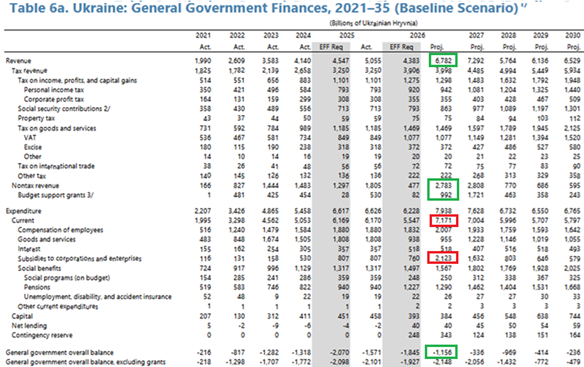
Consolidated budget 2021–2030. Source: IMF 20.07.2026.
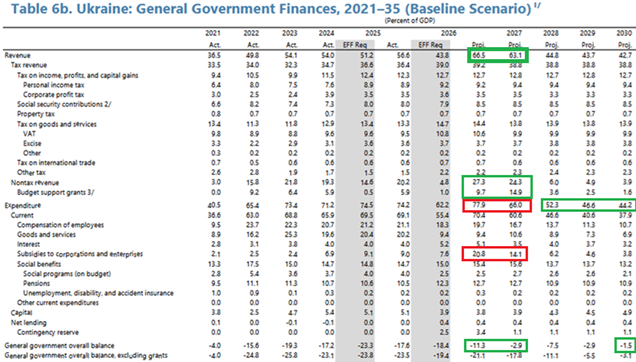
Consolidated budget % of GDP 2021–2030. Source: IMF 20.07.2026
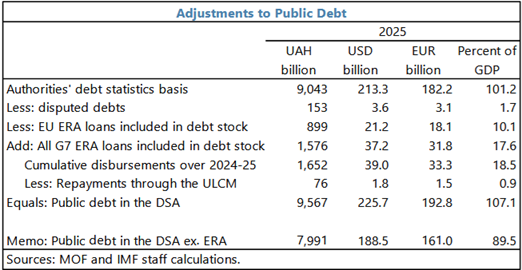
Difference between the IMF and Ministry of Finance public debt calculations at the beginning of 2026.
Source: IMF as of 20.07.2026.
Among the significant changes to the IMF programme, we should highlight the following:
Balance of payments
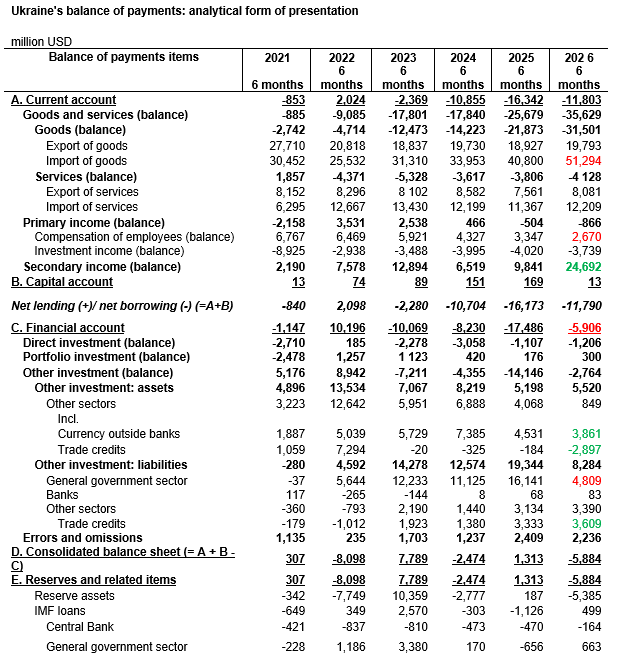
The balance of payments for the first half of 2026 was negative. The trade deficit continues to set records. In the first 6 months of 2026, the trade deficit amounted to USD 35.6 billion, up USD 10 billion from 2025 (USD 25.6 billion). Imports of goods exceeded exports of goods by more than 2.5 times (USD 51.3 billion versus USD 19.8 billion).
We should also note the continued downward trend in remittances from labour migrants to Ukraine. In the first 6 months of 2026, remittances were already more than 2 times lower than before the start of the war (USD 2.67 billion versus USD 6.77 billion in 2021). This reflects demographic processes, as there are increasingly fewer people left to send money to.
In the first half of 2026, Ukraine already received UAH 569 billion in grants to the budget. This is more than it did in all of 2025. As a result, secondary income is at a record level, with USD 24.7 billion received under this item in the first half of 2026.
However, in the first half of 2026, the current account was negative at USD 11.8 billion. This is better than in 2025, primarily due to grant assistance.
The financial account was positive at USD 5.9 billion in the first half of the year. Primarily due to new trade credits and the repayment of trade credits that were moved abroad in 2022. This amount exceeds USD 6 billion.
The decline in household demand for cash foreign currency should also be noted. Less was purchased than in any of the previous years of the war (2022–2025).
Source: NBU.
We are seeing positive signals from the Middle East that, in our view, could eventually lead to sustainable peace in the region. These developments include lower oil prices and a stronger EUR against the USD, from 1.13 to 1.15–1.16.
The NBU already began responding to these changes in late July and early August, weakening the UAH against the EUR and strengthening the UAH against the USD.
We believe that, given the significant financing available to Ukraine and the NBU’s increase in its inflation forecast to 10% in 2026, the NBU will keep the UAH/USD exchange rate within the range of 44.5–45.0 in August.
We expect the UAH/EUR exchange rate to remain within the range of 51–52 UAH / EUR.
We calculated the exchange rate the IMF used in its 2026 calculations. It is an average exchange rate of 44.5 UAH per USD.
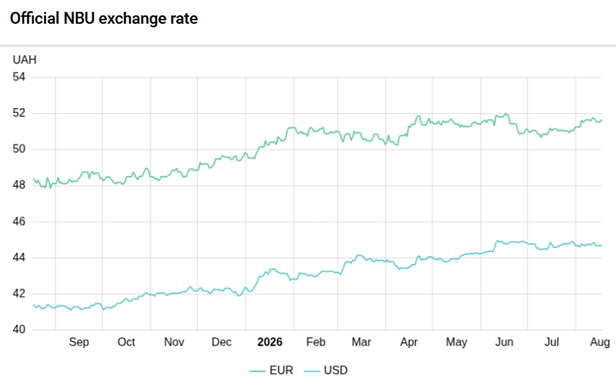
UAH exchange rate against the USD and EUR over the past 12 months. Source: NBU.
The IMF significantly revised its outlook for Ukraine’s balance of payments for 2026 and 2027. This is primarily due to financing inflows from the EU during these years. The main changes to the balance of payments are:
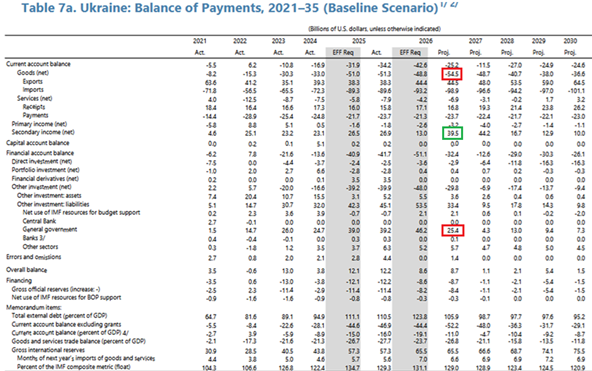
Source: IMF as of 20.07.2026.
The NBU significantly worsened its trade deficit forecast published in the Inflation Report for Q3 2026. The trade deficit forecast was increased from USD 58.2 billion to 89 billion. This is approximately 39% of GDP. At the same time, the forecast for exports of goods and services fell from USD 61.6 billion to 56.1 billion, while the import forecast rose from USD 119.8 billion to 145.1 billion.
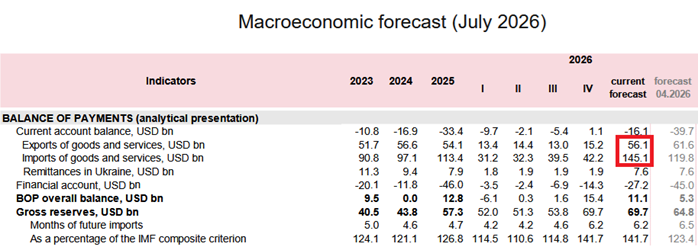
Source: NBU. Inflation Report. Q3 2026.
Ukraine’s international reserves decreased from USD 51.3 billion to 51.2 billion in July 2026.
According to balance sheet data, in July the NBU sold USD 4 758.3 million on the foreign exchange market and purchased USD 1.8 million. Net foreign currency sales amounted to USD 4 756.5 million.
In July, USD 1 640.6 million was received into the government’s foreign currency accounts at the National Bank, including:
In addition, Ukraine received USD 5.1 billion from the European Union as part of the defence tranche under the Ukraine Support Loan programme. These funds are not included in Ukraine’s international reserves due to their restricted (earmarked) purpose. At the same time, if the government sells these funds to the National Bank in exchange for UAH for subsequent use for their designated purpose, international reserves increase by the corresponding amount. In July, the government converted USD 3.43 billion of these funds into UAH, which contributed accordingly to the increase in international reserves.
A total of USD 515.4 million was paid for servicing and repaying public debt in foreign currency, including:
In addition, Ukraine paid USD 174.2 million to the International Monetary Fund.
Current international reserves provide financing for 4.2 months of future imports.
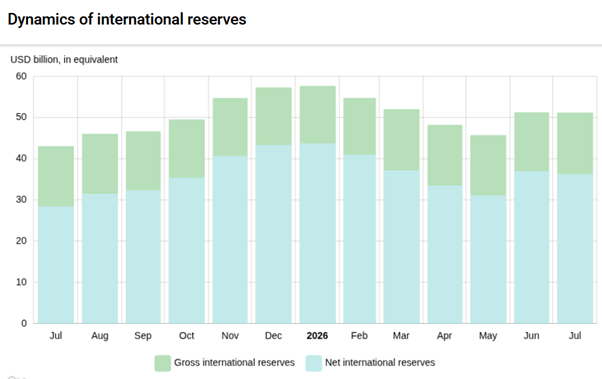
Change in international reserves over the past 12 months. Source: NBU.
September 15. Government of Ukraine. Budget 2027. Submission to the Verkhovna Rada.



Together we can change the future! Your support allows us to continue our research and provide objective analysis of key social issues. Join us today to build the future of our generations together.
Support