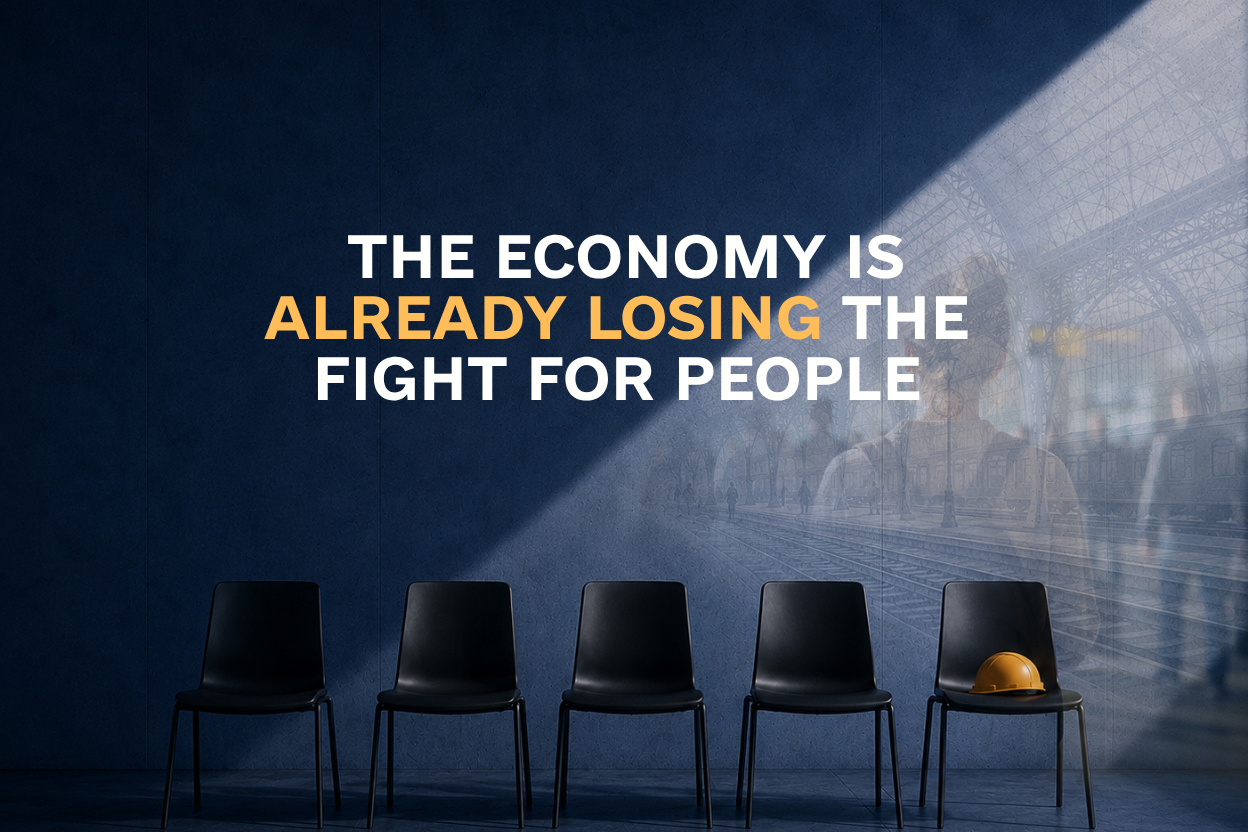
Ukraine will emerge from this war with a loss no amount of international aid can offset: its people. Millions have left. Hundreds of thousands are in the military.
Ukraine’s demographic pyramid, already unsteady before 2022, is now collapsing faster than the economy can absorb. This is a structural constraint that will define the limits of postwar recovery for the next 10 to 15 years. And it is already biting: businesses cannot find workers, the price of labour is climbing, and labour shortages are becoming as significant a constraint on growth as the cost of capital.
The question is no longer whether Ukraine needs a migration policy. It is what that policy will look like — and who will write it.
The Ukrainian Institute for the Future (UIF) has worked on demography and migration since 2018. This project builds on that work and turns it into a concept ready to be translated into policy.
We answer four questions on which the country’s economic future depends.
➡ Where Ukraine has already lost people: sectors, regions, professions.
➡ What inaction costs: the economic impact of the losses already incurred, and of those still to come if nothing changes — with a methodology anyone can check.
➡ Which countries Ukraine should learn from — and which it should not emulate. Countries that faced demographic ruptures before us answered them differently: some solutions worked, others failed. We set out what works, what does not, and under what conditions.
➡ What to do. A migration-policy framework resting on three pillars: an economic rationale, a realistic roadmap, and a clear-eyed map of the risks. The result: recommendations for government, business, and the expert community, developed to the level of terms of reference for regulation.
A series of analytical publications.
Two expert events — a closed-door roundtable with business and a public discussion. A risk map and a comparative analysis of international experience.
Separately, a publicly available interactive calculator of migration’s economic impact. Anyone will be able to test the scenarios and assumptions for themselves.
Ultimately, the project delivers a conceptual framework for Ukraine’s migration policy — the foundation for a full policy document.
Government — a policy framework it can take to the Verkhovna Rada, not a blank page.
Business — an economic rationale and a mechanism for attracting workers that is resilient to the next reshuffle at the ministry.
The expert community — open data and a methodology for its own calculations.
International partners — a Ukrainian position aligned with the regional context.
Someone will write this policy. The only question is whether it will be grounded in evidence, an honest risk assessment, and international experience — or become one more reactive answer to one more crisis.
We are doing the former — and we invite you to join. The project is open to cooperation with media, business associations, donor organisations, and expert institutions: from media partnerships and joint events to support for individual research strands and research collaboration.