Digests • 05 June 2026
Monthly Energy Digest – May 2026
In May, the Ukrainian power system operated in a pre-crisis mode and remained stable. Three nuclear power units were undergoing planned maintenance, and hydroelectric generation was lower than expected due to low flood levels. Thermal generation was also low because of damage from Russian attacks. Despite this, according to the electricity market operator, there were no shortage hours in the power system in May. Solar generation and imports covered the decline in output from other generation sources. Accordingly, the system operator did not apply consumption-restriction measures to consumers. However, outages occurred regularly across various regions due to equipment damage from Russian shelling.
In May, Ukraine imported 398,0 thousand MWh, which is 28.7% less than the 558,3 thousand MWh imported in April. Export rose 2.8 times, but in absolute terms the increase is relatively small – 94.1 thousand MWh in May compared to -33.3 thousand MWh in April.
The electricity export patterns were influenced by the domestic market deficit and price differences with neighboring European nations. In May, solar power production caused European prices to drop sharply. When neighboring countries’ prices fell below Ukraine’s, exports decreased. Ukraine’s prices are mainly affected by a capacity shortage caused by Russian strikes. However, there were instances, like from May 3–11, when Ukraine’s prices were the lowest among neighbors. During these times, electricity exports tended to rise.
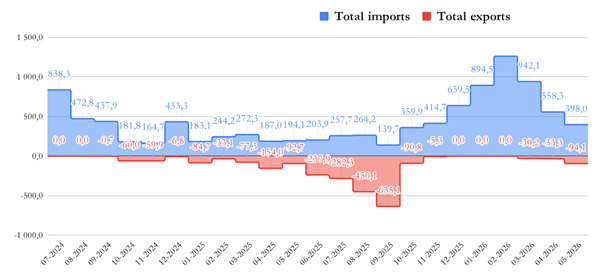
Monthly electricity export and import volumes for the recent year
(based on ENTSO-E data)
More than half of the electricity was imported from Hungary. Shares from other supplying countries remained the same as in April.
May and April import comparison (based on ENTSO-E data)

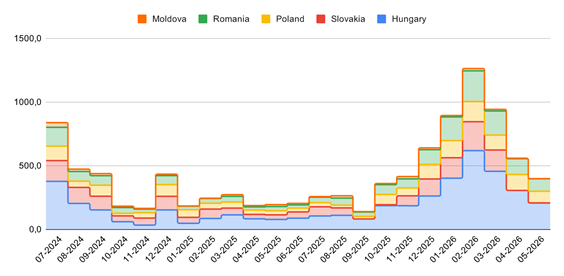
Monthly electricity import volumes by partner countries
May and April export comparison (based on ENTSO-E data)
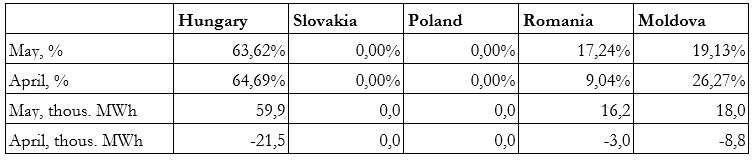
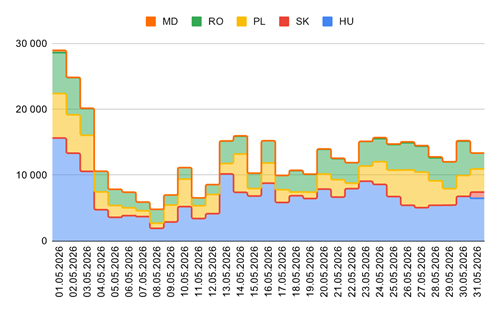
Daily volumes of electricity imports by countries of origin, MWh
(based on ENTSO-E data)
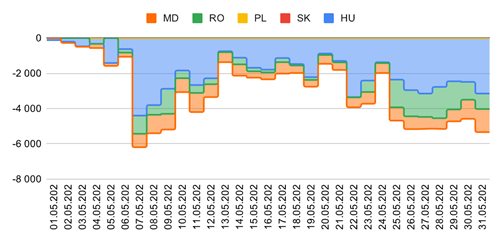
Daily volumes of electricity exports by countries of origin, MWh
(based on ENTSO-E data)
The debt of water utility companies as of the end of 2025 exceeded UAH 10 billion. 85% of all debts were owed by only two enterprises – KP KharkivVodokanal and KP Voda Donbasu (The Water of Donbas).
At the same time, some water utilities continue to demonstrate a high level of payment discipline. In 2025, 31 water utilities maintained electricity payment levels above 95%. Some companies achieved a settlement rate of over 100%.
These unpayments are among the key reasons for growing debts in the balancing market, posing a threat to the transmission system operator Ukrenergo, the operation of the power system, and the launching new power-generating facilities.
In May, the average weighted price of electricity on the day-ahead market (DAM) fell by 9.8% to UAH 5,222.67/MWh, down from UAH 5,791.59/MWh in April. The main reason for the price decrease was a significant increase in daytime solar generation.
Despite all fears and speculation, the introduction of a new price cap at UAH 15,000/MWh from May 1 did not trigger the predicted price jump, as the spring increase in solar power generation provided sufficient supply, and there was no shortage in the power system. In the short term, pricing will be determined by the balance between demand and available generation, with the key risk being a potential increase in capacity shortages due to further damage to infrastructure from Russian strikes.
On May 26, the NEURC approved setting the tariff for electricity transmission by NPC Ukrenergo at UAH 903.53/MWh (excluding VAT), effective July 1, 2026, which is 21.62% higher than the current tariff. The electricity transmission tariff for green electrometallurgy was set at UAH 535.97 per MWh, representing a 42% increase. The implementation of Ukrenergo’s special obligations to pay for electricity from RES is UAH 367.56/MWh. The dispatching tariff was increased by 7.83% to 118.64 UAH/MWh.
Ukrenergo proposed establishing the electricity transmission tariff at 958.87 UAH/MWh effective July 1, 2026, which is 29% higher than the current rate (742.9 UAH/MWh), and increasing the dispatching tariff by 55.5% to 171.12 UAH/MWh (currently 110.03 UAH/MWh). According to Ukrenergo’s calculations, the tariff component for fulfilling special obligations to RES generation within the transmission tariff will amount to 379.27 UAH/MWh, an increase of 18.93 UAH/MWh compared with the current indicator.
Ukrenergo explained the need to revise the tariffs by adjusting the forecast balance, reflecting the growth of the euro exchange rate, raising price caps in the electricity market, and increasing costs for restoring energy infrastructure after the Russian attacks. Besides, the company has to spend more to pay for the feed-in tariff for households that installed rooftop solar PV panels.
According to new calculations, the volume of electricity transmission will be is 5.5% less than the figure set in the current tariff. Mostly this was caused by new power generation installed behind the meter by companies and households, mostly solar.
The Ukrainian Cabinet of Ministers has approved an open tender for over 1.3 GW of new distributed generation capacity. This initiative, part of the National Resilience Plans, aims to boost energy security and reduce the deficit. All facilities are projected to be operational by the end of 2027.
The tender provides for the construction of shunting power plants with a total capacity of 1322 MW in four regional lots: 250 MW in Kyiv, Kyiv, and Chernihiv regions; 872 MW in Sumy, Kharkiv, and Poltava regions; 100 MW in the Dnipropetrovsk region; 100 MW in the Odesa region.
Support will be provided under the market premium mechanism when the electricity price is lower than the cost determined in the tender. Support will not be available around the clock, but only during certain peak hours of the power system, when capacity shortages are expected. The hours of support will depend on the time of year. The winners will receive payment for the service of ensuring the development of generating capacity at a maximum price of 27.92 euro cents per kWh, including VAT, for five years after the facility is put into operation.
Also, the new generation must be able to start from a stopped state within 30 minutes; provide continuous operation for at least 16 hours; operate in frequency restoration reserve mode; and have a second level of engineering protection for critical infrastructure.
The Cabinet of Ministers of Ukraine has approved updated rules for auctions to distribute support quotas for renewable energy facilities. The government’s announced support is allocated across different power generation technologies. The largest share, 700 MW, is allocated to the construction of wind energy facilities. 150 MW is allocated to the development of projects using biomass, biogas, and small hydropower facilities, while 50 MW is allocated to traditional solar generation.
For the first time, as part of “green” auctions, the government has allocated a dedicated 100 MW quota for solar power plants that will operate in combination with industrial energy storage facilities. The government has increased support for renewable energy sources in 2026 to 1 GW, slightly reducing the total projected support for alternative sources to 340 MW in 2027.
Investor support will be implemented under an updated procedure through the market premium mechanism, which compensates for the difference between the market price of electricity and the price set at the auction. Auctions will be held in the electronic trading system Prozorro. Sales will be conducted on a regional basis, with clearly defined territories that require additional capacity. The maximum starting price for auction participants is fixed at 8 euro cents per 1 kWh for solar and wind energy, and 12 euro cents per 1 kWh for other alternative sources.
The Ministry of Energy of Ukraine has approved a new composition of state representatives on the Supervisory Board of NPC Ukrenergo. It includes Yuriy Boyko, Yegor Perelygin, and Mykola Brusenko.
In total, the Supervisory Board of NPC Ukrenergo consists of 7 people: four independent members elected through a competition, and three representatives of the state. All previously elected independent representatives retain their positions, so the Supervisory Board is now fully formed.
Following an open, competitive selection, the Supervisory Board of UkrHydroEnergo PJSC elected Bohdan Sukhetsky as the company’s CEO. He has worked at UHE since 2010. Previously, he served as Deputy General Director for Commercial Activities and has been acting as the company’s General Director since May 2025.
Two foreign independent members of the Energoatom Supervisory Board, Patrick Fragman and Brice Bouyon, have decided to resign. Energoatom noted that both members of the Supervisory Board, like the other five, will continue to perform their duties until the established transition procedure is completed, and that the company’s and the Supervisory Board’s work will continue as usual. Patrick Fragman explained his decision by new professional obligations, in particular, the offer of full-time work. Brice Bouyon, for his part, announced his early resignation due to the significant operational workload associated with the Supervisory Board’s work.
By the end of the month, daily gas consumption dropped to 21-25 mcm. Domestic gas production is affected by Russian attacks, but it remains sufficient to cover demand, with the remainder pumped into storage facilities. In May, natural gas imports were at a minimal level: net import amounted to 33 mcm, which was stored.
The National Energy Regulatory Agency of Moldova (ANRE) introduced special conditions for using the Trans-Balkan route in the Moldova-Ukraine direction through the interstate connection points of Causani and Grebenyky. Suppliers and traders shipping natural gas via this route will receive a 90% discount on the toll for entering Moldova’s gas transport network to transit gas to Ukraine. The new transportation service will begin on October 1, 2026, at the start of the next gas year.
This should increase the attractiveness of the Trans-Balkan route, particularly for creating natural gas reserves. The adopted decision is part of the roadmap under the regional initiative CESEC (Energy Connectivity in Central and South-Eastern Europe).
The Court of the International Financial Center “Astana” (Kazakhstan) officially approved an arbitration award that allows the forced recovery of approximately $1.4 billion from Gazprom in favor of NJSC “Naftogaz of Ukraine”.
The decision concerns a claim for breach of the terms of the 2019 transit contract, when, in the spring of 2022, the operation of the Sokhranivka checkpoint was blocked due to Russian aggression. Despite the force majeure, the Ukrainian side continued to transport fuel through the alternative point “Sudzha,” but the Russian monopolist unlawfully reduced payments. The decision became the first public precedent in international practice, as a foreign court of an individual state gave the green light to the implementation of this arbitration obligation.
At the same time, Kazakhstan’s Ministry of Justice announced that it is impossible to implement the decision in the “Gazprom” and “Naftogaz” case. The relevant minister explained this position by citing the lack of key elements that would connect the trial to the legal framework of Astana’s financial center. The minister emphasized that the country does not plan to serve as an intermediary for implementing legal verdicts that have no direct legal connection to its jurisdiction.
On May 26, the NEURC approved the transition of the underground gas storage operator, JSC UkrTransGaz, to incentive RAB regulation. The new European model took effect on June 1, 2026, and will be accompanied by changes to tariffs for injection, storage, and withdrawal of natural gas. The approved multi-year parameters of incentive regulation and the new rules will remain unchanged at least until March 31, 2029.
Along with that decision, the energy regulator reviewed tariffs. The storage tariff was decreased by 9 percent, while the injection and withdrawal tariffs were increased by 16 percent and 13 percent, respectively.
On May 26, the NEURC adopted a resolution allocating capacity at the entry and exit points of gas transportation systems on interstate interconnections, in MWh per day, for the gas year 2026/2027. For domestic points, the unit of measurement of capacity will remain thousand cubic meters per day. The GTS operator of Ukraine must ensure that auctions for the allocation of capacity on interstate interconnections are held in MWh per day for the gas year 2026/2027 by October 1, 2026.
The required changes relate to implementing Commission Regulation (EU) 2017/459 on capacity allocation mechanisms in the GTS and Regulation (EU) 2024/1789. By 5 August 2026, network codes and guidelines must cover interconnection points within the EU and entry and exit points from third countries, especially Ukraine.
To convert tariffs into MWh per day, it is proposed to apply a coefficient of 10.64 kWh/cubic m, corresponding to the higher calorific value.
President of Polish Orlen Group, Ireneusz Fonfara, said that the company is interested in expanding its presence in Ukraine and is negotiating a possible purchase of a stake in JSC Ukrnafta. Fonfara stressed that the Ukrainian market is extremely important to the group, especially for the Mažeikiai oil refinery, which sells almost 18% of its products in Ukraine. Fonfara said Orlen had already begun negotiations regarding its possible participation in Ukrnafta.
The Cabinet of Ministers has allocated UAH 3 billion from the reserve fund for the installation of 216 block-modular boiler houses, in particular, in Kyiv. The government is allocating UAH 966 million to the Recovery Agency for projects in Kyiv and other regions. The remaining over UAH 2 billion will be provided as part of the implementation of resilience plans. All equipment must be put into operation no later than October 1.
The National Anti-Corruption Bureau of Ukraine has conducted searches at two members of the NEURC as part of an investigation into a case involving former Deputy Head of the President’s Office, Rostyslav Shurma. The investigation is examining the possible involvement of officials in advising Rostyslav Shurma on the mechanisms for receiving payments under the green tariff for power plants located in the temporarily occupied territories of the Zaporizhzhia region.
Investigative actions were conducted at the premises of Kostyantyn Ushchapovsky and Oleksandr Formagey. Ushchapovsky has worked at the NEURC since December 2021 and headed the Regulator in 2022. Formagey served on the Commission from 2018 to 2019 and has been a member since 2021.
This publication was created by the Ukrainian Institute of the Future with the support of the Askold and Dir Foundation, administered by ISAR Unity as part of the project “Strong Civil Society in Ukraine – a Driver of Reforms and Democracy” funded by Norway and Sweden. The content of the publication is
the responsibility of the Ukrainian Institute of the Future and does not reflect the views of the governments of Norway, Sweden, or ISAR Unity.


Together we can change the future! Your support allows us to continue our research and provide objective analysis of key social issues. Join us today to build the future of our generations together.
Support