Digests • 12 May 2026
On April 23, the European Council approved the provision of a EUR 90 billion loan to Ukraine. This is a reparations loan.
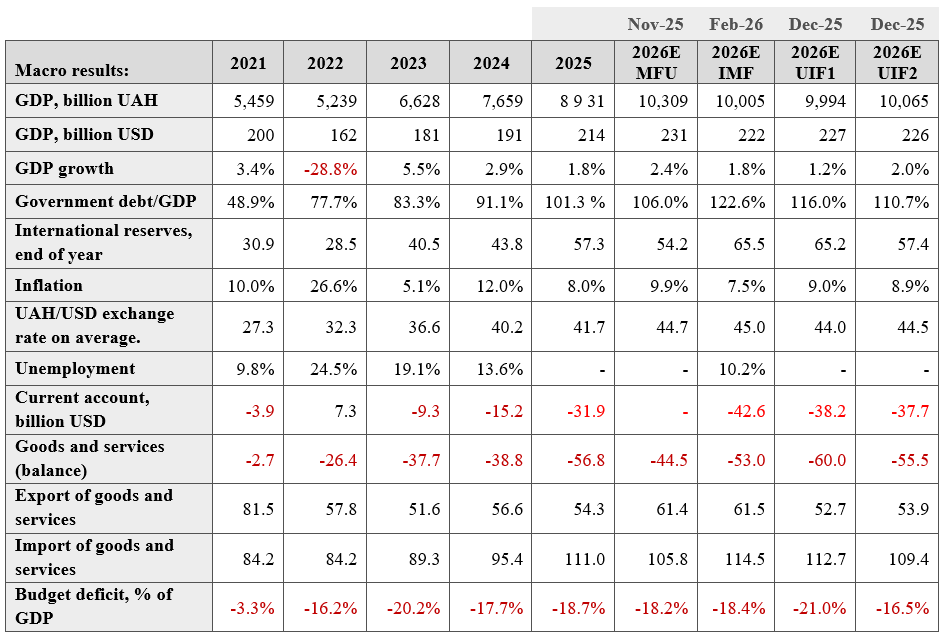
Ukraine’s trade deficit for Q1 2026 amounted to USD 17.4 billion. This is USD 5.4 billion more than in 2025.
On April 29, the NBU kept the key policy rate at 15%.
On May 7, the NBU updated its Q2 2026 inflation forecast in the Inflation Report. Economic growth in 2026 was lowered from 1.8% to 1.3% of GDP. Inflation rose from 7.5% to 9.4%. Find more details in this digest.
International reserves in April 2026 decreased from USD 52.0 billion to USD 48.2 billion.
EUR 90 billion loan from the EU.
On April 23, the European Council approved the provision of a EUR 90 billion loan to Ukraine. This step will allow the Commission to start disbursements as soon as possible in the second quarter of 2026.
The loan will help cover the country’s most urgent budgetary needs and defense industrial capacity needs in 2026 and 2027. The financing will be linked to strict conditions on Ukraine, including adherence to the rule of law, particularly in the fight against corruption.
The Ukraine support loan will be financed through EU borrowing on capital markets and will be backed by the EU budgetary headroom. The loan is to be repaid from the reparations that Russia must pay to Ukraine.
The financing will help strengthen the European and Ukrainian defense industries. It will be provided in two ways, with the following indicative allocation:
Ukraine is to receive EUR 45 billion to support the implementation of Ukraine’s Financing Strategy in 2026, with the following allocation:
EUR 8.35 billion — through macro-financial assistance;
EUR 8.35 billion — through the Ukraine Facility;
EUR 28.3 billion — to support Ukraine’s defense-industrial capacity.
Ukrstat estimated GDP growth in Q1 2026. Preliminary estimate — an economic decline of 0.5%.
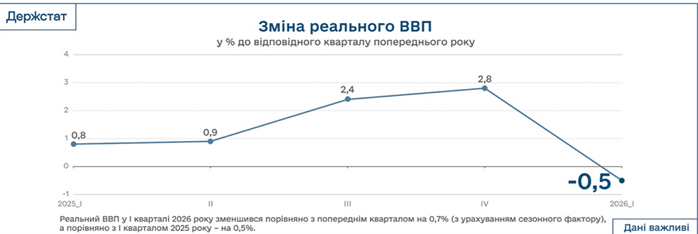
Figure translation
Change in real GDP
% year-on-year (compared to the corresponding quarter of the previous year)
The NBU downgraded its forecast for Ukrainian economic growth from 1.8% to 1.3% in 2026.
Consumer market inflation in April 2026 compared with March stood at 1.4%, and compared with April 2025, at 8.6%.
Core inflation in April 2026 compared with March stood at 0.9%, and compared with April 2025, at 7.6%.
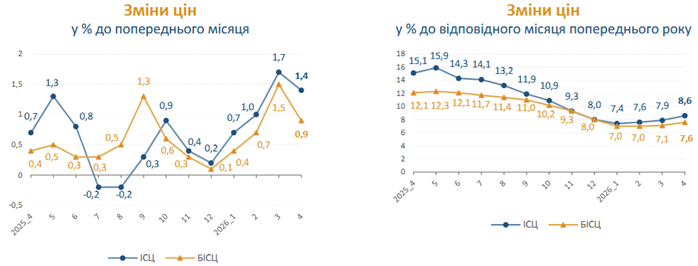
Price changes over the past 12 months. Source: Ukrstat.
Figure translation
Price changes
as a % of the previous month
Price changes
as a % of the corresponding month of the previous year
CPI
Core CPI
In the consumer market, food and non-alcoholic beverage prices increased by 1.9% in April. Products of grain processing rose the most (by 16.7%). Prices for sugar, sunflower oil, bread, pasta, fish and fish products, meat and meat products, fruit, vegetables, and rice increased by 3.6–1.5%. At the same time, eggs fell in price by 3.4%, while prices for butter, cheese, and lard decreased by 1.5–0.5%.
Prices for alcoholic beverages and tobacco products increased by 1.2%, driven by a 1.8% rise in tobacco product prices.
Transport prices increased by 4.7%, mainly due to a 7.9% rise in fuel and lubricant prices and increases in fares for road and rail passenger transport of 6.5% and 4.4%, respectively.
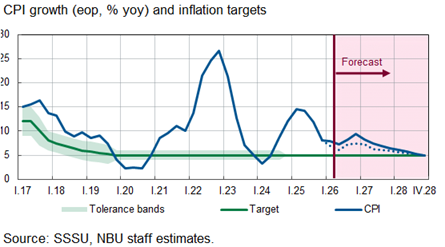
The NBU downgraded its 2026 inflation forecast from 7.5% to 9.4%. According to the NBU’s estimates, annual inflation will decline to 7.3% in mid-2026, and then begin to rise toward the end of 2026.
On April 30, the Board of the National Bank of Ukraine decided to keep the key policy rate at 15% to maintain the attractiveness of hryvnia instruments, the resilience of the foreign exchange market, and the manageability of inflation expectations amid rising price pressures.
The NBU noted that, after a prolonged period of decline, inflation began to rise, primarily due to higher energy prices. External assistance will enable financing the budget deficit and maintaining high international reserves, thereby helping ensure the resilience of the foreign exchange market.
To maintain the resilience of the foreign exchange market and the manageability of inflation expectations and processes, the NBU decided to keep the key policy rate at 15%.
Taking into account the need to keep inflation processes under control and return inflation to a sustainable slowdown trajectory, the NBU revised the forecast for the key policy rate — it is currently expected to remain at 15% until Q2 2027.
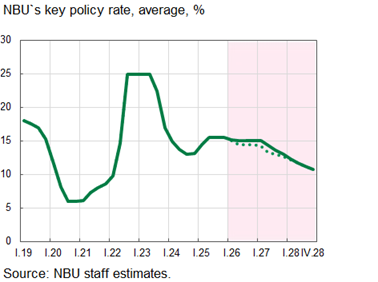
NBU policy rate forecast. Source: Inflation Report, April 2026.
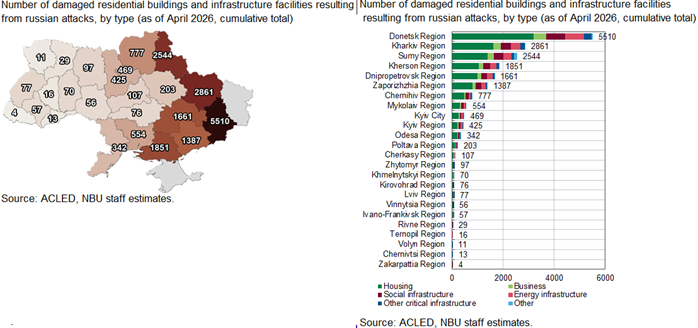
In its Inflation Report, the National Bank prepared an assessment of damage to housing and infrastructure facilities across Ukraine’s regions. As of April 2026, 19197 facilities had been damaged. Of these, housing accounted for 10978 facilities, business — 1819 facilities, social infrastructure — 2678 facilities, energy infrastructure — 2495 facilities, and other infrastructure — 1227 facilities.
According to work.ua, labor demand and supply in western regions are increasing relative to other regions. In particular, in western regions in 2025 compared with 2021, the number of CVs increased by 35%, and the number of vacancies by 66%, while the corresponding national averages were +11% and +24%, respectively, and for frontline regions, -52% and -55%, respectively.
In Q1 2026, the consolidated budget deficit amounted to UAH 97 billion, compared with UAH 208.5 billion in 2025. This result was achieved due to grants received by the budget in 2026 — UAH 174.9 billion compared with UAH 98.6 billion in 2025.
Tax revenues for the first 3 months of 2026 were UAH 95 billion higher than in 2025. This was primarily due to growth in personal income tax revenues (nominal wage growth), excise tax revenues (tax increases), and VAT revenues (nominal growth of the economy and imports).
An analysis of Q1 expenditures shows a 1.5-fold increase in spending on economic activity. We believe these are expenditures related to repairs of critical infrastructure and, to a lesser extent, to road repairs, as roads have many problems after the severe winter. Education expenditures also increased significantly. However, the budget includes 2 teacher salary increases. From January 1 to September 1, planned expenditures will exceed the 2025 level by UAH 100 billion in 2026.
Lower defense expenditures are primarily due to smaller transfers of Western military assistance to Ukraine’s budget, which are reflected in reduced revenues for budgetary institutions.
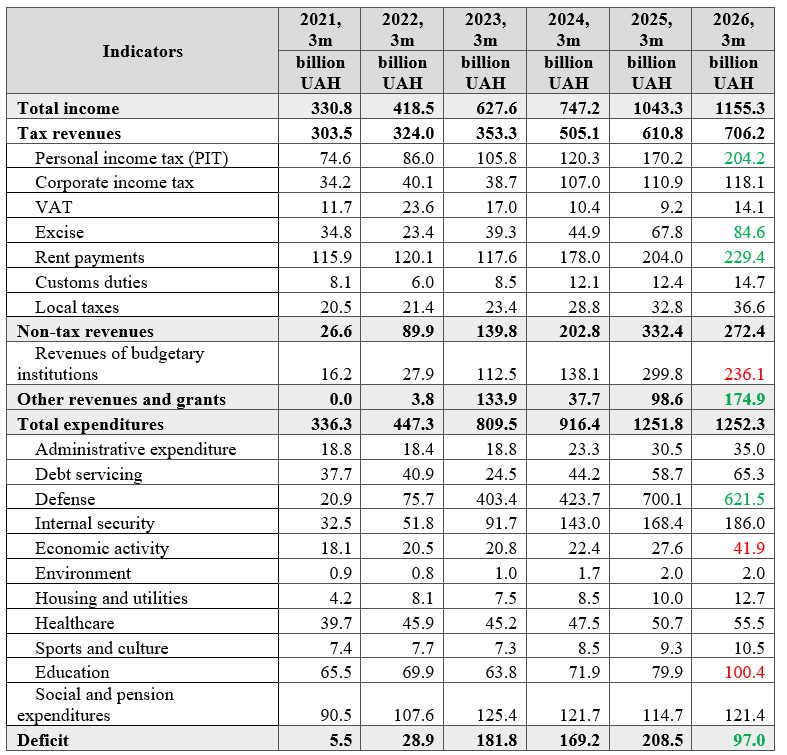
Consolidated budget execution. Q1 2021–2026. Source: Ministry of Finance.
In April 2026, financing was received from the following sources:
GBP 752 million (around USD 1 billion) from the United Kingdom under ERA. This is the final tranche under ERA. The first 2 tranches were received in 2025.
USD 38 million — from Japan.
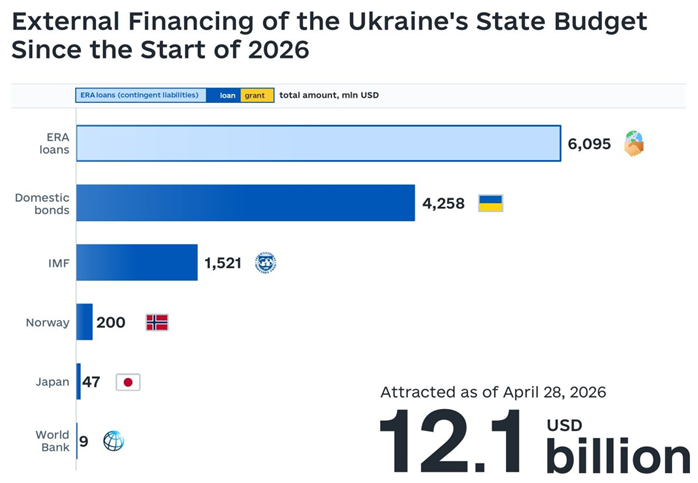
Source: Ministry of Finance.
At the beginning of April, balances in the state and local budget accounts totaled UAH 378 billion. In addition, the National Bank of Ukraine generated UAH 145 billion in profit for 2025 to be transferred to the State Budget. Thus, current resources are already sufficient to finance the budget until the end of July without EU funds.
The NBU estimates Ukraine’s financing needs for 2026 at USD 53 billion. This means that in May — December 2026, another USD 45 billion in external financing should be received. This is 2.5–3 times more than in the first 4 months (around USD 8 billion was received).
In March 2026, Ukraine’s public and publicly guaranteed debt decreased from USD 213.2 billion to USD 210.8 billion (-USD 2.5 billion).
The debt increased by USD 1.05 billion due to an IMF loan, after accounting for repayments of principal on previous loans.
The debt decreased mainly due to:
The balance of payments in Q1 2026 was negative. The trade deficit is showing a trend toward deterioration. In the first 3 months of 2026, the trade deficit amounted to USD 17.4 billion, up USD 5.4 billion from 2025 (USD 12 billion). Imports of goods continue to grow rapidly. In Q1, growth totaled USD 5.5 billion. If this trend continues, the trade deficit may reach 30% of GDP.
Several factors helped balance the situation in the balance of payments:
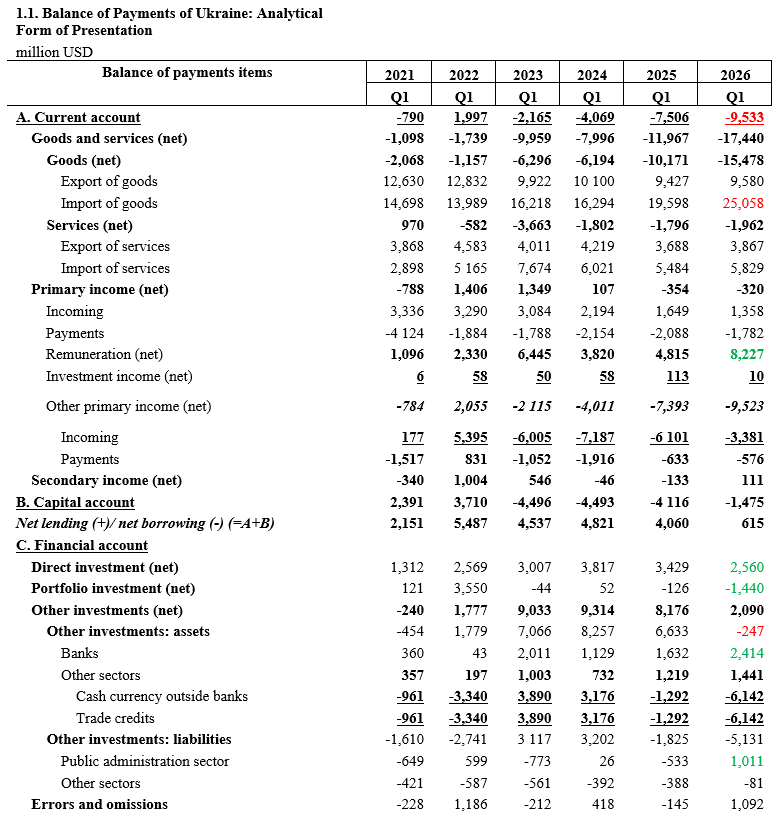
Balance of payments Q1 2021–2026. Source: NBU
Overall, the current account was recorded as negative at USD 9.5 billion in the first quarter and, according to our estimate, will deteriorate further, because a significant amount of grant assistance to the Government was received in Q1. In the following quarters, there will be more credit assistance.
The NBU revised its estimate of the trade deficit in 2026 from USD 54.2 billion to USD 58.2 billion. But based on current trends (a USD 17.4 billion deficit in Q1). This is a very optimistic forecast.
The situation in the Middle East reached a level of stabilization in April. And although the agreement has not yet been signed and the strait remains blocked, intensive military actions have stopped, and the process has moved into prolonged negotiations. This contributed to an increase in the EUR/USD exchange rate from 1.15 to 1.17–1.18.
As we predicted in the previous digest, the NBU somewhat changed its exchange rate policy amid the absence of an agreement with the EU, leading to a managed depreciation of the hryvnia against the dollar to UAH 44/USD, even as the EUR strengthened against USD.
But now, given the agreement voted on April 23 regarding EU financing for Ukraine in the amount of EUR 90 billion (more than USD 100 billion at the current EUR—USD exchange rate), the NBU understands that it has a stabilized financing situation that will even allow international reserves to increase.
But we also see that the NBU revised its 2026 inflation forecast from 7.5% to 9.4%. This, on the one hand, is a reaction to oil prices above USD 100 per barrel, but it is also an opportunity to avoid strengthening the hryvnia, minimizing inflation through the exchange rate.
Therefore, we believe that the UAH/USD exchange rate will remain close to 44 in May. The UAH / EUR exchange rate is in the range of 51–52.
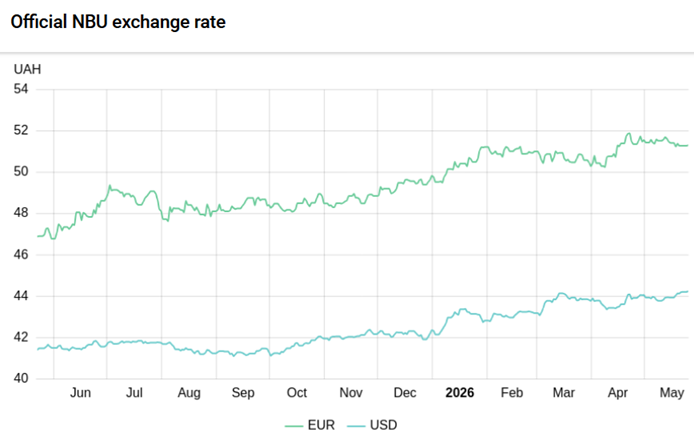
Hryvnia exchange rate against USD and the EUR over 12 months. Source: NBU.
Ukraine’s international reserves decreased from USD 52.0 billion to USD 48.2 billion in April 2026.
According to the balance sheet data, in April, the NBU sold USD 3,576.7 million on the foreign exchange market.
In April, USD 377.9 million was received into the government’s foreign currency accounts at the National Bank, including:
In addition, Ukraine received a loan of USD 1010.0 million under the agreement between Ukraine and the United Kingdom within the ERA framework. These funds were not included in Ukraine’s international reserves due to their restricted (earmarked) purpose of use.
USD 716.6 million was paid for servicing and repayment of public debt in foreign currency, including:
In addition, Ukraine paid USD 255.3 million to the International Monetary Fund.
The current volume of international reserves covers 4.9 months of future imports.
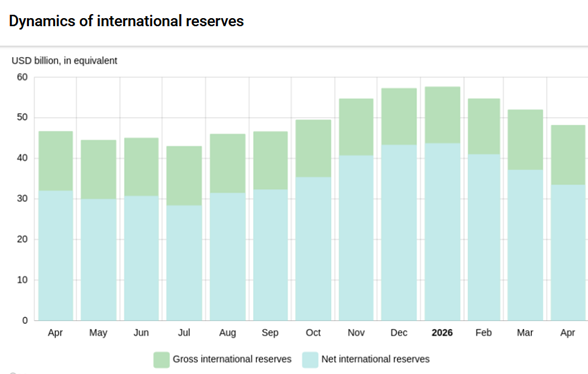
Change in international reserves over the last 12 months. Source: NBU.
The NBU expects international reserves to reach USD 64.8 billion by the end of 2026.
This publication was created by the Ukrainian Institute of the Future with the support of the Askold and Dir Foundation, administered by ISAR Unity as part of the project “Strong Civil Society in Ukraine – a Driver of Reforms and Democracy” funded by Norway and Sweden. The content of the publication is
the responsibility of the Ukrainian Institute of the Future and does not reflect the views of the governments of Norway, Sweden, or ISAR Unity.



Together we can change the future! Your support allows us to continue our research and provide objective analysis of key social issues. Join us today to build the future of our generations together.
Support