Series “Anatomy of an Empire” │ Ukrainian Institute of the Future
This material was prepared as part of work on the “Atlas of Russian Imperialism and Colonialism” — a UIF publication forthcoming this year.
This piece addresses the following questions:
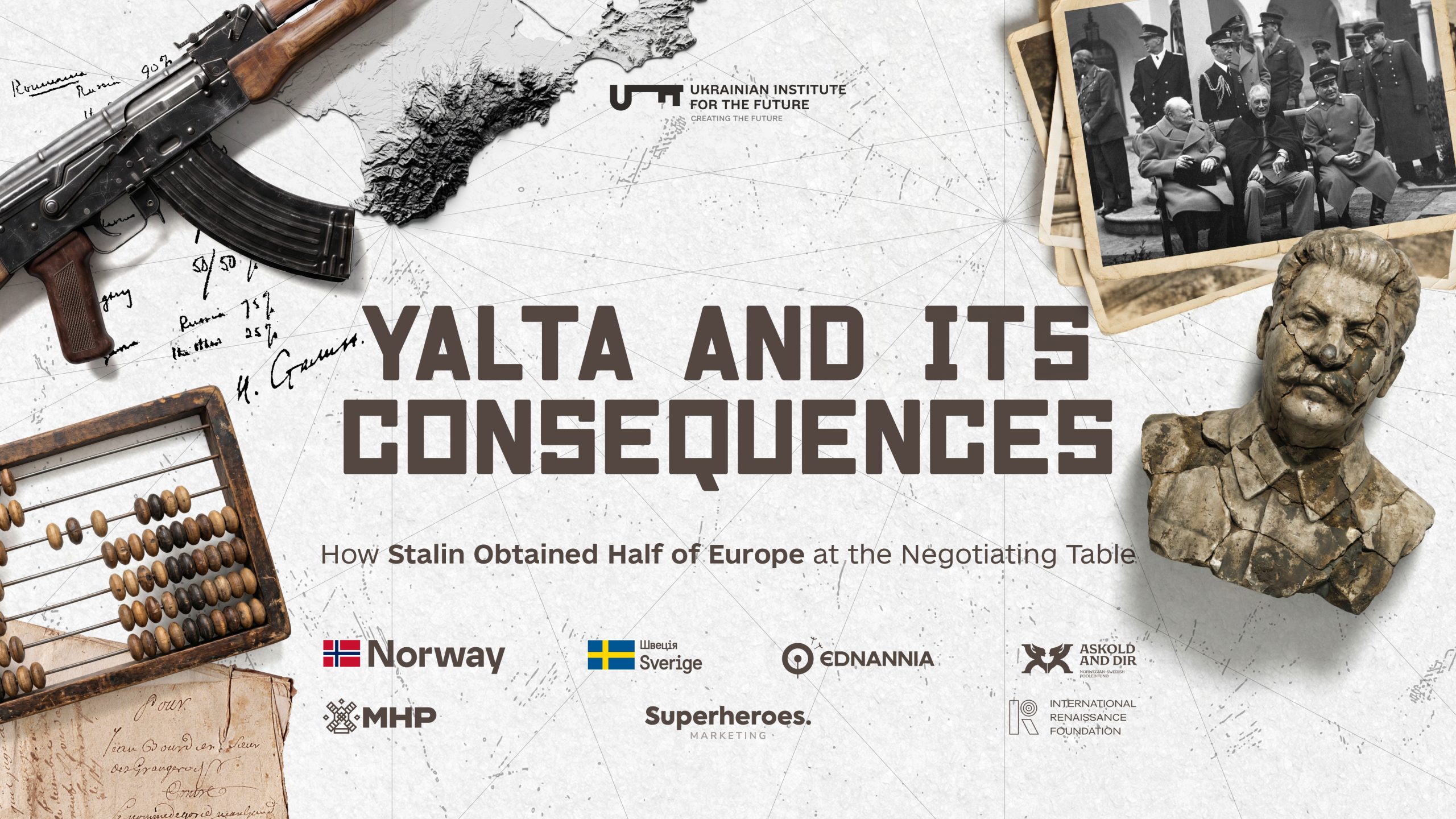
→ What Churchill and Stalin actually wrote on the “percentages sheet”
→ How the USSR installed communist governments through fabricated elections
→ Why Hungary 1956 and Czechoslovakia 1968 represent the same method
→ How the USSR held its “allies” — and what happened when any of them tried to leave
→ Why the West remains inclined today to negotiate with Moscow over the heads of smaller countries
A Sheet of Paper That Decided the Fate of Millions
October 1944. Moscow. Churchill and Stalin meet in the Kremlin.
Churchill takes out a sheet of paper and writes a column of figures:
Romania — 90% Russia, others 10%.
Greece — 90% Great Britain (with the USA), 10% Russia.
Yugoslavia — 50/50.
Hungary — 50/50.
Bulgaria — 75% Russia, others 25%.
Stalin takes a blue pencil and makes a tick.
Churchill would write later: “Might it not be thought rather cynical if it seemed we had disposed of these issues, so fateful to millions of people, in such an offhand manner? Let us burn the paper.”
Stalin replied: “No, keep it.”
This document — the percentages agreement — never acquired official status. But it accurately reflected the logic both leaders were acting on: the futures of peoples as arithmetic between two major players.
Yalta: Authorization to Establish Control
February 1945. Yalta. Roosevelt, Churchill, Stalin.
The USSR already controlled most of Eastern Europe — Soviet armies were advancing westward, and the question was not whether the USSR would be there, but on what terms.
The Declaration on Liberated Europe, concluded at Yalta, promised “free elections” in the liberated countries. Stalin signed it.
In parallel, however, it was agreed that the governments of “liberated” countries must be “friendly toward the USSR.” That phrase — “friendly toward the USSR” — became the operative content of Yalta. What “friendly” meant was for Moscow to define.
Roosevelt and Churchill concurred for practical reasons: the USSR was to enter the war against Japan, and the Soviet sacrifices on the Eastern Front had been without parallel.
The consequence was that peoples who had been occupied by the Nazis and liberated by the Allies found themselves in a new dependency. The occupier’s flag had simply changed color.
How “Friendly” Governments Were Installed
The method was first applied in Poland, then replicated everywhere.
The USSR backed the “Lublin” government — a Moscow-controlled structure composed of Polish communists who had spent the war in Moscow. At Yalta, it was agreed to include a number of members from the Polish government-in-exile, to give the appearance of a coalition.
The “free elections” promised at Yalta did not take place. In 1947, through falsification and repression, the communists secured a winning result.
Czechoslovakia was a different variation, but the same logic. By February 1948, the communists controlled the key ministries — above all, the interior ministry, and therefore the police. When non-communist ministers resigned in the expectation of presidential intervention, the communists used the opening to seize power outright.
The decisive role was played by trade unions and a “people’s militia” subordinate to the communist party. President Beneš capitulated. A country that had been the most developed democracy in the region before 1938 became a Soviet satellite.
In Bulgaria, Romania, Hungary, and East Germany — similar sequences with local variations.
In September 1947, the founding conference of the Cominform — the coordinating body of communist parties — was held in Szklarska Poręba in Poland. The head of Soviet propaganda, Zhdanov, delivered a speech on the two camps: the “democratic” and the “imperialist.” The meeting formalized what had already happened: the creation of a Moscow-subordinate bloc.
When They Tried to Leave: Hungary and Czechoslovakia
The Yalta system held until the first serious attempt at exit.
Hungary, 1956. Following Stalin’s death and the “thaw,” reform-minded Hungarian communists under Imre Nagy demanded genuine change: withdrawal from the Warsaw Pact, neutral status, free elections.
On 4 November 1956, Soviet tanks entered Budapest. Within weeks, the uprising was crushed. Approximately 2,500 Hungarians were killed. Nagy took refuge in the Yugoslav embassy, was lured out with a promise of safe passage — and executed in 1958.
The West did not intervene. The Suez Crisis was unfolding simultaneously, and British and French attention was elsewhere.
Czechoslovakia, 1968. The Prague Spring — Alexander Dubček’s attempt to build “socialism with a human face”: freedom of the press, genuine federalization, relaxation of censorship.
On 21 August 1968, Warsaw Pact forces invaded: 500,000 troops, 2,000 tanks. Dubček was taken to Moscow, compelled to sign the “Moscow Protocol,” then returned and gradually removed from power. He spent the end of the Cold War raking leaves in a park.
Brezhnev articulated the “doctrine of limited sovereignty”: socialist countries could be sovereign only to the extent that it did not threaten the “socialist community.”
In other words: sovereignty exists until Moscow decides it does not.
Why the West Chose Compromise
There are reasons why the West, in the period 1945–1968, failed to protect those it had promised to protect.
One factor was nuclear weapons. After 1949, the USSR possessed the atomic bomb. Any direct intervention risked nuclear war.
A second was exhaustion after the Second World War. Public appetite for new conflicts was minimal.
A third — and most consequential: the West had normalized viewing Russia as a great power with a “natural sphere of influence.” What happened in Hungary or Czechoslovakia was treated as an “internal matter” of that sphere.
This logic — “natural spheres of influence,” negotiating over the heads of smaller countries — recurs today whenever the West discusses “security guarantees for Russia” or “concessions” to end the fighting in Ukraine. The Yalta mindset did not dissolve with the USSR. It persists in every discussion about the “special interests of great powers.”
What This System Produced
The Soviet bloc of 1945–1989 was not simply a collection of “allies.” It was a set of dependent states whose domestic and foreign policy was determined by Moscow.
The one state that exited the bloc on its own terms was Tito’s Yugoslavia. Stalin made attempts to arrange his elimination; they failed. After Stalin’s death, Khrushchev traveled to Yugoslavia to make peace.
All the others — from East Germany to Romania — were bound to the USSR through a system of treaties, economic dependencies (the COMECON — Council for Mutual Economic Assistance), military presence, and party control.
When the system collapsed in 1989–1991, it collapsed everywhere simultaneously. Because it was held together not by organic support but by coercion. When the coercion was removed, everything went with it.
Poland, Hungary, Czechoslovakia, Romania, Bulgaria — all chose a different path the moment the opportunity arose. That too is an answer to the question of “natural spheres of influence”: peoples living inside them vote with their feet at the first opportunity.
A piece from the “Anatomy of an Empire” series. The series is based on the “Atlas of Russian Imperialism and Colonialism” — a major UIF research project forthcoming in print and digital format.
This text was prepared with the assistance of artificial intelligence on the basis of the “Atlas of Russian Imperialism and Colonialism.” This project is implemented with the financial support of the International Renaissance Foundation.
The views, assessments, and conclusions expressed in this authored publication represent the personal position of the author and do not necessarily reflect the official position of the Ukrainian Institute of the Future, its partners, or its donors.
This publication was produced by the NGO “Ukrainian Institute of the Future” with the support of the Askold and Dir Foundation, administered by ISAR Ednannia within the project “A Strong Ukrainian Civil Society — A Driver of Reform and Democracy,” funded by Norway and Sweden. The content of this publication is the sole responsibility of the NGO “Ukrainian Institute of the Future” and does not represent the views of the governments of Norway or Sweden, or of ISAR Ednannia.