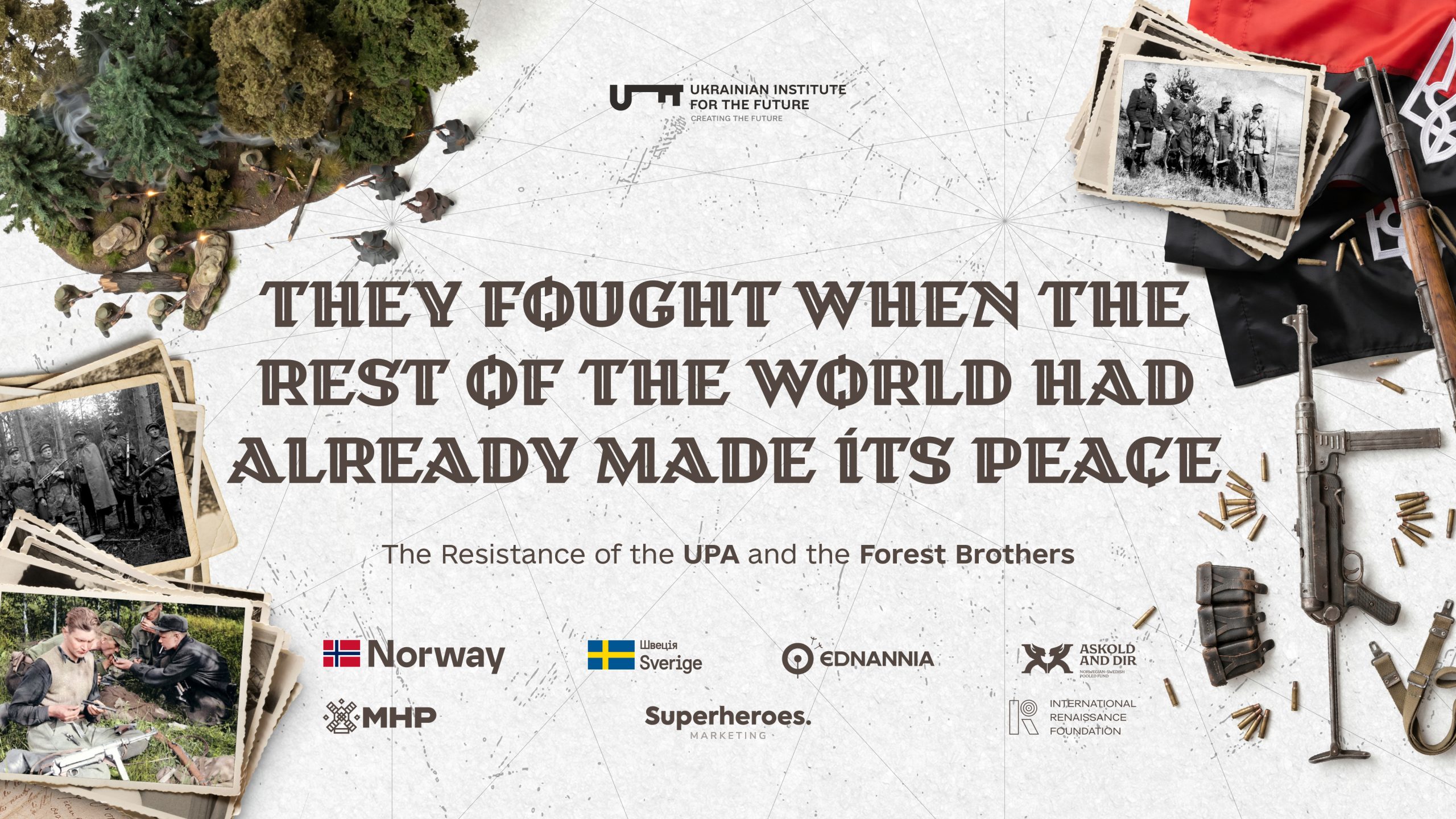
Series “Anatomy of an Empire” │ Ukrainian Institute of the Future
This material was prepared as part of work on the “Atlas of Russian Imperialism and Colonialism” — a UIF publication forthcoming this year.
This piece addresses the following questions:
→ Who the UPA and the Forest Brothers were — and how many people continued fighting Soviet power after 1945
→ How the NKVD methodically dismantled armed resistance — and why it took years
→ Why the international community abandoned the insurgents in 1945
→ Until what year armed resistance continued in Ukraine and the Baltic states
→ What the experience of that resistance means for understanding occupation today
The Moment That Is Usually Left Out
May 1945. The end of the Second World War in Europe. Victory over Nazism. Celebrations in the streets of London, Paris, Moscow.
But in those same days and nights, fighting continued in the forests of Galicia and Volhynia, in the marshes of Lithuania and Latvia. Thousands of people held their weapons.
Not because they were unaware of the Reich’s surrender. Because for them the war had not ended — it had simply changed its enemy. Nazi occupation had been replaced by Soviet occupation. For those who wanted their own state, the difference was a matter of flags.
For decades, this resistance — the UPA in Ukraine, the Forest Brothers in the Baltic states — was absent from official memory of the Second World War. The victors write not only the victory. They write what comes after.
The UPA: An Army Without a State
The Ukrainian Insurgent Army emerged in 1942–1943 and initially fought on two fronts — against the Nazis and against Soviet partisans — attempting to hold space for a future Ukrainian state.
After 1944, when the USSR consolidated control over Ukraine, the UPA redirected its efforts entirely against Soviet power.
The structure was robust: an underground network across Western Ukraine, communication channels with the emigration, its own propaganda, its own field hospitals. At its peak, between 40,000 and 100,000 fighters.
The NKVD responded with a coordinated set of measures:
- Mass punitive operations.
- “Agent-combat groups” — units of disguised security officers posing as insurgents to infiltrate and map the underground network.
- Deportation of fighters’ families.
- Propaganda campaigns portraying the UPA as “bandits” and “Nazi collaborators.”
- Amnesty offers — to draw fighters out of hiding and expose the network.
In 1949, commander-in-chief Roman Shukhevych made the decision to transition to underground operations, abandoning full-scale partisan warfare.
In March 1950, Shukhevych was killed in combat near Lviv. The last commander-in-chief was Vasyl Kuk. In May 1954, he was captured.
Even after this, resistance continued. The last engagement of a UPA unit took place in 1960. The last engagement of a single fighter — in 1967. The last underground operative surfaced in 1991, when Ukraine gained independence.
He had refused to submit to Soviet authority for forty-five years.
The Forest Brothers: Lithuania, Latvia, Estonia
In the Baltic states, armed resistance went by its own name — the Forest Brothers — and had its own structures.
The Lithuanian Forest Brothers established the “Union of Lithuanian Freedom Fighters” in 1948, led by Jonas Žemaitis-Vytautas. The last full operation of the Union dates to the early 1950s.
The Latvian movement held until the mid-1950s. The Estonian movement, similarly.
The scale of resistance was substantial. In Operation Surf alone, in March 1949, the NKVD deported over 94,000 people from all three Baltic republics in three days — specifically to strip the Forest Brothers of their social base. Those deported were the families of men suspected of having gone into the forests.
Organized armed resistance was not fully suppressed until the mid-1950s. Individual resistance lasted longer. In Lithuania, Stasys Guiga remained underground until 1986.
Why the World Did Not Notice
In 1945–1946, UPA representatives attempted to make contact with British and American forces. They received no response.
The West had just won a devastating war in partnership with Stalin. No one was prepared to open a new front — even an informational one. The Cold War was only beginning, and direct confrontation with the USSR remained a distant prospect.
Soviet propaganda, meanwhile, effectively labeled the UPA and the Forest Brothers as “Nazi collaborators” and “bandits.”
The insurgents fought in complete isolation. Without allies. Without supply lines. Without diplomatic support. Only with the conviction that their struggle was not futile.
The Yalta agreements had in effect ratified Soviet control over Eastern Europe. The right of peoples to self-determination existed on paper — but the West had already chosen pragmatism over principles.
The United States and Britain began supporting insurgents only in the late 1940s. By then, it was too late.
What the Experience of Resistance Means Today
The armed resistance of 1945–1960 establishes several things beyond dispute.
First: occupation is not an endpoint. The UPA and the Forest Brothers fought under the most adverse conditions — after military defeat, without recognition, without support. They lost in a tactical sense, but their resistance became part of a cultural memory that made the restoration of independence in 1991 not merely a political decision, but the continuation of unfinished work.
Second: the NKVD spent decades and considerable resources suppressing a resistance that, according to the official account, did not exist. This indicates that the real threat to Soviet power was acutely felt.
Third: international silence is not an argument — it is a miscalculation. Those who failed to support the armed resistance at the time spent the following decades living with Stalinist buffer zones on their borders.
Fourth: the question of the legitimacy of armed resistance against an occupying power is not settled. International law recognizes the right of peoples to self-determination — but does not always provide clear instruments. The experience of the UPA and the Forest Brothers is one of the most significant precedents in that ongoing discussion.
Memory as a Battlefield
One of Putin’s first moves after the annexation of Crimea — and again after the full-scale invasion — was to declare the UPA “Nazi collaborators” and extend that label to all armed resistance in contemporary Ukraine.
This is not incidental. Whoever controls the memory of resistance controls the legitimacy of resistance.
The battles over how the UPA is interpreted — in textbooks, in legislation, in the public domain — are not a historians’ dispute. They are a dispute over whether a people has the right to fight against occupation.
The answer that thousands of people in Ukraine and the Baltic states gave is unambiguous.
This is the eleventh piece in the “Anatomy of an Empire” series. The series is based on the “Atlas of Russian Imperialism and Colonialism” — a major UIF research project forthcoming in print and digital format. To be continued.
This project is implemented with the financial support of the International Renaissance Foundation.
The views, assessments, and conclusions expressed in this authored publication represent the personal position of the author and do not necessarily reflect the official position of the Ukrainian Institute of the Future, its partners, or its donors.
This publication was produced by the NGO “Ukrainian Institute of the Future” with the support of the Askold and Dir Foundation, administered by ISAR Ednannia within the project “A Strong Ukrainian Civil Society — A Driver of Reform and Democracy,” funded by Norway and Sweden. The content of this publication is the sole responsibility of the NGO “Ukrainian Institute of the Future” and does not represent the views of the governments of Norway or Sweden, or of ISAR Ednannia.