Digests • 20 April 2026
Ukraine’s trade deficit for the first 2 months of 2026 amounted to USD 10.8 billion. This is USD 3.4 billion higher than in 2025.
The State Statistics Service of Ukraine estimated Ukraine’s economic growth in 2025 at 1.8% of GDP.
On March 19, the National Bank of Ukraine kept the key policy rate at 15%.
The delay in the EU’s decision on the EUR 90 billion loan does not pose short-term risks to Ukraine’s budget financing. A more detailed analysis is provided in this digest.
International reserves decreased from USD 54.8 billion to 52.0 billion in March 2026.
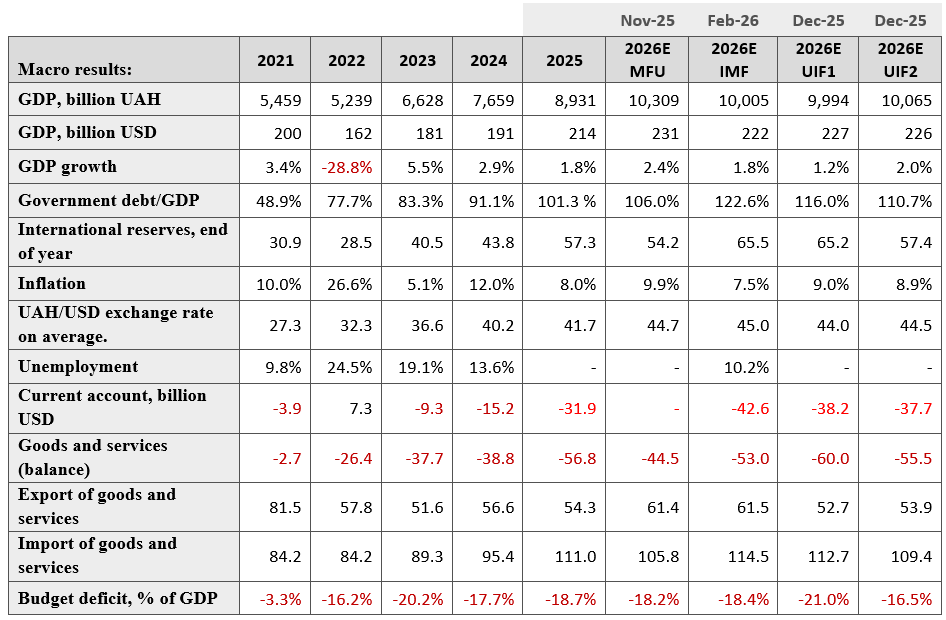
The State Statistics Service of Ukraine published the preliminary results for Ukraine’s economic growth in the fourth quarter and for the full-year of 2025. In the fourth quarter, the economy grew by 2.8% of GDP. On an annual basis, Ukraine’s economic growth in 2025 amounted to 1.8% of GDP.
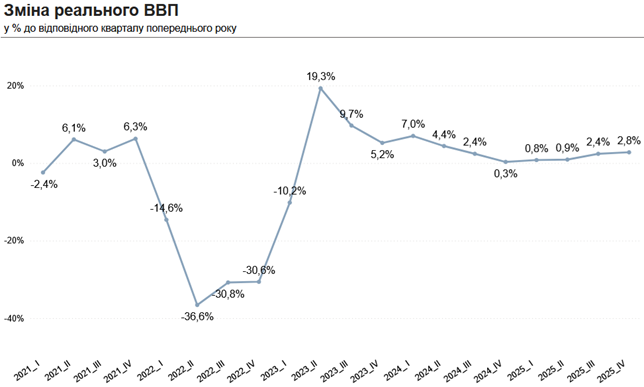
Ukraine’s economic growth in 2021-2025. Source: State Statistics Service of Ukraine.
Figure translation
Change in real GDP
% compared with the corresponding quarter of the previous year
According to the Ministry of Economy of Ukraine, the decline in the economy in January-February 2026 amounted to 1.2%.
Consumer market inflation in March 2026 compared with February stood at 1.7%, and compared with March 2025, it was 7.9%.
Core inflation in March 2026 compared with February stood at 1.5%, and compared with March 2025, it was 7.1%.
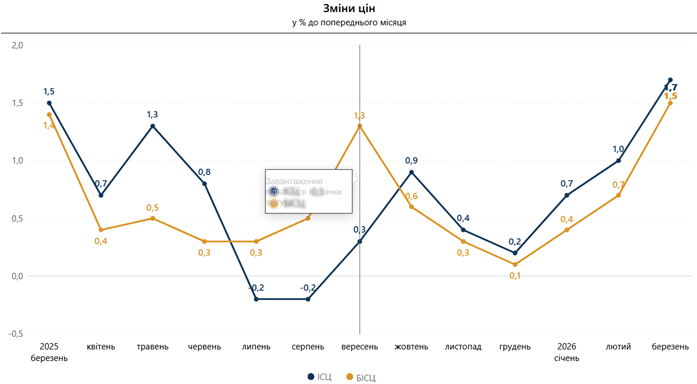
Price changes over the last 12 months. Source: State Statistics Service of Ukraine.
Figure translation
Change in prices
(in % to the previous month)
2025 March April May June July August September October November December 2026 January February March
In the consumer market in March, prices for food products and non-alcoholic beverages increased by 1.3%. The sharpest increase was recorded for eggs, which rose by 7.7%. Prices for processed grain products, sunflower oil, fruit, bread, fish and fish products, beef, vegetables, non-alcoholic beverages, and lard increased by 4.8% to 0.8%. At the same time, prices for sugar, pasta products, rice, pork, poultry meat, and butter decreased by 1.0% to 0.1%.
Prices for alcoholic beverages and tobacco products increased by 1.1%, driven by a 1.3% rise in tobacco product prices.
Clothing and footwear rose in price by 12.0%, with clothing up 12.0% and footwear up 11.8%.
Transport prices increased by 6.4%, mainly due to a 13.2% rise in fuel and lubricants prices, as well as higher fares for railway and road passenger transport, which increased by 8.2% and 6.0% respectively.
On March 19, the Board of the National Bank of Ukraine decided to keep the key policy rate at 15%. The NBU is postponing further monetary easing in view of the risks of stronger inflationary pressure and worsening inflation expectations.
The future inflation trajectory may be higher than previously forecast, in particular due to rising energy prices against the backdrop of the war in the Middle East. At the same time, there is uncertainty regarding further developments.
If significant pro-inflationary risks persist, the NBU will refrain from easing monetary policy. At the same time, if these risks intensify further, the NBU will be ready to raise the key policy rate and take additional measures to maintain price stability.
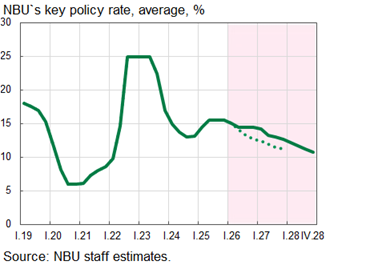
NBU policy rate forecast. Source: Inflation Report, January 2026.
BUDGET
In January-February 2026, the consolidated budget deficit amounted to UAH 3.2 billion, compared with UAH 203.7 billion in 2025. This result was achieved due to grants received by the budget in 2026 – UAH 165 billion compared with UAH 0.5 billion in 2025.
Tax revenues in the first 2 months of 2026 were UAH 55 billion higher than in 2025. First and foremost, this was due to an increase in personal income tax revenues of UAH 19.8 billion (+17.9% growth).
We should note the low level of military assistance received by the budget. In January-February 2026, it was approximately UAH 120 billion lower than in 2025. As a result, defense expenditures in 2026 were also lower than in 2025 by UAH 140 billion. At the same time, expenditures on internal security in the first 2 months of 2026 increased by UAH 12 billion. These are very poor spending priorities.
In March 2026, financing was received from the following sources:
USD 1,521 million from the IMF – the first IMF tranche under the new program;
USD 200 million grant from Norway.
In addition, on April 1, Ukraine received the second tranche under the ERA program from Japan in the amount of about USD 1.3 billion.
At present, the concept of a “financial catastrophe” on the horizon is being discussed in Ukraine. We are more optimistic about Ukraine’s ability to meet its budgetary needs if the EU’s EUR 90 billion loan is not received.
First, as of March 1, there were UAH 427 billion in the accounts of the Ministry of Finance and local budgets. This is approximately USD 9.5 billion. In addition, from March 1 to April 2, Ukraine received approximately USD 3 billion.
We also see the following sources of financial resources through the end of 2026, amounting to about USD 34 billion.
Forecast of Ukraine’s financial resources (April-December 2026)
| Source of funding | Expected amount (April–December) | Status / Conditions for receipt |
| EU (Ukraine Facility) | ~ USD 8.4 billion | Critical: Requires the adoption of 11 legislative bills in order to receive EUR 4 billion. |
| USA (ERA) | ~ USD 3.85 billion | Grants through the World Bank. |
| Japan (ERA) | ~ USD 1.45 billion | Concessional loans/grants for civilian needs. |
| United Kingdom (ERA) | ~ USD 1.045 billion | The remaining amount from the USD 3 billion ERA limit. |
| IMF (EFF) | ~ USD 2.3 billion | Dependent on successful program reviews. |
| Norway (Nansen Program) | ~ USD 0.4 billion | The estimated share provided as direct budget support. |
| Internal resources (NBU/gov.corps) | ~ USD 4.5 billion | NBU dividends and profit (peak in April-June). |
| Others (Korea, World Bank, etc.) | ~ USD 8.0 billion | SURGE, RISE projects, and bilateral loans. |
| Domestic government bonds | ~ USD 4.0 billion | |
| GENERAL RESOURCE | ~ USD 33.945 billion |
Source: UIF calculations.
These resources enable the budget to be financed through November-December 2026. Therefore, even if the large EUR 90 billion EU loan is delayed, there are still at least 6 months to resolve this issue. On the other hand, an end to the war would be the better scenario, because it would both reduce future financing needs and help minimize public debt, which has already exceeded 100% of GDP.
In February 2026, Ukraine’s public and publicly guaranteed debt declined from USD 215 billion to 213.2 billion (-1.8 billion).
Ukraine received only grant financing in February. The debt declined mainly due to the revaluation of euro-denominated debt against the US dollar.
The balance of payments in January-February was negative. The trade deficit is showing signs of further deterioration. In the first 2 months of 2026, the trade deficit amounted to USD 10.8 billion, which is USD 3.4 billion more than in January-February 2025 (USD 7.4 billion).
Our forecast for the trade deficit in 2026 was the most pessimistic at USD -60 billion. The IMF forecasts a trade deficit of USD 53 billion. The NBU forecasts USD 54.2 billion. But with this start-of-year dynamic, primarily due to the growth in goods imports, the trade deficit has a good chance of reaching USD 65-70 billion. This would bring it to 27-28% of GDP, which is, in fact, a huge imbalance.
Part of this imbalance in January-February was offset by secondary income (grants and other assistance) of USD +5.84 billion, compared with USD 1.96 billion in January-February 2025.
However, in the first 2 months of 2026, the current account was negative at USD -5.5 billion.
The financial account for the first 2 months of 2026 was positive at USD 2.46 billion. And although Ukraine did not receive government loan assistance, we should note significant activity in obtaining and repaying trade credits that had been withdrawn in 2022. This provided USD 2.6 billion over 2 months, which is a very large amount.
Overall, amid extreme uncertainty surrounding the situation in the Middle East, our March forecast under the baseline scenario was correct. We projected an exchange rate of 43.5-44 under the baseline scenario and 50.5-51.5 for the EUR, with the exchange rate moving beyond 44 UAH per USD if the EUR-USD rate were to fall below 1.15.
At present, we believe the NBU’s priorities regarding exchange rate formation for April may change.
First, we are seeing a higher-than-expected trade deficit. Second, the EU will not finance Ukraine in April as previously planned. Moreover, the situation surrounding the EUR 90 billion loan has become more uncertain. Forecasts of not receiving the funds have now shifted to July. In our assessment, this will shape a different approach by the National Bank to exchange rate formation. We believe that under such conditions, the NBU may once again begin allowing the hryvnia to depreciate against the dollar.
On the other hand, the war in the Middle East is also a factor of uncertainty. If the war ends, this should generate optimism and strengthen the euro against the US dollar. If the war continues to drag on, this would weaken the euro against the dollar.
Baseline scenario – a move in the UAH-USD exchange rate into the 44.0-44.5 range. If the EUR-USD rate falls to 1.14 and below, then a move into the 44.5-45.0 range is possible. The EUR-UAH exchange rate estimated at 50.5-51.5.
If the war in the Middle East ends, we see the UAH-USD exchange rate for April at 43.5-44.0.
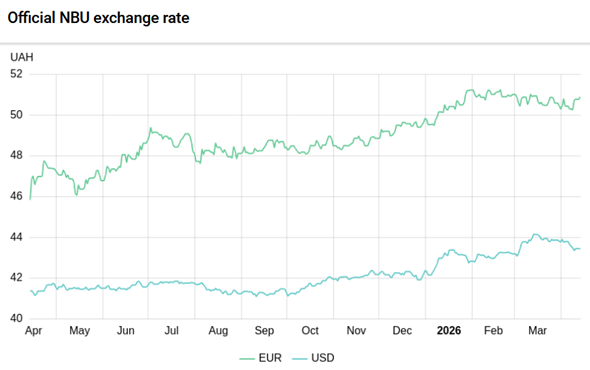
Hryvnia exchange rate against the USD and EUR over the last 12 months. Source: NBU.
Ukraine’s international reserves decreased from USD 54.8 billion to 52.0 billion in March 2026.
According to the NBU’s balance sheet data, in March, the NBU sold USD 4,774.4 million on the foreign exchange market.
In March, USD 3,045.9 million was received into the government’s foreign currency accounts at the National Bank, including:
USD 1,521.1 million – from the International Monetary Fund under the Extended Fund Facility (EFF) program;
USD 1,474.3 million – through World Bank accounts;
USD 50.5 million – from the placement of foreign currency-denominated domestic government bonds.
A total of USD 123.3 million was paid for the servicing and repayment of public debt in foreign currency, including:
USD 59.4 million – servicing and repayment of debt to the World Bank;
USD 6.1 million – servicing of debt to the EU;
USD 5.2 million – servicing of domestic government bonds;
USD 52.6 million – payments to other creditors.
In addition, Ukraine paid USD 260.0 million to the International Monetary Fund.
The current level of international reserves is sufficient to finance 5.5 months of future imports.
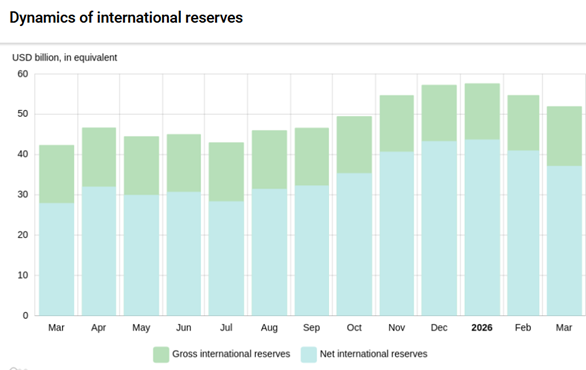
Change in international reserves over the last 12 months. Source: NBU.
April 30. NBU. Decision on the key policy rate.
May 7. NBU. Inflation Report, Q2 2026.
This publication was created by the Ukrainian Institute of the Future with the support of the Askold and Dir Foundation, administered by ISAR Unity as part of the project “Strong Civil Society in Ukraine – a Driver of Reforms and Democracy” funded by Norway and Sweden. The content of the publication is
the responsibility of the Ukrainian Institute of the Future and does not reflect the views of the governments of Norway, Sweden, or ISAR Unity.



Together we can change the future! Your support allows us to continue our research and provide objective analysis of key social issues. Join us today to build the future of our generations together.
Support