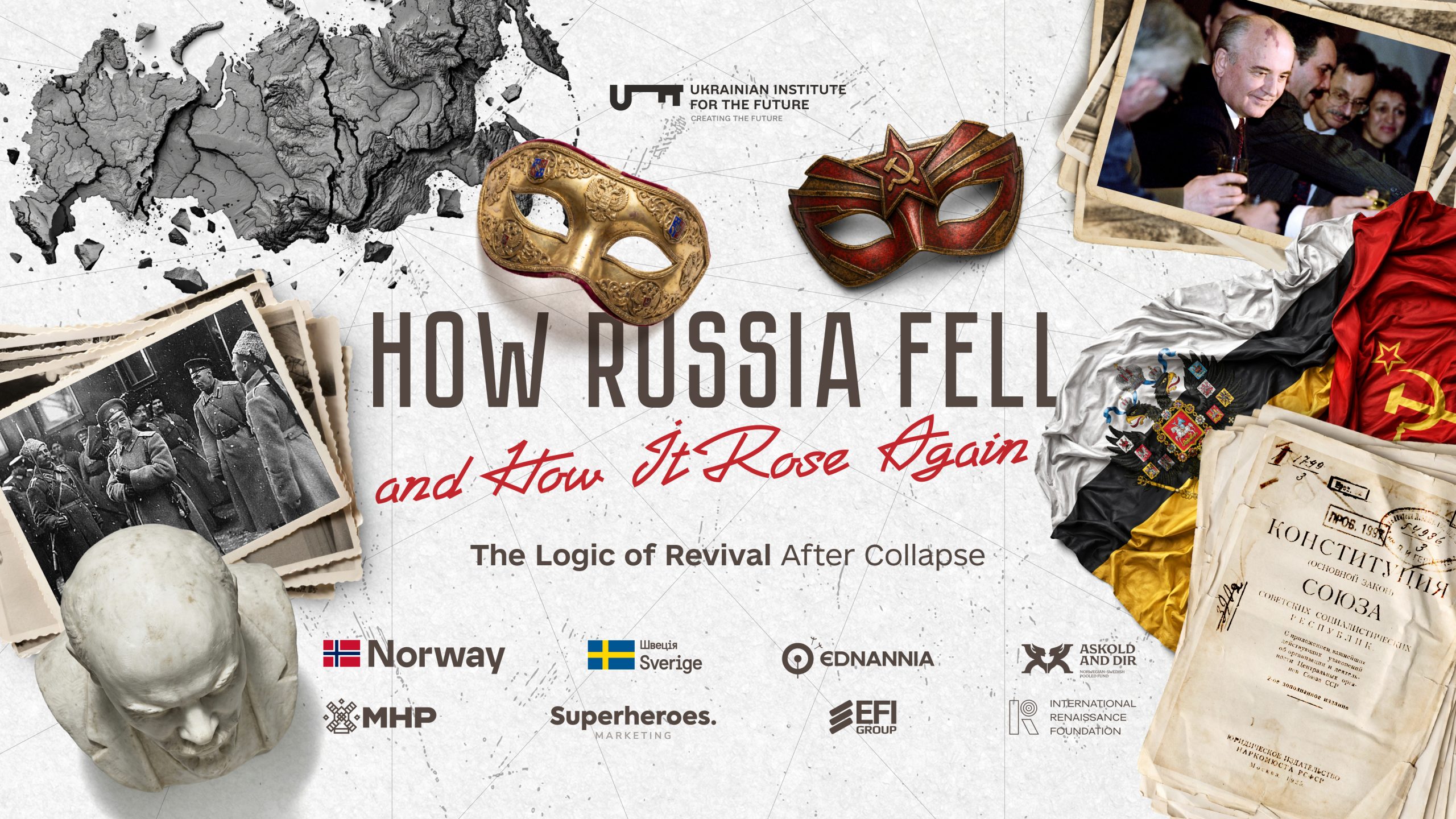
Series “Anatomy of an Empire” │ Ukrainian Institute of the Future
This material was prepared as part of work on the “Atlas of Russian Imperialism and Colonialism” — a UIF publication forthcoming this year.
This piece addresses the following questions:
→ How many states declared independence after 1917 — and why most of them disappeared
→ What distinguished Finland from the Ukrainian People’s Republic — and why the first survived while the second did not
→ What tactics the Bolsheviks developed to disguise conquest
→ Why the “voluntary” USSR of 1922 is a fiction
→ What the periods 1917–1922 and 1991–2022 have in common
1917: An Empire Fragments Within Months
February 1917. Nicholas II abdicates. The Provisional Government controls nothing beyond Petrograd. Across the former empire, what textbooks call “national liberation movements” begins — though in practice it is simply peoples seizing a power vacuum.
Within months:
- In Kyiv, the Ukrainian Central Rada was formed.
- In Helsinki, parliament assumed authority and declared independence in December.
- In Simferopol, the Crimean Tatar Qurultay declared the Crimean People’s Republic.
- In Tbilisi, the Transcaucasian Commissariat was established.
- In Tallinn, Riga, and Vilnius — representative bodies of their own.
- In Kazan — the project of Idel-Ural autonomy.
- In Tashkent — Muslim autonomy.
Within a year of the monarchy’s fall, independent entities were breaking away from the former Russian Empire one after another. Most survived for months or years. Some, for a few decades.
Why did some survive while others did not? The answer lies not in ideas — but in structure.
Why Some Survived and Others Did Not
Finland had its own parliament — the Eduskunta — since 1907. Its own legislation. Its own bureaucracy. The share of ethnic Russians in its population: under one percent.
Poland had its own national bourgeoisie, intelligentsia, and political parties. In Warsaw, ethnic Poles constituted a majority of the urban population.
The Baltic states presented a similar picture: a Protestant educational tradition, comparatively high literacy, and an established local elite.
Ukraine was a different case. Nine guberniyas with no autonomous status. Urban population: roughly 20 percent, but cities were predominantly Russian, Polish, and Jewish, not Ukrainian. Literacy: around 20 percent. Its own bureaucracy: minimal. Political parties: semi-legal or illegal until 1917.
Ukraine declared the Ukrainian People’s Republic, fought — and lost. Not for lack of determination. Because of a structural deficit in state capacity accumulated over two and a half centuries of Russian imperial rule.
Bolshevik Tactics: Masks, Not Sabres
The Bolsheviks did not simply conquer — they developed a new method that allowed conquest to proceed unnoticed.
When they marched on Kyiv in December 1917, they did not announce an invasion. Instead they backed an alternative “government” — the Ukrainian People’s Republic of Soviets in Kharkiv — and presented the advance on Kyiv as an internal conflict between two Ukrainian structures.
They applied the same method in Finland — establishing a “Finnish People’s Government” on the eve of the 1939 invasion. In the Baltic states — “people’s governments” and “petitions” for accession.
The sequence was consistent:
- Find or create a local loyal structure.
- Recognize it as the sole legitimate representative of the people.
- Support it “at its request” — with arms and troops.
- Frame the conquest as liberation or reunification.
This was not a Bolshevik invention — Russia had used the same approach with Crimea in the 1770s and with Georgia in the 1800s. The Bolsheviks, however, refined it into a replicable system.
1922–1924: The “Voluntary” Union
On 30 December 1922, the USSR was officially proclaimed. Four republics “voluntarily” signed the Union Treaty: the RSFSR, the Ukrainian SSR, the Byelorussian SSR, and the Transcaucasian SFSR.
The reality behind this “voluntariness”: Ukraine had experienced three Bolshevik invasions before the signing. The first in December 1917. The second in December 1918. The third in December 1919.
In each instance, the Bolsheviks re-established control over Ukraine by force. The place of genuinely Ukrainian states was taken by “Ukrainian” “Soviet” or “Socialist” “Republics.”
The 1924 Soviet constitution formally declared the equality of republics and their right to secede. Lenin inserted this as a “tactical concession” — to pacify non-Russian peoples. Even at the time of drafting, no one considered these provisions operative.
Over seventy years of the “union,” not a single republic exercised the right to secede — until the collapse of the entire system in 1991.
1991: The Same Map, the Same Logic
In December 1991, the USSR dissolved. Once again — as in 1917 — independent states broke away from the former empire one after another.
And once again, Moscow applied the same tactics.
The sequence resumed immediately:
- December 1991 – March 1992: Russian-backed “republics” appeared in Moldova, Georgia, and Nagorno-Karabakh.
- 1994–1996: The First Chechen War — an attempt to hold by force what was trying to leave.
- 1999–2000: The Second Chechen War — more decisive, with the mass bombardment of Grozny.
- 2008: Georgia — direct armed aggression and the occupation of Abkhazia and South Ossetia.
- 2014: Crimea and Donbas — the same model of “people’s republics” and “referendums,” rehearsed in 1940.
- 2022: Full-scale invasion of Ukraine.
From 1917 to 2022: one continuous cycle. Collapse, restoration by force, new “voluntary” unions, new “liberations.”
Why the Cycle Repeats
The answer lies neither in the character of particular leaders nor in Kremlin ideology. It lies in the fact that none of Russia’s collapses has been followed by genuine decolonization.
In 1922, conquered peoples became constituent parts of a “federation” rather than independent nations.
In 1991, Russia declared itself the “successor state” of the USSR — inheriting all rights and none of the obligations toward the peoples it had controlled.
Without genuine decolonization — recognition of the right of peoples to self-determination without qualification — the cycle continues.
The question of Russia’s decolonization is not an academic discussion. It is the practical precondition for lasting peace.
This is the ninth piece in the “Anatomy of an Empire” series. The series is based on the “Atlas of Russian Imperialism and Colonialism” — a major UIF research project forthcoming in print and digital format. To be continued.
This project is implemented with the financial support of the International Renaissance Foundation.
The views, assessments, and conclusions expressed in this authored publication represent the personal position of the author and do not necessarily reflect the official position of the Ukrainian Institute of the Future, its partners, or its donors.
This publication was produced by the NGO “Ukrainian Institute of the Future” with the support of the Askold and Dir Foundation, administered by ISAR Ednannia within the project “A Strong Ukrainian Civil Society — A Driver of Reform and Democracy,” funded by Norway and Sweden. The content of this publication is the sole responsibility of the NGO “Ukrainian Institute of the Future” and does not represent the views of the governments of Norway or Sweden, or of ISAR Ednannia.