Series “Anatomy of an Empire” │ Ukrainian Institute of the Future
This material was prepared as part of work on the “Atlas of Russian Imperialism and Colonialism” — a UIF publication forthcoming this year.
This piece addresses the following questions:
→ What korenizatsia was — and why the Bolsheviks introduced it at all
→ How Ukraine became a major cultural center within just a few years
→ What the “Red Renaissance” was — and who it produced
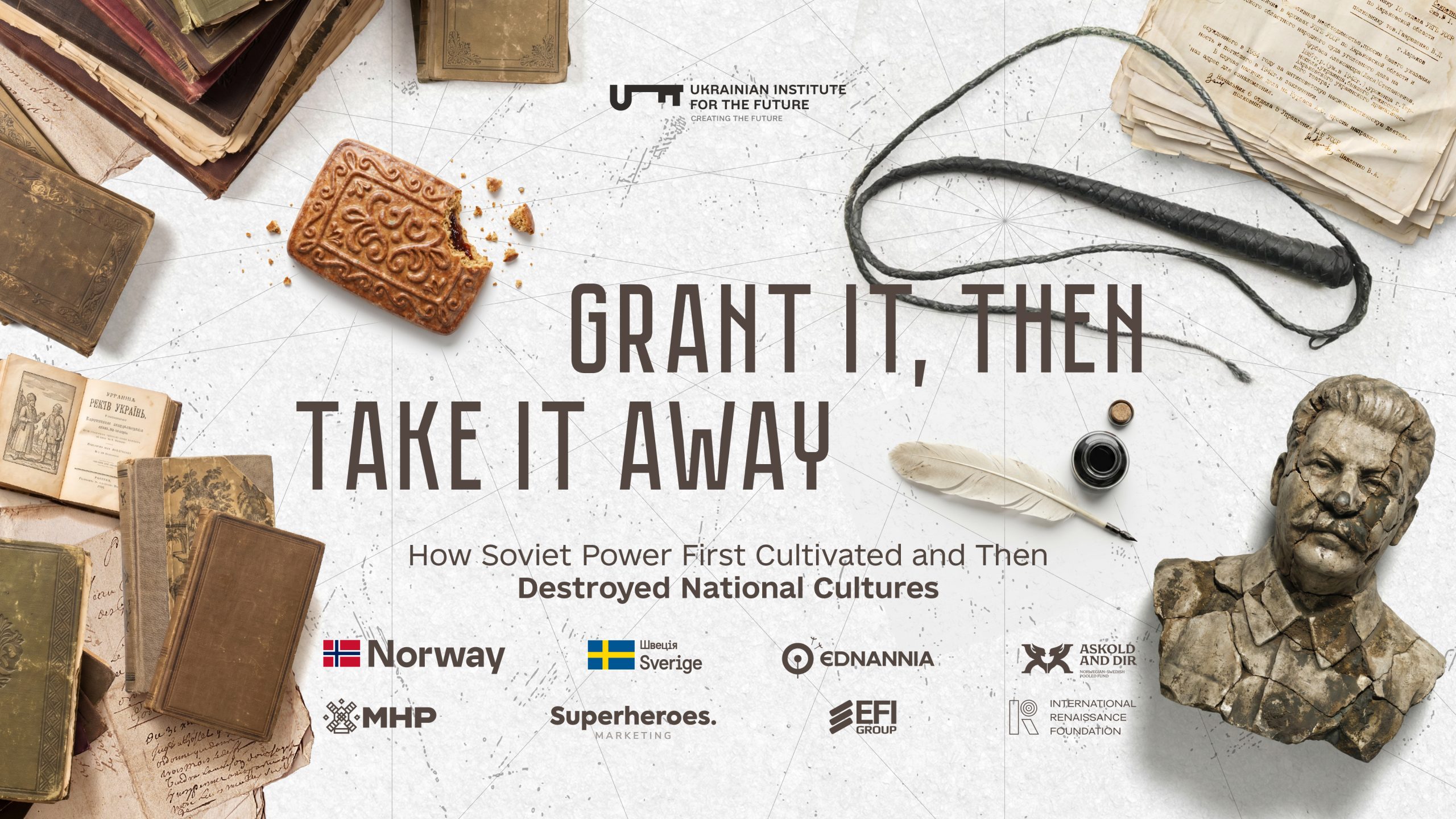
→ Why allowing and then destroying is a more effective instrument of control than outright prohibition
→ Where this logic recurs in the concept of “Russkiy Mir”
A Paradox Worth Explaining
In the early 1920s, the Soviet Union did something that appears paradoxical for a state we associate with Russification. Moscow officially proclaimed a policy of developing the languages and cultures of non-Russian peoples. It introduced written scripts for 72 languages based on the Latin alphabet. For 48 of them, it created written forms for the first time.
In Ukraine, schools, higher education, and official administration were transferred to the Ukrainian language within a matter of years. By 1929, 69 percent of schools and universities in the Ukrainian SSR were conducting instruction in Ukrainian. Ninety-eight percent of Ukrainian children were being educated in their native language.
Kharkiv, then the capital, became a center of literature, theater, and architecture. Writers, artists, and directors — Khvylovyi, Kulish, Kurbas — were producing what would later be called the “Red Renaissance.”
Then, within a few years, nearly all of them were arrested, shot, or driven to suicide.
This sequence — allow to flourish, then destroy — was not incidental. It is a more refined instrument of control than simple prohibition.
Why the Bolsheviks Permitted Korenizatsia at All
After the revolution and the civil war, Moscow faced a structural problem: how to hold together a vast multi-ethnic state where the majority were not Russian, and where the revolution had not been received as it had been in Petrograd.
In Ukraine, the Bolsheviks came to power through three waves of invasion and bitter fighting. In Central Asia, armed resistance — the Basmachi movement — continued into the 1920s. The Caucasus was burning.
Lenin and part of the party leadership understood that open Russification in these conditions would produce endless uprisings. A different approach was needed.
Korenizatsia was a tactical concession. Give peoples the form — language, culture, representation in local organs of power. Retain the substance — ideological control, economic dependence, real authority.
The American historian Terry Martin described the USSR as “the world’s first affirmative action empire” — a state that formally extended privileges to minorities while preserving the structural dominance of the center.
Korenizatsia also served a second practical purpose: if a Soviet Ukrainian-language culture developed in Ukraine, the competing one — “Petliurist,” “bourgeois,” “anti-Soviet” — would have no space to occupy.
The Flourishing: What Was Accomplished
The years 1923 to 1929 in Ukraine constituted a genuine cultural explosion. It was not entirely a product of korenizatsia — in part it was a natural process that had not yet been suppressed.
Mykola Khvylovyi wrote prose in which Ukraine looked toward Europe rather than toward “Moscow philistinism.” He posed the question directly: “Where is Ukraine headed — West or toward Moscow?”
Les Kurbas built the Berezil Theatre — one of the most avant-garde theatrical projects in Europe at the time. His formal experiments were running ahead of what was being done in Berlin and Paris.
Mykola Kulish wrote plays in which Soviet Ukrainian reality did not look as Moscow wished it to look.
The “Slovo” Building in Kharkiv — a writers’ cooperative where most of the figures of the Red Renaissance lived — became the symbol of this brief ascent.
By 1927, 90 percent of Belarusian, 94 percent of Kyrgyz, and 96 percent of Tatar schoolchildren were being educated in their native languages. In 1933, a third of all newspapers in the USSR were published in languages other than Russian.
These were not marginal changes. They constituted a systemic transformation — one that would have to be systematically destroyed.
The Reversal
The turning point came at the end of the 1920s. Stalin had consolidated power, the NEP was wound down, and forced industrialization and collectivization began. Concessions were no longer necessary.
1930: Khvylovyi came under press attack for “nationalist deviations.” He continued to write — but under pressure, in conditions far removed from creative freedom.
1933: on 13 May, Khvylovyi shot himself. He was thirty-nine years old. Weeks before his suicide, his closest friend Mykhailo Yalovy had been arrested.
Kurbas was arrested in 1933. Shot in 1937.
Kulish was arrested in 1934. Shot in 1937.
The majority of the Slovo Building’s residents passed through arrest, the camps, or execution.
In 1937–1938 alone, more than 750,000 people were shot across the USSR — without trial, by decree of NKVD troikas. A significant proportion were members of the creative and academic elites of the non-Russian republics. Of the 102 full and candidate members of the Central Committee of the Communist Party of Ukraine, three survived.
Why “Grant, Then Destroy” Is More Effective Than Outright Prohibition
Simple prohibition of a culture tends to unify. It gives a nation a common adversary, a shared experience of resistance, an underground tradition.
The destruction of an elite following its flowering is more damaging.
First, it strips a generation of its points of reference. After 1937, young Ukrainian intellectuals had no one to look to: the preceding cultural layer had been shot or broken.
Second, it instills fear and self-censorship in those who survived. To remain alive meant either silence, denunciation, or writing as Moscow required.
Third, it eliminates the very idea that something different is possible. If the most talented are dead or in the camps, is there any point?
The “Red Renaissance” was not simply the tragedy of individual lives. It was the deliberate destruction of a generation that could have formed the foundation of an independent cultural space.
“Russkiy Mir” as a New Korenizatsia
After 2014, “Russkiy Mir” — the Russian World — gained wide currency in Kremlin rhetoric. Within this framework, Russia declared itself the defender of a “shared cultural heritage” belonging to Russians and Ukrainians alike.
The structure, however, was the same as korenizatsia: offer the form — language, identity, a sense of belonging to a great culture. Retain the substance — ideological and political control.
“Russkiy Mir” did not offer equality. It offered absorption. Enter the “great” culture and receive protection. But protection from what, and on what terms — Moscow defined.
When Ukraine declined the “protection” in 2022, “Russkiy Mir” moved to open destruction. The bombardment of universities, libraries, and theaters. The prohibition, in occupied territory, of any education or culture that does not conform to the narrative approved by Moscow.
The same steps. The same sequence.
This is the eighth piece in the “Anatomy of an Empire” series. The series is based on the “Atlas of Russian Imperialism and Colonialism” — a major UIF research project forthcoming in print and digital format. To be continued.
This project is implemented with the support of the International Renaissance Foundation.
The views, assessments, and conclusions expressed in this authored publication represent the personal position of the author and do not necessarily reflect the official position of the Ukrainian Institute of the Future, its partners, or its donors.
This publication was produced by the NGO “Ukrainian Institute of the Future” with the support of the Askold and Dir Foundation, administered by ISAR Ednannia within the project “A Strong Ukrainian Civil Society — A Driver of Reform and Democracy,” funded by Norway and Sweden. The content of this publication is the sole responsibility of the NGO “Ukrainian Institute of the Future” and does not represent the views of the governments of Norway or Sweden, or of ISAR Ednannia.