Digests • 16 March 2026
On February 26, the IMF launched a new 4-year program with Ukraine totaling USD 8.1 billion and presented new macroeconomic forecasts for 2026 and the following years. This digest covers the key points and figures of the IMF program.
Consumer market inflation in February 2026 compared to January stood at 1.0%, and compared to February 2025, at 7.6%. This marks a change in the trend. Annual inflation has started to rise.
International reserves declined in February 2026 from USD 57.7 billion to USD 54.8 billion.
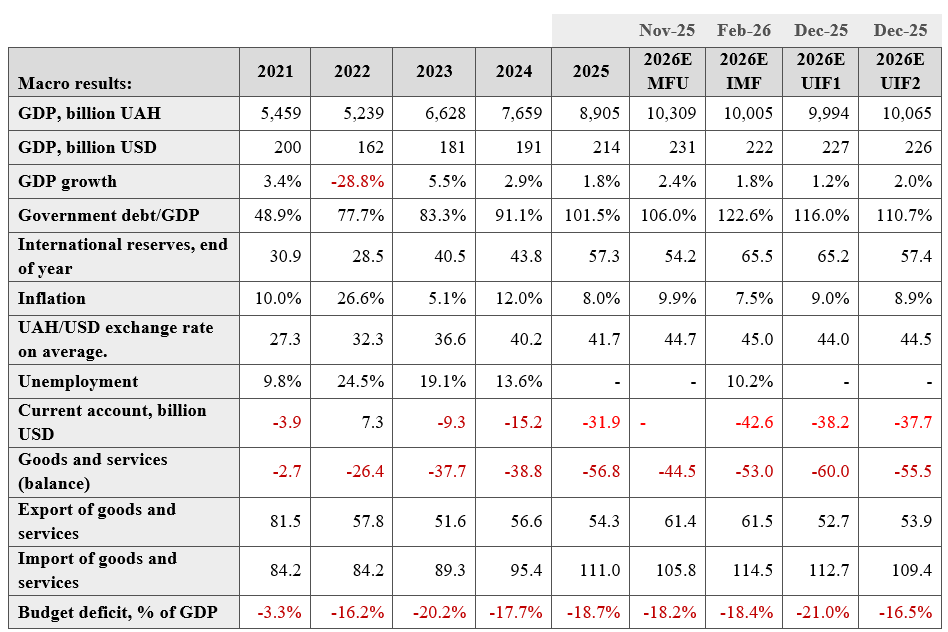
2025 — either actual data or the NBU’s forecast for 2025.
The Executive Board of the International Monetary Fund (IMF) approved a 48-month Extended Arrangement under the Extended Fund Facility (EFF) in the amount of SDR 5.9353 billion (approximately USD 8.1 billion, or 295 percent of quota). This arrangement is part of a broader international support package for Ukraine totaling USD 136.5 billion. The Executive Board’s decision enables the immediate disbursement of SDR 1.1 billion (approximately USD 1.5 billion).
As Russia’s war against Ukraine is still ongoing, and the time available under the 2023 EFF arrangement is insufficient to restore external viability, the Ukrainian authorities requested a new IMF-supported Extended Arrangement under the Extended Fund Facility (EFF) to address Ukraine’s balance of payments problem and restore medium-term external viability in line with the Fund’s policy on UCT lending under exceptionally high uncertainty (EHU). Accordingly, the 2023 EFF was canceled.
The main objectives of the authorities’ new program are to entrench economic and financial stability further, restore debt sustainability on a forward-looking basis under both the baseline and adverse scenarios, and advance reforms that will lay the foundation for a strong post-war recovery and support Ukraine’s goal of EU accession.
The new program will build on the achievements under the 2023 EFF while addressing the challenges arising from the prolonged war. The program’s macroeconomic priorities include (i) implementing prudent fiscal policy, including a sound 2026 budget, with measures to strengthen revenue mobilization by ensuring a level playing field and reducing tax evasion and avoidance; (ii) anchoring price stability and safeguarding against external imbalances, including through greater exchange rate flexibility; and (iii) preserving financial sector stability.
The authorities also seek to implement ambitious structural reforms to ensure a strong post-war recovery and reconstruction and achieve their goal of EU accession. These include strengthening fiscal institutions and tax administration, improving governance and anti-corruption systems, developing financial and capital market infrastructure for post-war reconstruction supported by growth in private lending, and promoting a market economy.
The financing gap of USD 136.5 billion over the 4-year program period is expected to be closed through donor support commitments and relief from debt operation flows. In 2026, the USD 52 billion gap is expected to be covered through disbursements under EU mechanisms, G7 ERA financing, bilateral support, and the newly approved IMF-supported program. Ukraine’s creditor group, which holds the majority of Ukraine’s official bilateral debt, has committed to extending the current suspension period for debt service payments and to completing a final debt treatment once the exceptionally high uncertainty has been resolved.
The IMF significantly revised its forecasts for Ukraine’s economy in the new program, compared with the last review.
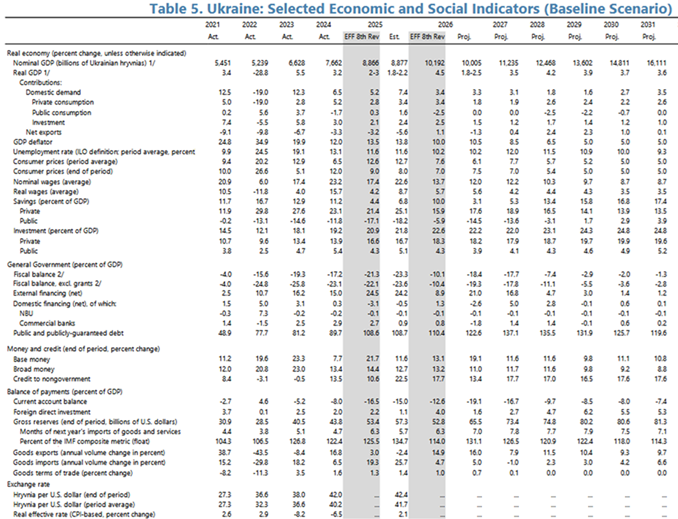
Source: IMF, February 26, 2026.
The IMF expects Ukraine’s economic growth in 2026 to be 1.8–2.5% (1.8% according to its calculations). It forecasts inflation in 2026 at 7.5%. The IMF typically does not specify the UAH/USD exchange rate, but calculations indicate an average of about 45 UAH per USD.
We should note here the very large budget deficit in 2027 (17.7% of GDP), which indicates that in the first year of peace (the IMF’s assumption), the Government of Ukraine does not want to cut spending and will continue to live on borrowing, having increased debt to 137% of GDP (according to IMF calculations).
Consumer market inflation in February 2026 compared to January stood at 1.0%, and compared to February 2025, at 7.6%. This marks a change in the trend, as annual inflation has started to rise again.
Core inflation in February 2026 compared to January stood at 0.7%, and compared to February 2025, at 7.0%.
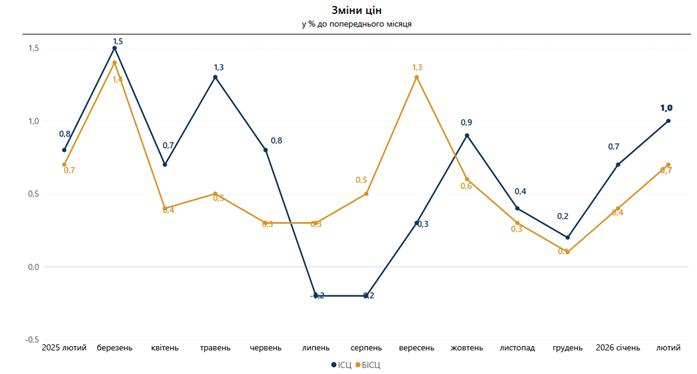
Price changes over the last 12 months. Source: Ukrstat.
Figure translation
Change in prices
(in % to the previous month)
2025 February March April May June July August September October November December 2026 January February
In the consumer market, food product and non-alcoholic beverage prices increased by 1.4% in February. Vegetables rose the most in price (by 13.0%). Prices for fruit, processed grain products, eggs, fish and fish products, bread, pasta products, sunflower oil, beef, milk, and non-alcoholic beverages increased by 6.1–0.4%. At the same time, prices for poultry meat, pork, sugar, butter, lard, fermented milk products, and cheese decreased by 4.1–0.3%.
Prices for alcoholic beverages and tobacco products increased by 1.2%, driven by a 1.6% rise in tobacco product prices.
Clothing and footwear became cheaper by 2.7%, with clothing up 3.0%, and footwear down 2.2%.
In January 2026, Ukraine recorded a positive budget balance. The budget surplus amounted to UAH 42.5 billion. This result was achieved primarily due to grant revenues received by the budget, totaling UAH 101 billion. We believe these were funds from the United States through ERA financing. In addition, expenditures in January are typically lower due to advance spending in December.
We should note the low level of military assistance included in the budget. In January 2025, it was almost UAH 90 billion higher than in January 2026. Therefore, defense budget expenditures in January 2026 were UAH 86 billion lower than a year earlier.
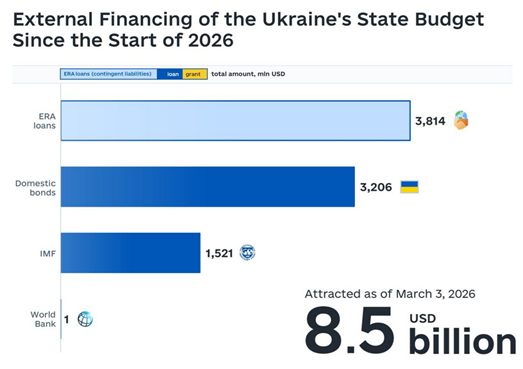
Source: Ministry of Finance.
During the first 2 months, Ukraine received financing under the ERA program, but in the form of grants rather than loans. On February 16, Ukraine received a USD 690 million grant.
Ukraine also received other grants totaling USD 3.1 billion through the World Bank account. We believe this was financing from the United States.
On March 3, the IMF provided the first tranche of financing for Ukraine under the new program, amounting to USD 1.521 billion.
According to IMF calculations, Ukraine is expected to receive USD 51.4 billion in external financing in 2026. USD 3.8 billion from the IMF, USD 26.8 billion from the EU under the EUR 90 billion program. USD 10.6 billion through ERA. These are primarily funds from the United States and Japan, and USD 9.8 billion from other creditors.
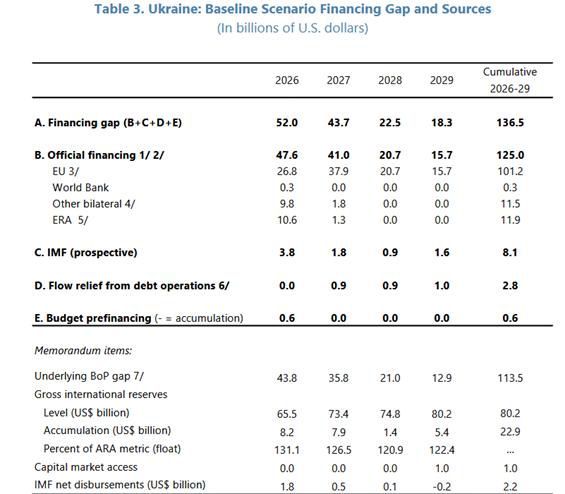
Source: IMF, February 26, 2026.
We should note 2 important things here:
As of February 1, 2026, the balance of financial resources in the state and local budgets amounted to UAH 486 billion. This enables financing expenditures for 3 months without external financing.
As of February 1, 2026, Ukraine’s state and state-guaranteed debt increased from USD 213.3 billion to USD 215 billion (up by USD 1.7 billion in January 2026).
The debt increased mainly due to the revaluation of EUR-denominated debt into USD.
The IMF presented its view of consolidated public finances through 2035, as well as the results of consolidated budget execution since 2021.
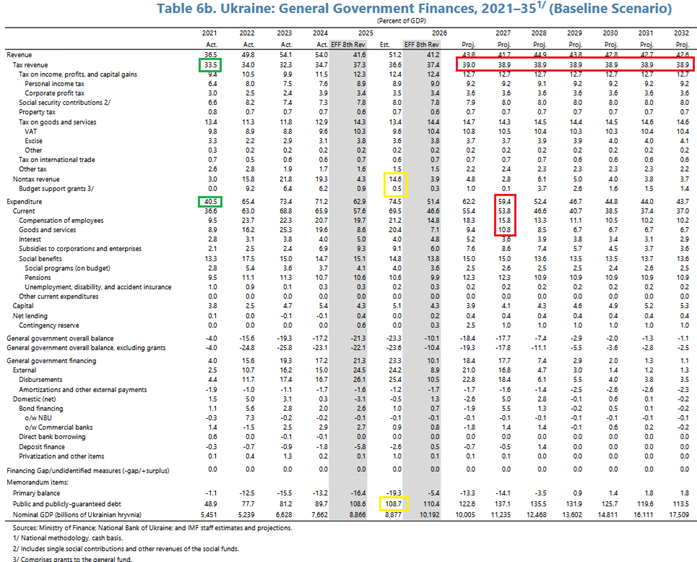
Source: IMF, February 26, 2026.
Based on the figures for 2025 and the following years, we formulate the following key points:
The balance of payments in January was neutral. However, we must note a deterioration in the trade in goods. Thus, in January 2026, the goods trade deficit increased from USD 3.5 billion to USD 4.4 billion compared with January 2025.
Remittances from migrant workers to Ukraine are also deteriorating. In January 2026, they fell to USD 456 million. In 2025, remittances remained at the level of USD 500-600 million per month. These negative trends were offset by grant assistance and other secondary income, which totaled USD 4 billion in January.
The IMF published its forecast for Ukraine’s balance of payments for 2026-2033.
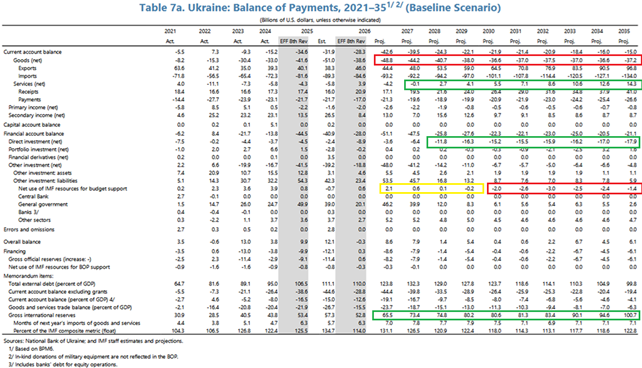
Source: IMF, February 26, 2026.
Based on these data, we formulate the following key points:
In February and at the beginning of March, contrary to our forecast of a stabilization in the UAH/USD exchange rate, the depreciation trend persisted. The reason lies in the changes that have occurred since the beginning of the war in the Middle East. Against the backdrop of rising oil prices, the EUR/USD exchange rate declined from 1.19 to 1.16. This affected the NBU’s exchange rate policy. Thus, the NBU began to minimize the EUR/UAH exchange rate while simultaneously increasing the USD/UAH exchange rate. Accordingly, in our view, the NBU is now shaping the exchange rate based on the EUR/USD currency pair. In the current oil price shock, when oil has surged to USD 115 per barrel, it is very difficult to forecast the dynamics, which depend heavily on political statements and the prospects for ending the war in the Middle East. If the EUR/USD exchange rate falls to 1.15 or below, we do not rule out the USD/UAH exchange rate moving above UAH 44 per USD. However, the baseline forecast for March is UAH 43.5-44.0 per USD and UAH 50.5-51.5 per EUR.
In its report under the new program, the IMF typically does not specify the exchange rate used in its calculations. However, according to our calculations, the IMF forecasts Ukraine’s GDP in 2026 at USD 223 billion, with a nominal figure of UAH 10,005 billion. This implies an average exchange rate of around UAH 45 per USD.
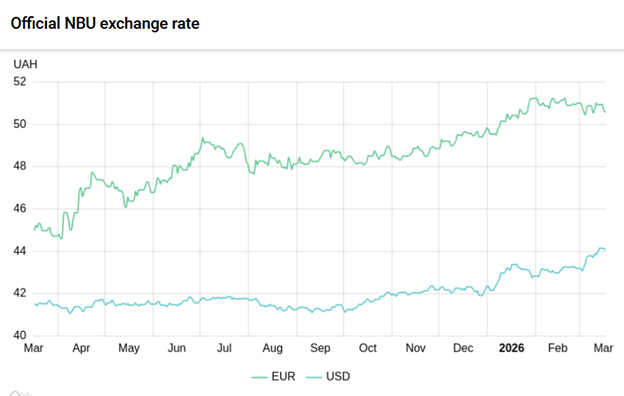
Hryvnia exchange rate against the USD and EUR over the last 12 months. Source: NBU.
Ukraine’s international reserves decreased in February 2026 from USD 57.7 billion to USD 54.8 billion.
In February, compared with January 2026, the National Bank’s net sale of foreign currency decreased by 19.8%. According to the NBU’s balance sheet data, it sold USD 2,989.5 million on the foreign exchange market.
In February, USD 1,000.4 million was received into the government’s foreign currency accounts at the National Bank, including:
In addition, Ukraine paid USD 279.7 million to the International Monetary Fund.
The current level of international reserves provides financing for 5.7 months of future imports.
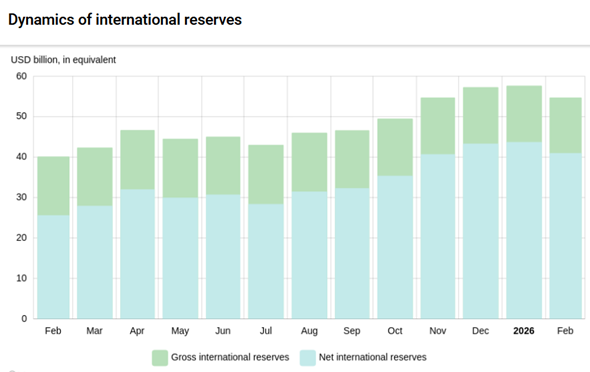
Change in international reserves over the last 12 months. Source: NBU.
March 19. NBU. Decision on the key policy rate.
End of March. Ukrstat. GDP for 2025.
This publication was produced by the NGO “Ukrainian Institute of the Future” with the support of the Askold and Dir Foundation, administered by ISAR Ednannia within the project “A Strong Ukrainian Civil Society — A Driver of Reform and Democracy,” funded by Norway and Sweden. The content of this publication is the sole responsibility of the NGO “Ukrainian Institute of the Future” and does not represent the views of the governments of Norway or Sweden, or of ISAR Ednannia.



Together we can change the future! Your support allows us to continue our research and provide objective analysis of key social issues. Join us today to build the future of our generations together.
Support